
A Blockchain Primer › Module 4 › Lesson 4.5
Lesson 4.5: Case Study — Choosing a Blockchain for a Real Project — The Full Process from Requirements to Solution
- #1. The Core Question
- #2. An Everyday Analogy
- #3. Core Concepts Explained
- #4. Diagrams
- #5. Key Takeaways
- #6. Quiz
The previous lessons laid out blockchain's limits, proof patterns, and programmability. This lesson ties them together in one complete case: when you're facing a real project, how do you get from "should we use a blockchain at all" to "exactly which type, and how do the pieces fit together"?
1. The Core Question
A lot of people start by asking "which chain should we use" and skip the more important questions. What does this project actually need to prove? Does it really need several parties maintaining the record together? Does it need smart contracts, oracles, or tokens?
This lesson answers one question: How do you turn a business requirement, step by step, into a blockchain selection plan you can actually carry out?
The short version: Selection isn't about picking a technology. It's about settling "what to prove, who maintains it, and how the pieces fit together" first, and only then landing on a specific form.
2. An Everyday Analogy
Before Buying a Home, Get Clear on Why You Need One
A homebuyer who only asks "which building is best" may end up with the wrong place. A smarter order goes like this:
- What do I need it for: living in it myself, or renting it out?
- How many people will use it: a family of three, or roommates?
- Location and budget: how far is it from work? How much can I spend?
- Long-term constraints: school district, property management, mortgage, resale?
Choosing a blockchain works the same way. First answer "why, who takes part, what to prove, and how it'll be used." Don't start by picking names out of a pile of chains.
3. Core Concepts Explained
3.1 The Case Background
Say we're building a product traceability platform that spans several organizations:
- Manufacturers record when each batch of goods leaves the factory.
- Logistics companies record transport and warehouse checkpoints.
- Retailers record when goods go on the shelf and when they sell.
- Regulators need to run spot checks.
- Consumers want to scan a code and see the whole path.
The participants don't know each other well and don't fully trust each other. Everyone wants to stop "someone editing the records after the fact."
3.2 Step One: Settle What Needs to Be Proved
Measured against the seven proof patterns, this project mainly needs:
- Proof of existence: a given batch of goods, or a given quality inspection, really existed.
- Proof of time: when the goods left the factory, went into the warehouse, and went on the shelf.
- Proof of order: leaving the factory came first, then transport, then going on the shelf.
- Proof of authorship: which organization submitted this record.
- Proof of ownership / responsibility: who's accountable for each stage.
So what it needs is "a record that several parties maintain together, that can be audited, and that resists tampering," not a simple internal database.
3.3 Step Two: Judge Whether Distribution Is Really Needed
The key question: could one trusted central institution handle this?
Here there are many participants, no built-in trust between them, and no willingness to hand all the data over to any one company. So having several organizations maintain the same record together really does add value over a standalone central database.
We only keep going if this step passes. If it doesn't, we should be honest and say "this doesn't need a blockchain."
3.4 Step Three: Choose Read Access and Write Access
Who reads? Who writes?
- Consumers and regulators need to look things up, so reading should be open, or at least publicly verifiable.
- Not just anyone should be able to write records. Writing should be limited to vetted participating organizations.
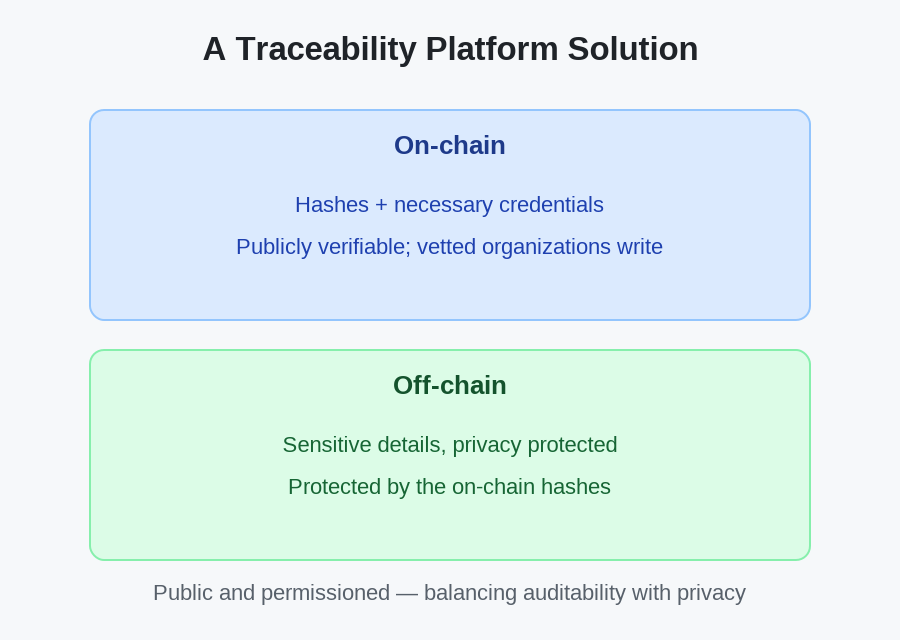
So this project leans toward public and permissioned: everyone can read, but only selected organizations can write.
3.5 Step Four: Consider Which Components Are Needed
The traceability platform mainly needs:
- A transaction/record data structure: to store each traceability event.
- Identity and authorization: to tell apart what each organization is allowed to submit.
- Hashing and the chain structure: to make any changes detectable.
- A consensus mechanism: to get participating nodes to agree on the order of records.
- Optional: smart contracts: to enforce rules automatically, like "only goods that pass inspection can move to the next stage."
- Optional: oracles: if temperature and location have to be read automatically from sensors, you'll need hardware oracles.
- Optional: tokens: if organizations that break the rules should be fined, or good behavior rewarded, internal points tokens are worth considering, but issuing them isn't required.
The point isn't to pile on every capability. It's to choose based on the requirements.
3.6 Step Five: Check the Limits
Measured against the limitations from lesson 4.1, this project needs to watch out for:
- Privacy: some business data may be sensitive. Public inspectability has to be balanced against confidentiality, and sensitive details should stay off-chain when necessary.
- Scalability: traceability records come in large volumes, so throughput has to keep up.
- Cost: writes happen often, so fees have to be kept under control.
- Legal acceptance: whether on-chain records can count as evidence for regulators needs legal clarity.
If these limits would clash badly with the requirements, adjust the plan. Don't force it through.
3.7 Step Six: The Business Case and Node Incentives
Last, answer this: who pays the costs? Why would nodes want to maintain the system?
- Participating organizations share the cost of running nodes and get traceability records they can all audit in return.
- Whoever writes a record pays a transaction fee.
- Regulators and consumers get records they can trust more.
- If tokens are introduced, explain what problem they solve. Don't issue a token just to have one.
3.8 Conclusion: An Executable Plan
Put it all together, and you can define the project like this:
- Form: a public and permissioned consortium chain.
- Core components: the record data structure, identity and authorization, the hash chain, and consensus, plus optional smart contracts and oracles.
- Privacy strategy: hashes and necessary proofs on-chain, sensitive details off-chain.
- Incentive: organizations maintain it together, and writing costs a fee.
- Limits: start with a small pilot to test throughput, cost, and legal validity.
That's a complete selection process, from "why" to "how."
4. Diagrams
Figure 4-5-1: The Six Steps of Blockchain Selection
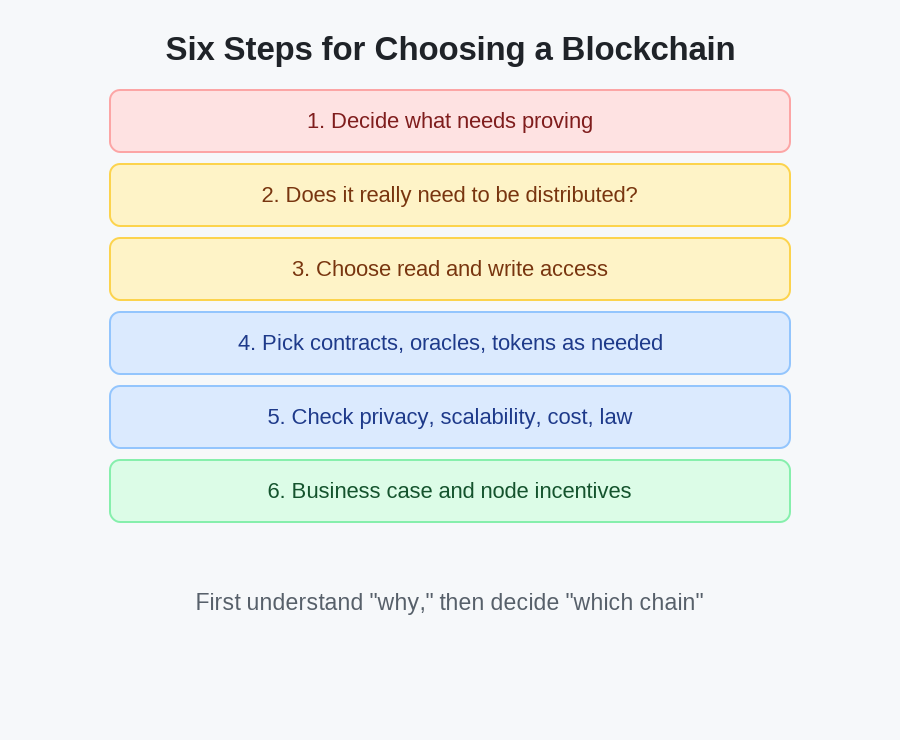
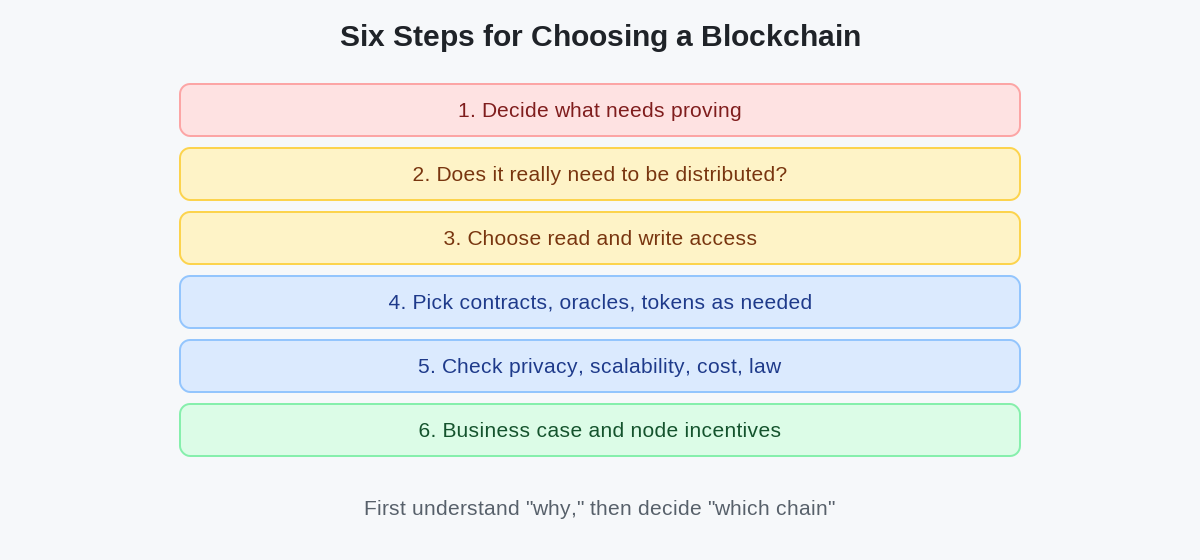
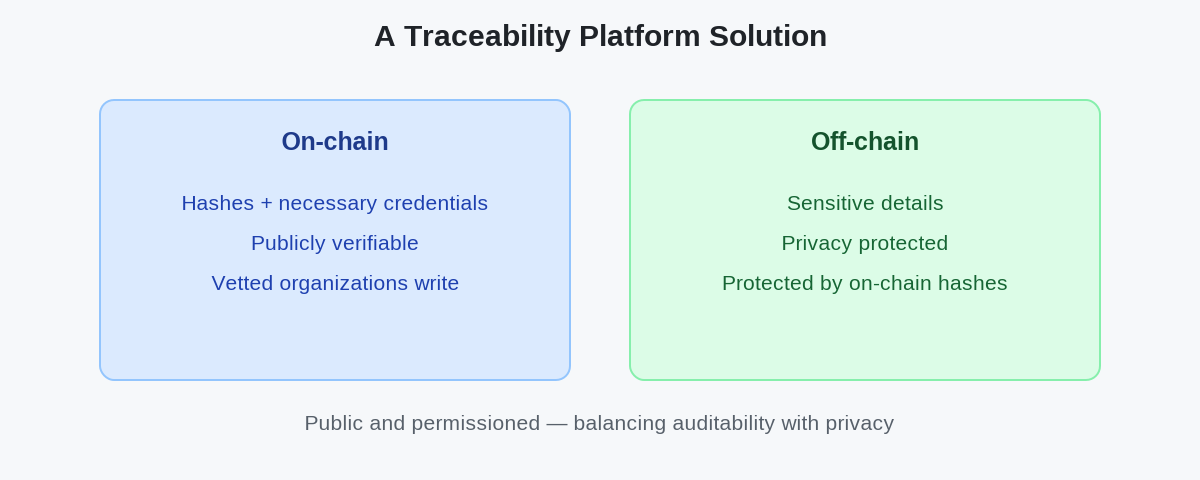
Figure 4-5-2: The Traceability Platform Solution
5. Key Takeaways
- Selection asks "what to prove, who maintains it, how the pieces fit together" first, and "which chain" second.
- Settle the proof patterns first: existence, time, order, authorship, and responsibility.
- Be honest about whether distribution is really needed. If it isn't, don't use a blockchain.
- Use read access and write access to decide the form: public/private × permissionless/permissioned.
- Choose smart contracts, oracles, and tokens only as needed. Don't pile on capabilities.
- Check the limits: privacy, scalability, cost, legal acceptance, and more.
- The plan is only complete once you've answered the business case and node incentives.
6. Quiz
Part 1: Single Choice (1–4)
Question 1
What should the first step of choosing a blockchain be?
A. Going straight to a well-known chain
B. Figuring out what this project needs to prove
C. Issuing a token first
D. Buying mining rigs first
Show answer
Answer: B
Explanation: The first step of choosing a blockchain is figuring out what needs to be proved, not going straight to a chain or issuing a token.
Question 2
For the traceability platform in the case, which form fits best?
A. Public and permissionless
B. Public and permissioned
C. Private and permissionless
D. Private and permissioned
Show answer
Answer: B
Explanation: Consumers and regulators need to look things up publicly, while only vetted organizations get to write, so it's public and permissioned.
Question 3
Why does the traceability platform keep "hashes on-chain and details off-chain"?
A. To balance public verifiability against business privacy
B. Because no data at all can be stored on-chain
C. Because hashes can't prove existence
D. Because off-chain data is more tamper-resistant
Show answer
Answer: A
Explanation: Keeping hashes and necessary proofs on-chain allows public verification without leaking sensitive details. The on-chain hashes protect the off-chain details.
Question 4
If it turns out the participants fully trust the same central institution, what's the most honest conclusion?
A. Keep using a blockchain because it sounds cutting-edge
B. A blockchain may not be needed, and a central database is simpler
C. A token definitely has to be issued
D. All data has to be made public
Show answer
Answer: B
Explanation: If the central institution is trusted, a blockchain may not be necessary. A central database is simpler.
Part 2: Multiple Choice (5–7)
Question 5
Which proof patterns does the traceability platform mainly use?
A. Proof of existence and time
B. Proof of order
C. Proof of authorship
D. Proof of ownership or responsibility
Show answer
Answer: A, B, C, D
Explanation: Traceability needs proof of existence, time, order, authorship, and responsibility.
Question 6
Which limits should you check when choosing a blockchain?
A. Privacy
B. Scalability and cost
C. Legal acceptance
D. Node incentives
Show answer
Answer: A, B, C, D
Explanation: Privacy, scalability, cost, law, and node incentives all need to be checked.
Question 7
Which statements about choosing a blockchain are correct?
A. Read access and write access decide the blockchain's form
B. Smart contracts, oracles, and tokens should be chosen as needed
C. The business case and node incentives have to be answered together
D. As long as the technology is advanced, it fits every project
Show answer
Answer: A, B, C
Explanation: Read/write access decides the form, components are chosen as needed, and the business case and incentives have to be considered together. D is wrong because advanced technology doesn't fit every project.
Part 3: True or False (8–9)
Question 8
True or false: every project suits a blockchain, as long as there's enough data.
Show answer
Answer: False
Explanation: Not every project needs a blockchain. It depends on whether you really need several parties maintaining the record together and resistance to tampering.
Question 9
True or false: a permissioned blockchain can balance trustworthiness against privacy and speed by limiting who can write.
Show answer
Answer: True
Explanation: By vetting who can write, a permissioned chain can strike a balance among trustworthiness, privacy, and speed.
Part 4: Scenario Analysis (10)
Question 10
An industry association wants to build a system that records its member companies' qualifications and annual inspection results. The member companies compete with each other and don't fully trust each other. The public needs to check whether a company belongs to the association, but only members the association has vetted can submit updates.
Answer the following:
- Which proof patterns does this system need?
- Which blockchain form does it match most closely? Why?
- To automate "reminders or qualification freezes when annual inspections expire," which components are needed?
Show answer
Answer:
- It needs proof of existence, time, and authorship, plus ownership/responsibility for member qualifications and annual inspection results.
- It matches public and permissioned most closely: the public can read, but only members the association has vetted can write.
- It needs smart contracts to trigger reminders or freezes automatically based on time rules. If the inspection data comes from outside systems, it also needs oracles.