
A Blockchain Primer › Module 4 › Lesson 4.2
Lesson 4.2: When to Use Blockchain, and When Not To — Proof Patterns and a Decision Method
- #1. The Core Question
- #2. An Everyday Analogy
- #3. Core Concepts Explained
- #4. Diagrams
- #5. Key Takeaways
- #6. Quiz
So far we've covered what a blockchain is, how it works, and where its limits are. This lesson turns to applications: what can a blockchain actually prove and record, and how do you tell whether a given situation really fits it?
1. The Core Question
A blockchain can store lots of kinds of data, but "can store" doesn't mean "worth using." Does a situation need proof of existence, time, order, identity, authorship, or ownership? Does it really need a distributed ledger?
This lesson answers three questions: What general usage patterns does blockchain offer? Which specific areas can it be used in? And what should you ask when you analyze a blockchain application?
The short version: A blockchain is a digital storage box with time, order, and tamper resistance built in. First figure out what it needs to prove. Then ask whether distributed really beats centralized for the job.
2. An Everyday Analogy
A General-Purpose Storage Box
Boxes, cabinets, and drawers can hold documents, parts, photos, money, clothes, or wine. The box itself doesn't decide what goes inside. The person using it does.
A blockchain is also a general-purpose digital storage box that can hold lots of kinds of data. But more general-purpose isn't always better. If you're only storing a few books, a regular bookshelf may be cheaper and easier.
What You're Proving Matters More Than What You're Storing
The same act of "writing data in" serves different kinds of proof in different applications:
- Proving that a document really existed.
- Proving that something happened at a certain time.
- Proving which of two events came first.
- Proving that someone is the author.
- Proving who owns an asset.
Only once you've pinned down what needs proving can you tell whether a blockchain fits.
3. Core Concepts Explained
3.1 Blockchain's Properties as General-Purpose Storage
A blockchain has several properties that don't depend on the application. It's:
- Tamper-resistant.
- Append-only.
- Ordered.
- Timestamped.
- Open and transparent.
- Equipped with security mechanisms like identity, authentication, and authorization.
- Eventually consistent.
These properties let it hold all kinds of data, but they also come with limits on privacy, cost, and speed. Whether an application fits depends on whether these properties line up with what it needs.
3.2 The Seven General Proof Patterns
Proof of existence. Only cares whether a piece of data has been written. Useful for registries that need to prove something exists only once, like brand names, patents, license numbers, and internet addresses.
Proof of non-existence. The reverse: proving that an entry doesn't show up in the ledger. Useful for cases involving complaint records, fines, or criminal records.
Proof of time. Proves not just that data exists but when it was added. Useful for logistics, notifications, payment tracking, the start and end of tenders, and forecast management.
Proof of order. Cares about which event came first, not necessarily the exact time. Useful for application processes, tender audits, escrow services, and "first come, first served" situations like university applications, patent filings, and copyright claims.
Proof of identity. Proves that an identity already exists. Useful for digital identity documents for people, animals, or goods, such as driver's licenses and passports in e-government systems.
Proof of authorship. Proves that a particular person or organization really wrote a piece of data to the blockchain. Useful for digital publishing, tracking document revisions, content distribution, collaborative editing, and copyright protection.
Proof of ownership. Manages and states ownership, usually by combining the existence, order, identity, and authorship patterns with identification, authentication, and authorization. Useful for real estate, cars, company shares, bonds, and digital currencies.
3.3 Ten Concrete Application Areas
Blockchain applications cover a lot of ground. These are just common examples:
- Payments: managing who owns digital fiat money and how it's transferred.
- Cryptocurrencies: managing digital payment tools that don't depend on governments or central banks.
- Micropayments: transferring very small amounts, where traditional payment fees may not be worth it.
- Digital assets: managing how digital items, or digital stand-ins for real-world assets, are created, owned, and transferred.
- Digital identity: proving identity and handling authentication with unique digital identifiers.
- Notarization services: digitizing, storing, and verifying documents, contracts, and records of ownership or transfers.
- Compliance and auditing: giving regulated industries an audit trail for business activity.
- Taxation: calculating and collecting taxes based on transactions or ownership, which cuts down on tax evasion or double taxation.
- Voting: creating, distributing, and counting digital ballots.
- Record management: creating and keeping records such as medical histories.
These don't all fit blockchain equally well. Some only need a trusted central database. Others really do need several parties to maintain the record, plus tamper resistance and auditability.
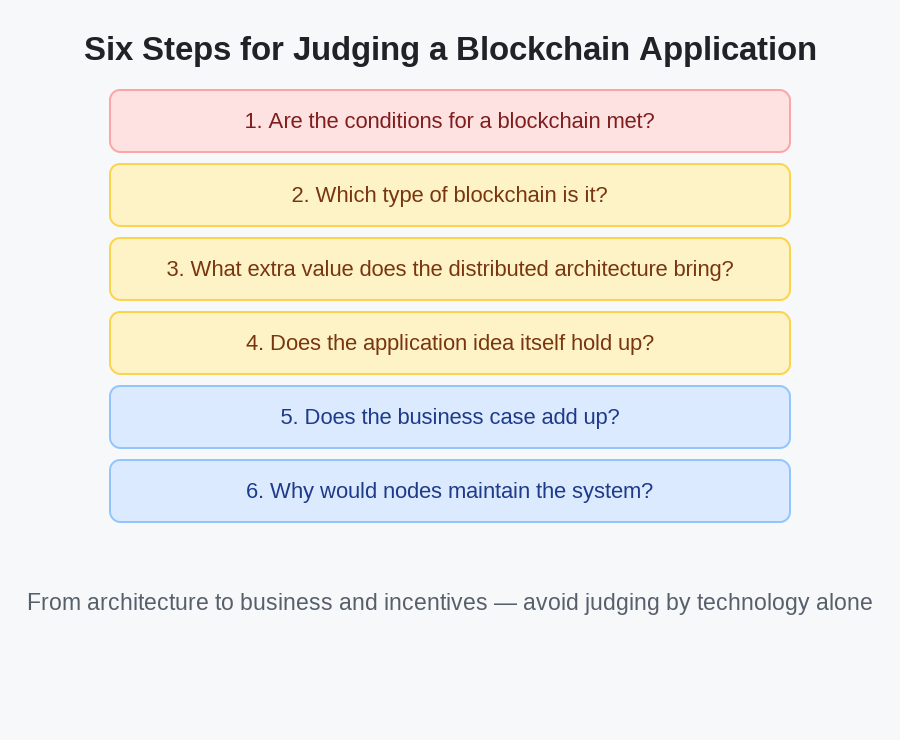
3.4 Six Questions for Judging a Blockchain Application
When you analyze a specific application, ask six questions in order.
First, are the conditions for using a blockchain met? Is the system really purely distributed? Does it have central components? How do new nodes join? Do nodes have equal rights?
Second, which type of blockchain is it? Public or private? Permissioned or permissionless? Who decides read and write access? Is there an onboarding review?
Third, what extra value does a purely distributed peer-to-peer architecture bring? Centralized systems aren't bad by nature. You need to explain why distribution is necessary, and what its upsides and downsides are.
Fourth, does the application idea itself hold up? What problem does the system solve, what service does it offer, what data does it store, what operations does it perform, and what security mechanisms does it use? No architecture, however good, can rescue a bad application idea.
Fifth, does the business case add up? Look at costs, fixed vs. variable costs, who pays them, the licensing model, and who earns the profits or takes the losses.
Sixth, why would nodes want to maintain the system? What are the compensation rules? How are fees collected? What are they paid in? Do the rewards make honesty pay better than cheating?
3.5 Don't Use Blockchain for Blockchain's Sake
If an application only needs one trusted central authority, a central database may be simpler, faster, and cheaper. Blockchain fits situations where several parties don't trust each other, need to maintain a record together, and don't want to lean entirely on a central referee.
When you analyze an application, be willing to conclude: "this doesn't need a blockchain."
4. Diagrams
Figure 4-2-1: The Seven Proof Patterns
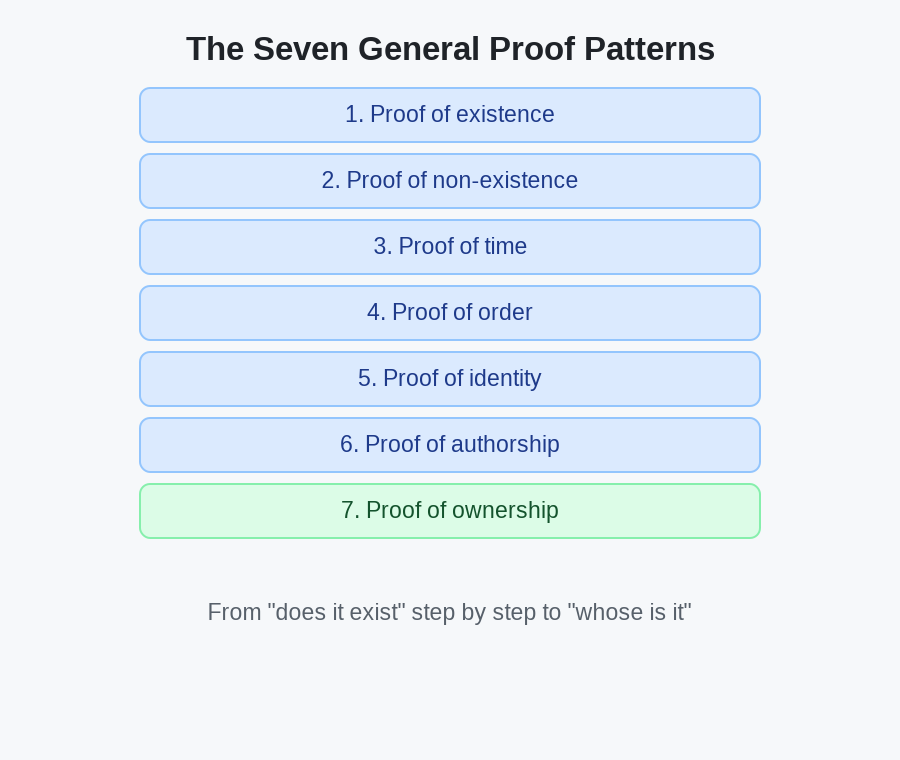
Figure 4-2-2: The Six-Step Decision Method
5. Key Takeaways
- A blockchain is general-purpose digital storage with tamper resistance, order, timestamps, and eventual consistency.
- The seven general proof patterns: existence, non-existence, time, order, identity, authorship, and ownership.
- Specific applications include payments, cryptocurrencies, micropayments, digital assets, digital identity, notarization, auditing, taxation, voting, and record management.
- Being able to store data doesn't make a blockchain the right tool. A central database may be simpler.
- When you analyze an application, ask: are the conditions met, which type of chain is it, what extra value does distribution bring, does the application idea hold up, does the business case work, and why would nodes maintain the system?
- No architecture can rescue a bad application idea.
- Be willing to conclude that "this situation doesn't need a blockchain."
6. Quiz
Part 1: Single Choice (1–4)
Question 1
"Proving that a document already existed at a certain time" is closest to which patterns?
A. Proof of existence and proof of time
B. Proof of non-existence
C. Proof of authorship
D. Proof of ownership
Show answer
Answer: A
Explanation: The document exists and the time it was added is recorded. That's proof of existence and proof of time, not non-existence, authorship, or ownership.
Question 2
"Proving which of two applications was submitted first" is closest to which pattern?
A. Proof of order
B. Proof of identity
C. Proof of non-existence
D. Proof of ownership
Show answer
Answer: A
Explanation: Which application came first is a question of relative order, so it's proof of order.
Question 3
When you analyze a blockchain application, why ask "what extra value does a purely distributed architecture bring"?
A. Because a centralized system may be simpler, faster, and cheaper
B. Because distributed is always better than centralized
C. Because blockchains can't store data
D. Because every application has to be decentralized
Show answer
Answer: A
Explanation: A centralized system may be simpler, faster, and cheaper. You can't assume distributed is always better.
Question 4
Which of these is NOT one of the seven general proof patterns?
A. Proof of existence
B. Proof of order
C. Proof of authorship
D. Proof of the highest ad click-through rate
Show answer
Answer: D
Explanation: The highest ad click-through rate isn't a general proof pattern of blockchain. Existence, order, and authorship are.
Part 2: Multiple Choice (5–7)
Question 5
Which of these are general proof patterns of blockchain?
A. Proof of existence
B. Proof of time
C. Proof of identity
D. Proof of ownership
Show answer
Answer: A, B, C, D
Explanation: All four are among the seven general patterns.
Question 6
When you judge a blockchain application, which questions should you consider?
A. Whether the system really needs a distributed architecture
B. Which type of blockchain it uses and how read/write access is assigned
C. Whether the application idea and business case hold up
D. Why nodes would be willing to maintain the system
Show answer
Answer: A, B, C, D
Explanation: You need to consider the architecture, the type, the application idea, the business case, and how nodes are compensated.
Question 7
Which statements about specific applications are correct?
A. Blockchain can be used for payments, digital assets, identity, and auditing
B. Every application is definitely better than a centralized alternative
C. Voting and record management are possible directions for applications
D. Each situation needs its own judgment on whether blockchain fits
Show answer
Answer: A, C, D
Explanation: Blockchain can serve these areas, but whether it beats a centralized alternative has to be judged case by case. B goes too far.
Part 3: True or False (8–9)
Question 8
True or false: as long as data is written to a blockchain, the application is guaranteed to have business value.
Show answer
Answer: False
Explanation: Writing to a blockchain doesn't automatically create business value. No architecture can rescue a bad application idea.
Question 9
True or false: blockchain fits situations where several parties who don't trust each other maintain a record together without wanting to lean entirely on a central referee.
Show answer
Answer: True
Explanation: This is exactly the kind of situation blockchain fits: several parties who don't trust each other, maintaining a record together.
Part 4: Scenario Analysis (10)
Question 10
A small company wants to use a blockchain to record its employees' leave requests. Every employee works in the same office, and the company has a trusted HR system.
Answer the following:
- Which proof pattern does this situation match most closely?
- Why might a central database be a better fit?
- If the company has to use a blockchain, which two analysis questions should it answer first?
Show answer
Answer:
- It matches proof of existence, time, or order most closely, depending on what the leave-request records contain and the order they come in.
- The company has a trusted internal HR system, so there's no need for parties who don't trust each other to maintain the records together. A central database is simpler, faster, and cheaper.
- First ask "what extra value does a purely distributed architecture bring" and "does the application idea / business case hold up." You could also ask why nodes would be willing to maintain the system.