
A Blockchain Primer › Module 4 › Lesson 4.1
Lesson 4.1: The Real Limits of Blockchain — Technical and Non-Technical Limitations
- #1. The Core Question
- #2. An Everyday Analogy
- #3. Core Concepts Explained
- #4. Diagrams
- #5. Key Takeaways
- #6. Quiz
We've explained how a blockchain lets nodes that are strangers maintain a ledger together. But a system that works doesn't automatically fit every situation. This lesson looks at where its limits are: which ones come from the technology itself, and which ones come from the law and from users.
1. The Core Question
A blockchain's openness and decentralization are what let it build trust. But those same two traits can also cause problems with privacy, cost, speed, and governance.
This lesson answers three questions: What are blockchain's main limitations? Why do they matter for business applications? And which ones can technology improve, and which ones depend on law and education?
The short version: Openness and decentralization are where blockchain gets its power, and they're also where its limits come from. Technical and non-technical limitations together decide which situations it really fits.
2. An Everyday Analogy
A Powerful Machine That's Picky About Where It Works
A piece of heavy construction equipment can move huge loads, but it's useless for renovating a cramped apartment. It isn't a "bad machine." It just has a limited range of jobs it's right for.
Blockchain is similar:
- It's great at keeping a ledger's integrity intact in open environments where participants don't trust each other.
- But it isn't always a good fit for situations that need strong privacy, high throughput, low latency, or frequent upgrades.
Deciding whether to use a blockchain isn't about whether it's "cutting-edge." It's about whether its limitations run straight into what your business needs.
3. Core Concepts Explained
3.1 Technical Limitation One: Limited Privacy
A blockchain keeps a public ledger so that every node can verify transactions and ownership. As a result, details like the goods involved, quantities, the accounts, and timestamps are usually visible to every participant.
This transparency isn't an accident. It's part of how verification works. Without data that's transparent enough, nodes would have a hard time checking for double-spending and ownership.
But for applications that need confidentiality, it's a limitation. Transactions anyone can inspect can clash with trade secrets and personal privacy.
3.2 Technical Limitation Two: A Security Model That Leans Entirely on the Private Key
Blockchains use asymmetric cryptography to identify accounts and authorize transactions. Only whoever holds the private key can control an account's assets.
The cryptography itself can be very strong, but the security model has one unforgiving rule: the private key is the only security credential.
If the private key gets lost, sent to someone by mistake, or stolen, the account's security is gone. The system has no extra "safety net" to recover or freeze your assets. It's like handing someone your house key or your bank card PIN: whatever the reason, whoever has it controls the assets.
3.3 Technical Limitation Three: Limited Scalability
To keep integrity intact in an open network, a blockchain has nodes validate transactions, solve hash puzzles, and spread blocks. Every one of those steps takes time.
Hash puzzles are slow on purpose, because their job is to make tampering more expensive. The price is limited processing speed: throughput can't keep up with a centralized database.
So a blockchain has to balance security, decentralization, and speed. Situations that need extremely high throughput and low latency may not be a good fit for using a blockchain directly.
3.4 Technical Limitation Four: High Cost
Solving hash puzzles uses up computing power, electricity, time, and money. The higher the difficulty, the higher the cost.
These costs aren't waste. They're part of the security mechanism. The high computing cost is exactly what makes rewriting history unprofitable. But for business applications, cost directly affects whether a project is feasible.
3.5 Technical Limitation Five: Hidden Centralization
Hash puzzles and rewards set off a race for computing power. People with capital buy specialized hardware and win rewards more easily, and people without it may drop out.
The result: on the surface there are lots of nodes, but a handful of players with massive computing power may actually be the ones maintaining the system's integrity. They form an oligarchy that could refuse certain transactions, discriminate against certain users, or act together to sway the system.
In its structure, the system is still distributed. But in terms of power, a few players may hold its integrity in their hands. That's hidden centralization.
3.6 Technical Limitation Six: Lack of Flexibility
A blockchain is made of many interlocking components, so changing one can ripple through many others. Once the system is running, it's hard to upgrade the protocol, fix defects, or adjust cryptographic algorithms.
Tamper resistance cuts both ways. It prevents tampering, but it also makes it hard to fix mistakes in the historical record. Cryptographic algorithms and protocols have to stay valid for a very long time, which sets a high bar for how long the technology has to last.
3.7 Technical Limitation Seven: The Need for Critical Mass
A blockchain's security depends on honest nodes controlling most of the computing power. If the system is small and its total computing power is low, an attacker could grab the majority with modest resources and launch a 51% attack.
So a new chain needs to reach a certain number of honest nodes and amount of computing power before it's secure enough. Systems with few users, low market value, and little computing power are especially fragile.
3.8 Non-Technical Limitation One: Insufficient Legal Acceptance
In many jurisdictions, transactions and ownership records on a blockchain still don't have a clear legal status. Can an on-chain record count as proof of ownership? Are the results of running a smart contract legally binding? Which country's law applies to a cross-border transaction?
Technology alone can't answer these questions. Legal and regulatory frameworks have to catch up, one step at a time.
3.9 Non-Technical Limitation Two: Insufficient User Acceptance
If users don't understand private keys, transaction confirmations, fees, and irreversibility, they'll have a hard time trusting and using a blockchain.
An unclear legal status also wears down user confidence, and without enough education and outreach, users overestimate or underestimate the risks. User acceptance and legal acceptance affect each other.
3.10 How to Overcome the Limits
There are two ways to tackle technical limitations:
- Improve the existing technology, for example with better throughput, privacy protection, and key management.
- Make conceptual changes, for example to the consensus mechanism, the permission model, or the system architecture.
Non-technical limitations depend more on education, law, and regulation: helping users understand how the system works, and getting the law to recognize on-chain records and transactions as valid.
4. Diagrams
Figure 4-1-1: The Seven Technical Limitations
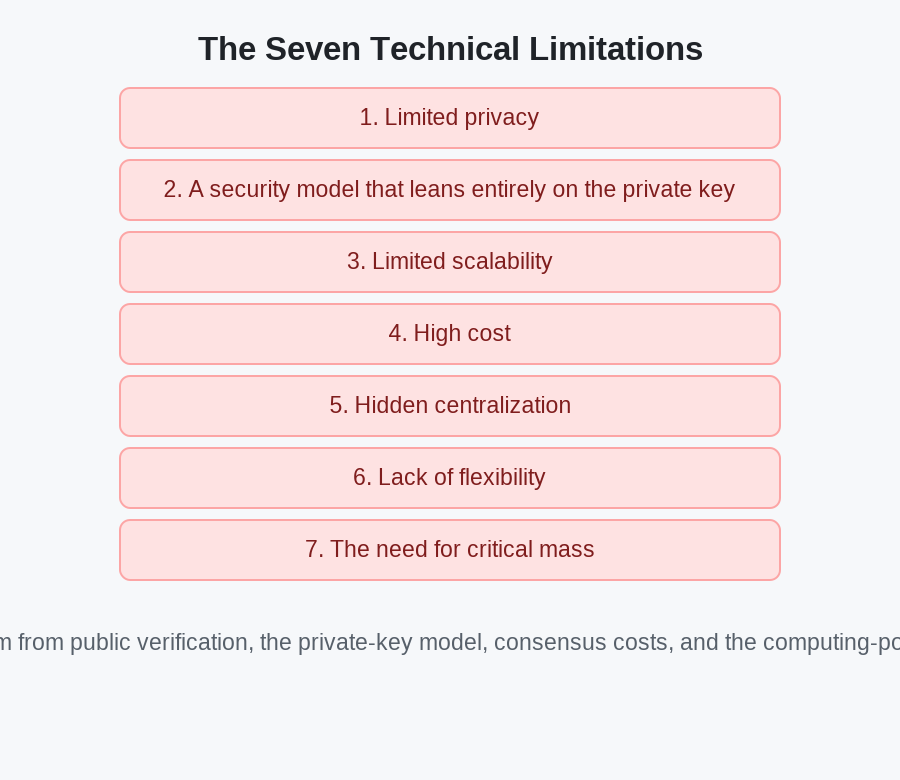
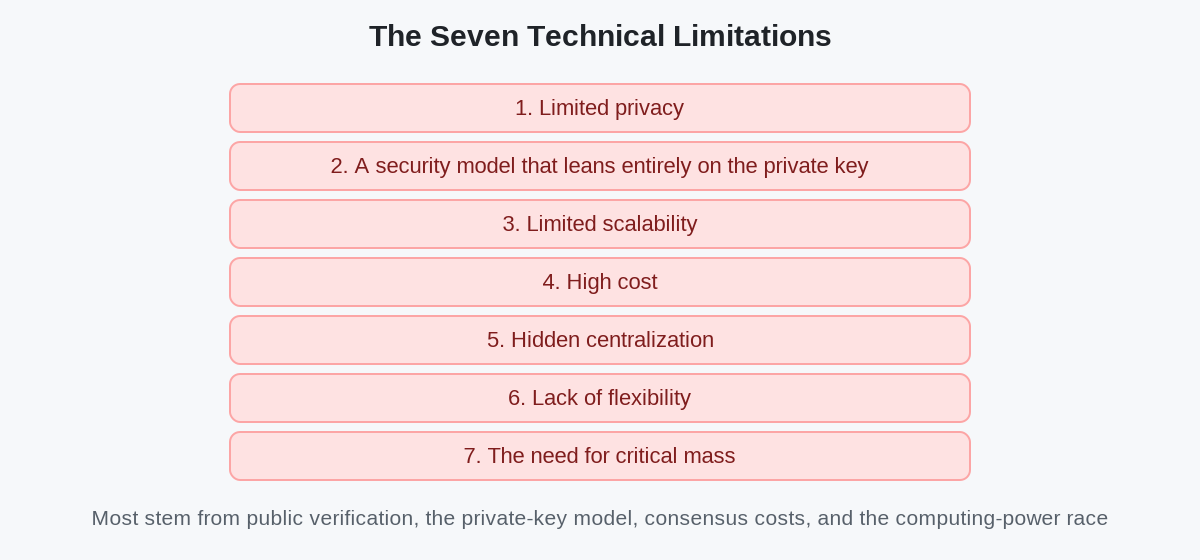
Figure 4-1-2: Technical vs. Non-Technical Limitations
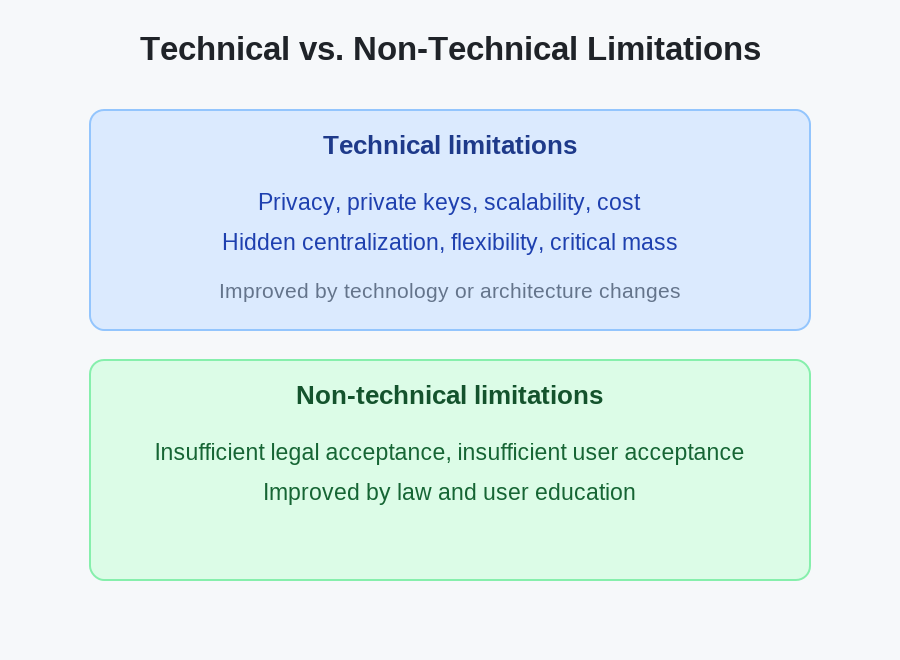
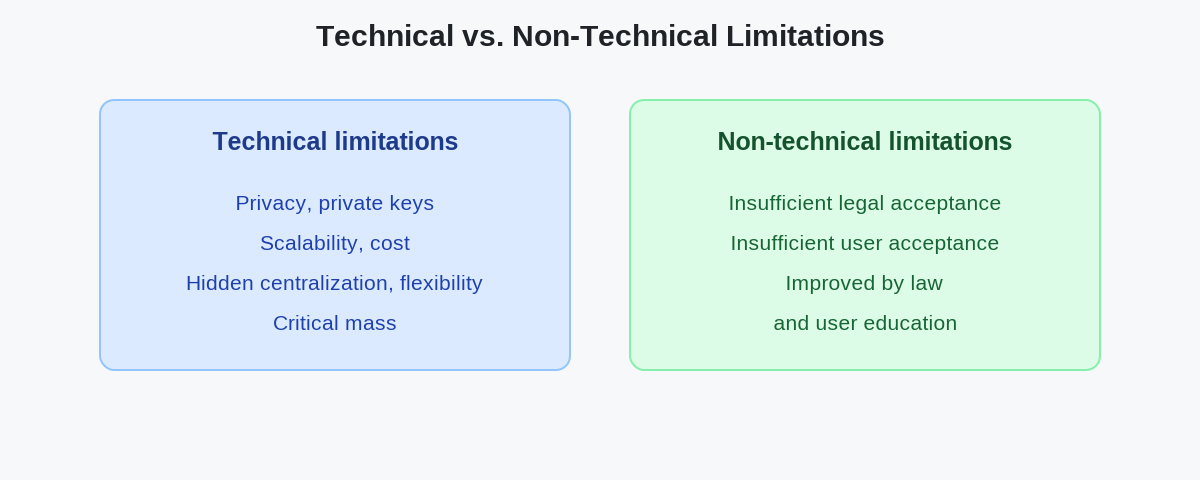
5. Key Takeaways
- Openness and decentralization are both blockchain's strengths and where its limits come from.
- The seven technical limitations: limited privacy, the private-key security model, limited scalability, high cost, hidden centralization, lack of flexibility, and the need for critical mass.
- The transparent ledger makes verification possible, but it gives up privacy.
- The private key is the only control credential. Lose it or leak it, and you lose the account's security.
- Hash puzzles provide security, but they limit throughput and drive up cost.
- Specialized hardware and the race for rewards can create hidden centralization.
- When a system is too small and has too little computing power, a 51% attack gets easier.
- The main non-technical limitations are legal acceptance and user acceptance.
- Technical limits can be improved or redesigned. Non-technical limits need law and education.
6. Quiz
Part 1: Single Choice (1–4)
Question 1
What directly causes blockchain's limited privacy?
A. Transaction data is visible to every participant so it can be verified
B. Every node has to use its real name
C. Private keys are too short
D. Block headers have no timestamp
Show answer
Answer: A
Explanation: The public ledger lets every participant verify transactions, but that also makes transaction details visible. Real-name requirements, private key length, and timestamps aren't the cause.
Question 2
What's the most critical weakness in blockchain's security model?
A. Hash functions are too slow
B. The private key is the only control credential, and losing or leaking it means losing security
C. Blocks are too large
D. There are too many nodes
Show answer
Answer: B
Explanation: The private key is the only control credential, and losing or leaking it directly breaks account security. The strength of the cryptography itself isn't the weakness.
Question 3
What does "hidden centralization" mainly refer to?
A. A publicly known central server still sitting inside the system
B. A few players with massive specialized computing power effectively holding most of the maintenance power
C. All nodes being anonymous
D. Block headers being deleted
Show answer
Answer: B
Explanation: Hidden centralization means a few players with massive specialized computing power effectively hold most of the maintenance power. It doesn't mean a publicly known central server.
Question 4
Why does a new chain need "critical mass"?
A. More nodes means smaller blocks
B. Only when honest computing power reaches a certain scale can the system hold off a 51% attack
C. More users means safer private keys
D. Less computing power means cheaper transactions
Show answer
Answer: B
Explanation: Critical mass makes sure honest computing power reaches a large enough scale, which lowers the risk of a 51% attack. It has nothing directly to do with block size or private key safety.
Part 2: Multiple Choice (5–7)
Question 5
Which of these are technical limitations of blockchain?
A. Limited privacy
B. Limited scalability
C. High cost
D. Lack of flexibility
Show answer
Answer: A, B, C, D
Explanation: All four are technical limitations of blockchain.
Question 6
Which statements about scalability and cost are correct?
A. Hash puzzles are slow on purpose, to make tampering more expensive
B. Security and throughput have to be balanced against each other
C. Higher difficulty usually means higher computing cost
D. A blockchain is always faster than a centralized database
Show answer
Answer: A, B, C
Explanation: Hash puzzles take time in order to increase security, security and throughput have to be balanced, and difficulty affects cost. D goes too far. A blockchain isn't necessarily faster than a centralized database.
Question 7
Which statements about non-technical limitations are correct?
A. How the law treats on-chain transactions and ownership is still unclear
B. Users who don't understand the system trust it less
C. Education and law can improve acceptance
D. Technical improvements alone can solve every legal question
Show answer
Answer: A, B, C
Explanation: Legal and user acceptance are non-technical limitations that education and law can improve. D is wrong because technology alone can't solve legal questions.
Part 3: True or False (8–9)
Question 8
True or false: as long as a blockchain is technically secure enough, every industry can adopt it directly.
Show answer
Answer: False
Explanation: Technical security isn't the same as legal and user acceptance, and it doesn't mean the system fits every industry.
Question 9
True or false: hidden centralization means the system's technical structure is still distributed, but real power may be concentrated in a few players.
Show answer
Answer: True
Explanation: The technical structure can stay distributed, but when computing power is concentrated, real power is concentrated too.
Part 4: Scenario Analysis (10)
Question 10
A company wants to use a public blockchain to record large amounts of users' medical data. It needs strong privacy, high throughput, and low latency, and it wants to be able to change historical records when mistakes happen.
Answer the following:
- Which blockchain limitations does this run into?
- Why does "publicly verifiable" conflict with medical privacy?
- If they have to use a blockchain, what directions should they consider?
Show answer
Answer:
- It runs into limited privacy, limited scalability, high cost, lack of flexibility, and insufficient legal acceptance, among others.
- Medical data has to stay confidential, but a public blockchain needs transaction details to be publicly verifiable. Letting anyone inspect the data and protecting privacy are directly at odds.
- Consider a permissioned blockchain, privacy-preserving techniques, keeping sensitive data off-chain and putting only the necessary proofs on-chain, and spelling out legal responsibilities and how corrections will work.