
A Blockchain Primer › Module 5 › Lesson 5.5
Lesson 5.5: What's Next — A Learning Roadmap and Paths for Going Deeper
- #1. The Core Question
- #2. An Everyday Analogy
- #3. Core Concepts Explained
- #4. Diagrams
- #5. Key Takeaways
- #6. Quiz
This is the last lesson of the course. All five main threads are done: why we need blockchain, the data journey of a transaction, how stranger nodes maintain a ledger together, how to choose and combine blockchains, and going from knowledge to real-world applications. This lesson pulls what you've learned into one roadmap that shows you where to go next and how to get there.
1. The Core Question
The worst thing after finishing a course is "I've seen it all, but I forget it the minute I close the book." How do you turn concepts spread across many lessons into a set of tools you can use again and again? And which direction should you dig into next?
This lesson answers three questions: What has this course given you? How do you review and go deeper? And which traps should you steer clear of as you keep learning?
The short version: First pull the whole course into one map, then pick a direction and head down it. However far you go, bring the habit of "ask about the premises first, then weigh the trade-offs."
2. An Everyday Analogy
After You Get a Map
Finishing a course is like getting a map. You know the city's neighborhoods, how the roads connect, and where it's easy to take a wrong turn. But having a map isn't the same as having walked every street.
The next step isn't looking at an even bigger map. It's picking one street and walking down it, so one part of the map turns into ground you actually know.
That's exactly the kind of map of blockchain this course has given you.
3. Core Concepts Explained
3.1 What This Course Really Taught You
Looking back, this course didn't teach you "how to trade coins." It gave you a framework for analysis:
- Four questions for taking any system apart.
- Centralized, distributed, and peer-to-peer ways of organizing a system.
- Trust, integrity, and the stranger problem.
- The six stages a transaction goes through, from signature to the chain.
- Hashing, signatures, blocks, the chain structure, and detecting changes.
- Propagation, validation, forks, incentives, and consensus.
- The four blockchain types and the seven proof patterns.
- How smart contracts, oracles, tokens, and DeFi work, and what their risks are.
- The judgment habit of "ask about the premises first, then weigh the trade-offs."
These tools don't depend on any particular project, and they don't stop working when some coin's price goes up or down.
3.2 Stage One: Walk the Five Main Threads Again
Reviewing isn't rereading. It's going back over the material with questions in mind. Ask yourself these as you follow each of the five main threads:
- Why we need blockchain: can I take a system apart with the four questions? Can I explain the stranger-node problem clearly?
- The data journey of a transaction: can I walk through everything from "starting a transaction" to "getting it recorded on the chain"? What do signing, hashing, and blocks each do?
- How stranger nodes maintain the ledger: can I explain propagation, validation, forks, incentives, and consensus on paper?
- How to choose and combine: can I use the seven proof patterns and the six-step decision method to judge whether a situation needs a blockchain?
- Real-world applications: can I explain how each DeFi product works and what its risks are, plus blockchain's benefits and costs?
If you can't walk through a thread smoothly, go back to the matching lesson and reread that section. That works better than paging through the whole course from the start.
3.3 Stage Two: Do the Five Attack-and-Defense Experiments by Hand
The five experiments from lesson 5.2 are worth doing again away from the screen:
- Use paper and pen to fake an edit to an old record, and watch the references break all the way to the head.
- Fake a double-spend, and watch two branches narrow down to one.
- Fake a forged signature, and see why verification fails.
- Work out how long it would take to rewrite the whole chain.
- Compare what a 51% attack costs on a small chain versus a large one.
Doing them by hand sticks much better than memorizing the conclusions.
3.4 Stage Three: Pick a Direction and Go Deeper
Once you know the map well, pick a street to explore. Here are the directions the course offers:
- Data structures: get a solid grip on the details of hashing, the chain structure, and Merkle trees.
- Consensus: compare the trade-offs of PoW, PoS, PoA, and other mechanisms.
- Applications: go through the risk checklists for smart contracts, oracles, tokenization, and DeFi one at a time.
- Judgment: find real projects, practice the six-step decision method on them, and practice reaching the conclusion "this doesn't need a blockchain."
Whichever you pick, you don't need to chase new buzzwords. Digging deep into the course's concepts already gets you a long way.
3.5 Keep Three Disciplines as You Continue Learning
There will only be more and more information, and it gets easier to be led astray by slogans. Stick to these three disciplines:
- Ask about the premises first. For any conclusion, ask: does it depend on an honest majority? On how assets are distributed? On legal recognition?
- Sort out the trade-offs. Transparency vs. privacy, security vs. speed, decentralization vs. cost. Neither side of any of these comes free.
- Look at who maintains it. Who maintains the system, and why would they? If the incentives don't make sense, even the best design won't get far.
These three are the most valuable things to take away from this course.
3.6 Closing: What You Can Do Now
Now that you've finished this course, you can:
- Look at a system's functional and non-functional sides separately.
- Explain the problem blockchain solves and where its limits are.
- Walk through a transaction's whole path, from signature to the chain.
- Understand how stranger nodes maintain a ledger together.
- Judge whether a situation should use a blockchain, and which type.
- Read and understand how smart contracts, oracles, tokens, and DeFi work and what their risks are.
The map is in your hands. What comes next is taking it out and finding your own way.
4. Diagrams
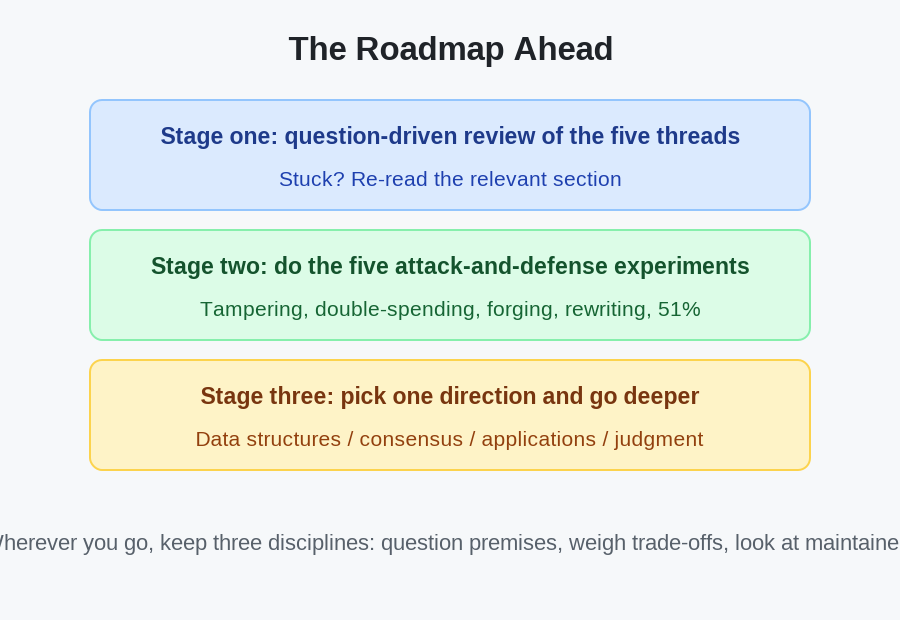
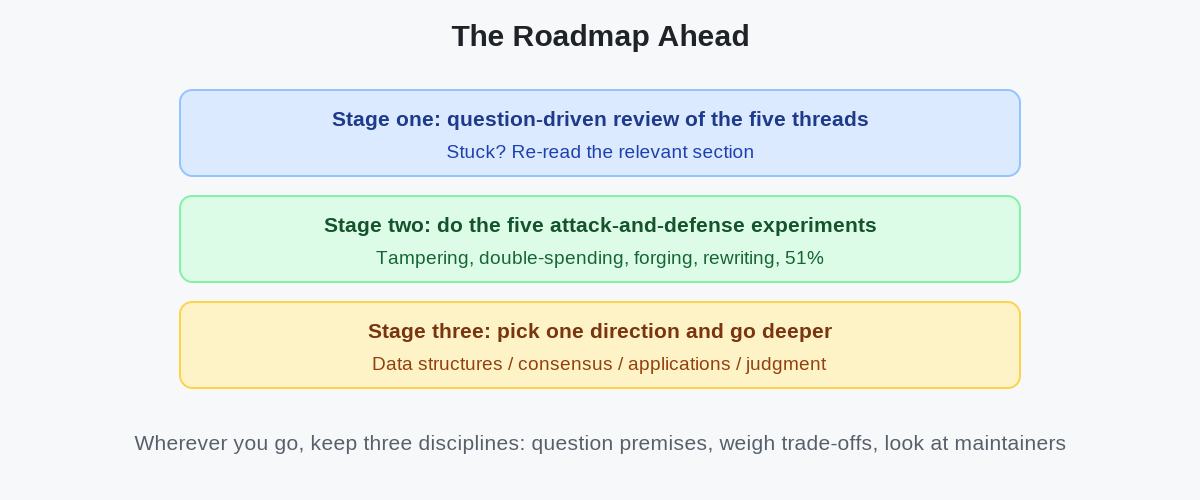
Figure 5-5-1: The Roadmap for What's Next
5. Key Takeaways
- This course gives you a framework for analysis, not an operating manual for any particular project.
- Stage one: go back over the five main threads with questions in mind, and reread the matching lesson wherever you get stuck.
- Stage two: do the five attack-and-defense experiments by hand.
- Stage three: pick one of the four directions (data structures, consensus, applications, or judgment) and go deeper.
- Stick to three disciplines as you keep learning: ask about the premises first, sort out the trade-offs, and look at who maintains it.
- A habit of judgment matters more than chasing new buzzwords.
6. Quiz
Part 1: Single Choice (1–4)
Question 1
What's the core thing this course gives readers?
A. A framework for analyzing blockchain concepts and situations
B. An investment method that's guaranteed to make money
C. An operating manual for one particular public chain
D. A glossary you have to memorize
Show answer
Answer: A
Explanation: The course gives you a framework for analysis. It isn't an investment method, a manual for one chain, or a glossary.
Question 2
While reviewing the five main threads, you find you can't explain "forks and eventual consistency" smoothly. What's the best move?
A. Skip it
B. Go back to the matching lesson in Module 3 and reread that section
C. Copy out the whole course from the beginning
D. Memorize the name of a new coin
Show answer
Answer: B
Explanation: If you can't walk through a thread smoothly, go back to the matching lesson and reread that section. Skipping it or copying everything out both work worse than rereading the part you need.
Question 3
What does the discipline of "ask about the premises first" ask?
A. Which conditions the conclusion depends on, such as an honest majority or legal recognition
B. Whether the project team paid to trend
C. Whether the token price went up
D. Whether the term sounds new
Show answer
Answer: A
Explanation: "Ask about the premises first" asks which conditions a conclusion depends on. Prices, paid trending, and how new a term sounds aren't premises.
Question 4
What does the discipline of "look at who maintains it" mainly look at?
A. Who maintains the system, why they would, and whether the incentives make sense
B. Whether the website's colors look good
C. How many pages the whitepaper has
D. Whether the founder has been on TV
Show answer
Answer: A
Explanation: "Look at who maintains it" looks at who maintains the system, why, and whether the incentives hold up. Looks, page counts, and TV appearances say nothing about incentives.
Part 2: Multiple Choice (5–7)
Question 5
Which three disciplines does the course recommend as you keep learning?
A. Ask about the premises first
B. Sort out the trade-offs
C. Look at who maintains it
D. Only watch the price
Show answer
Answer: A, B, C
Explanation: The three disciplines are asking about premises, sorting out trade-offs, and looking at who maintains it. Watching only the price isn't one of them.
Question 6
Which directions can you go deeper in during stage three?
A. Data structures
B. Consensus
C. Applications
D. Judgment, practiced with the six-step decision method
Show answer
Answer: A, B, C, D
Explanation: All four directions (data structures, consensus, applications, and judgment) are on offer.
Question 7
After finishing this course, what should you be able to do?
A. Explain the problem blockchain solves and where its limits are
B. Walk through a transaction's path from signature to the chain
C. Judge whether a situation should use a blockchain
D. Guarantee that any blockchain project turns a profit
Show answer
Answer: A, B, C
Explanation: The course aims for understanding and judgment. D's "guaranteed profit" isn't something the course can promise.
Part 3: True or False (8–9)
Question 8
True or false: this course aims to help people analyze and judge, not to give investment advice.
Show answer
Answer: True
Explanation: The course aims to teach analysis and judgment. It doesn't give investment advice.
Question 9
True or false: for review, copying everything out from start to finish works better than going back over the five main threads with questions in mind.
Show answer
Answer: False
Explanation: Going back over the five main threads with questions in mind works better than copying everything out from the start.
Part 4: Scenario Analysis (10)
Question 10
A reader who has finished this course says: "I want to keep learning about blockchain, but there's way too much information online, and I don't know what to look at."
Answer the following:
- Based on the course's roadmap, what should he do first?
- Which directions can he go deeper in? What goal does each one suit?
- Faced with the flood of information online, which three disciplines should he use to filter it?
Show answer
Answer:
- Start with stage one: go back over the five main threads with questions in mind, find the spots you can't explain, and reread those sections. Then do stage two, the five attack-and-defense experiments by hand.
- The four directions are: data structures (get a solid grip on hashing and the chain structure), consensus (compare the trade-offs of PoW/PoS/PoA and others), applications (study the risks of smart contracts, oracles, tokenization, and DeFi), and judgment (analyze real projects with the six-step decision method). Each direction suits a different goal, so you should pick whichever interests you most.
- Filter with the three disciplines: ask about the premises first, sort out the trade-offs, and look at who maintains it. For now, be skeptical of any new claim that can't answer these three.