
A Blockchain Primer › Module 5 › Lesson 5.4
Lesson 5.4: The Future of Blockchain and Its Costs — Long-Term Benefits, Potential Costs, and Three Possible Directions
- #1. The Core Question
- #2. An Everyday Analogy
- #3. Core Concepts Explained
- #4. Diagrams
- #5. Key Takeaways
- #6. Quiz
Earlier lessons covered where blockchain can be used. This lesson looks further ahead: what might it bring to society, and what might it cost us? Which directions could the future take?
1. The Core Question
People tend to overestimate new technologies in the short run and underestimate them in the long run. Blockchain is no exception. It may reshape middlemen, processes, and the way trust works, and it may also cause problems with privacy, accountability, and jobs.
This lesson answers two questions: What long-term benefits and potential costs might blockchain bring? And what kinds of applications could show up in the future?
The short version: Blockchain may make processes more automated, more standardized, and cheaper. But it may also bring problems with privacy, accountability, jobs, and re-intermediation. The future won't take just one shape.
2. An Everyday Analogy
The Internet's Early Vision
People first pictured the internet as a decentralized, open system that anyone could join, with standards set by consensus. It still has those traits today, but it also grew giant platforms, centralized services, and forms that look pretty different from that first vision.
Technologies evolve, and they drift away from what their inventors first pictured. You can't predict blockchain's future from its original vision alone.
Vending Machines and Service Counters
Vending machines didn't "eliminate transactions." They replaced some staffed counters with machines that follow clear rules. They're faster and more standardized, but when something complicated goes wrong, it's hard to find a person who'll take responsibility.
Blockchain may work the same way. It automates a lot of middleman processes, but accountability, handling exceptions, and person-to-person service don't just go away on their own.
3. Core Concepts Explained
3.1 The Technology Keeps Evolving
Blockchain isn't set in stone. It will keep developing in several ways:
- Technical improvements and variants: swapping out hash functions, cryptographic methods, data structures, communication protocols, hash puzzles, and so on.
- Better scalability: making the network, storage, data usage, and consensus algorithms more efficient.
- Conceptual evolution: changing permissions, privacy, consensus, transactions, state data structures, and the overall way data is organized.
Technical improvements usually only affect implementation details. Conceptual evolution changes what a blockchain can do and how it works.
3.2 Several Important Conceptual Evolutions
Permission models. Public/private and permissioned/permissionless are different combinations of read and write access, and they change the system's purpose and how distributed it is.
Privacy. The tension between a public ledger and the need for privacy is driving private chains, privacy layers, and zero-knowledge proofs. A zero-knowledge proof can show that a statement is true without revealing all the data behind it.
Consensus. Beyond proof of work, there's proof of stake, Paxos, Raft, and other approaches. Different consensus mechanisms make different trade-offs among security, energy use, complexity, and provability.
Transactions and smart contracts. You can think of a transaction itself as a tiny, self-contained contract. More complex contract logic can be written as smart contracts and run on-chain, which stretches blockchain from "storing transactions" to "running programs."
State data. Some systems keep not just the transaction history but the whole current state of the system, like balances, contracts, and reputation. Running smart contracts changes that state.
Data structures. A blockchain doesn't have to be a straight line. It could be a branching tree, or even a more complex directed acyclic graph that lets different branches merge later.
3.3 Long-Term Benefits
The long-term benefits blockchain may bring include:
- Disintermediation: not necessarily getting rid of middlemen, but replacing "middlemen who depend on human institutions" with software middlemen that follow rules, or squeezing a chain of middlemen into a single system.
- Automation: more manual processes turn into automatic interactions between nodes.
- Standardization: transactions and contract interactions need shared rules, which pushes industries toward common standards.
- Streamlined processes: to get on-chain, organizations take a fresh look at their existing processes and simplify them.
- Faster processing: automation and standardization cut down on time spent waiting on people.
- Lower costs: automation and disintermediation may lower transaction and middleman costs.
- Trust shifts to protocols and technology: some of the trust people place in other people and institutions moves to cryptographic verification and consensus mechanisms.
- Trust becomes a commodity: trustworthy transactions may become cheap and everywhere, like calculators or cell phones.
- More awareness of technology: the conversations blockchain sets off get more industries thinking about the role technology plays.
3.4 Potential Costs
Blockchain may also have downsides:
- Not enough privacy: a public ledger lets everyone read the transaction history.
- Lack of accountability: when an automated, protocol-driven system goes wrong, who's responsible? Traditional middlemen usually come with guarantees, mediation, and legal liability. A software system can't necessarily fill the same role.
- Job losses: middleman roles in banking, brokerage, custody, remittances, and notarization may take a hit.
- Re-intermediation: if blockchain is too complicated or its legal status is unclear, people may prefer to keep using middleman services, with the middlemen just adopting blockchain behind the scenes. That cancels out part of the disintermediation effect.
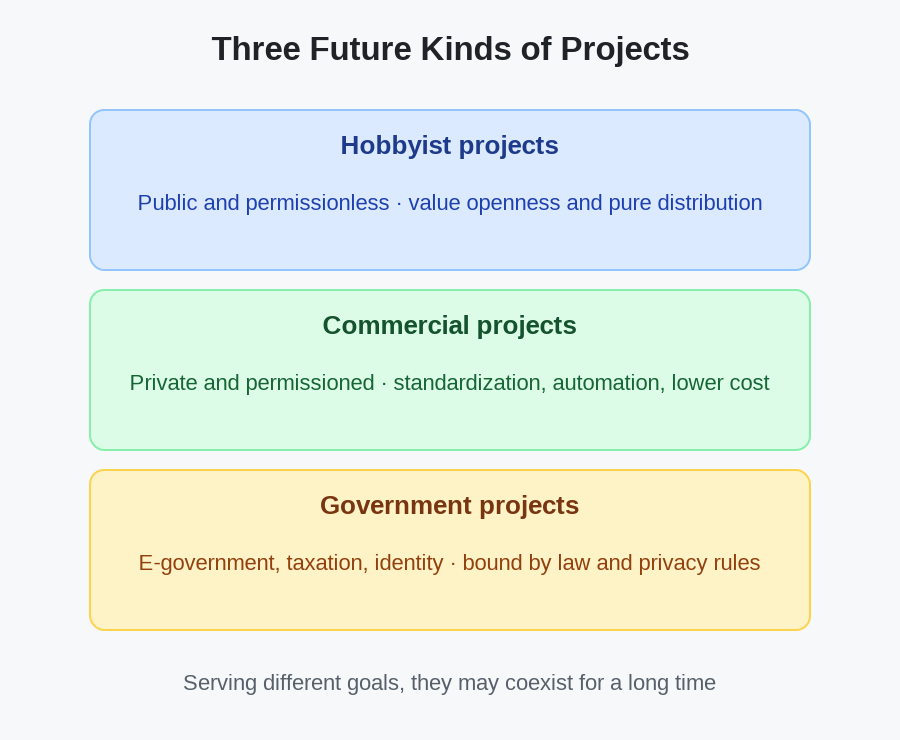
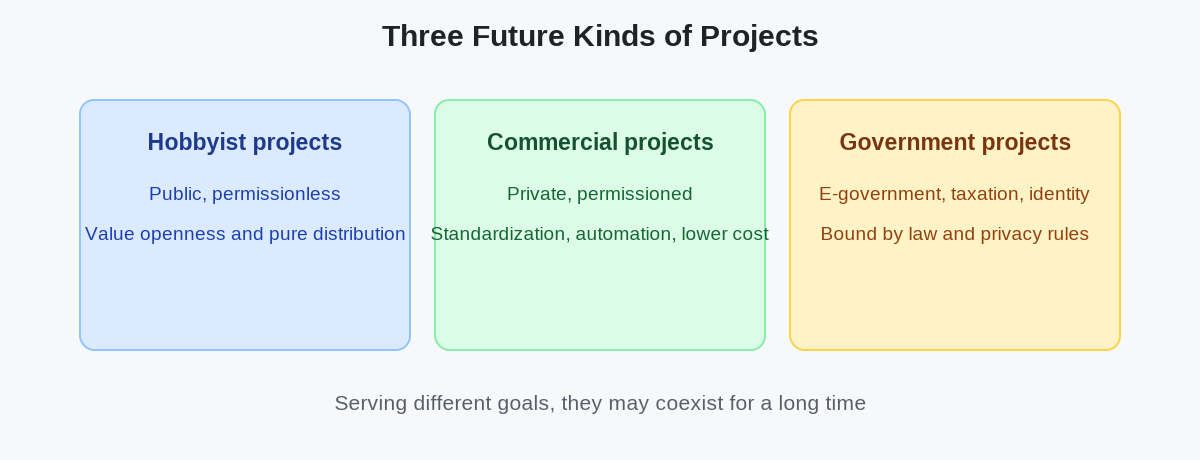
3.5 Three Possible Future Shapes
Three kinds of blockchain projects may show up.
Small-scale hobbyist projects. These use public, permissionless blockchains. Their supporters care about full openness and pure distribution, and sometimes attach a political or ideological message.
Large-scale commercial projects. These mostly use private, permissioned blockchains. Industry consortia or leading companies launch them, aiming for standardization, automation, streamlined processes, and lower costs.
Government projects. These serve e-government, taxes, identity, record management, land registries, educational credentials, central bank digital currencies, and more. Taxes pay for government projects, so they face fewer commercial pressures, but laws on privacy and data security bind them.
3.6 Don't Rush to Predict the Endgame
The internet's history shows that technologies evolve and drift away from their early visions. Blockchain's future may include several shapes at once, rather than one shape replacing all the others.
For people and organizations, what matters isn't betting on some "endgame." It's understanding the trade-offs of each shape and judging which one fits your own situation.
4. Diagrams
Figure 5-4-1: Long-Term Benefits and Potential Costs
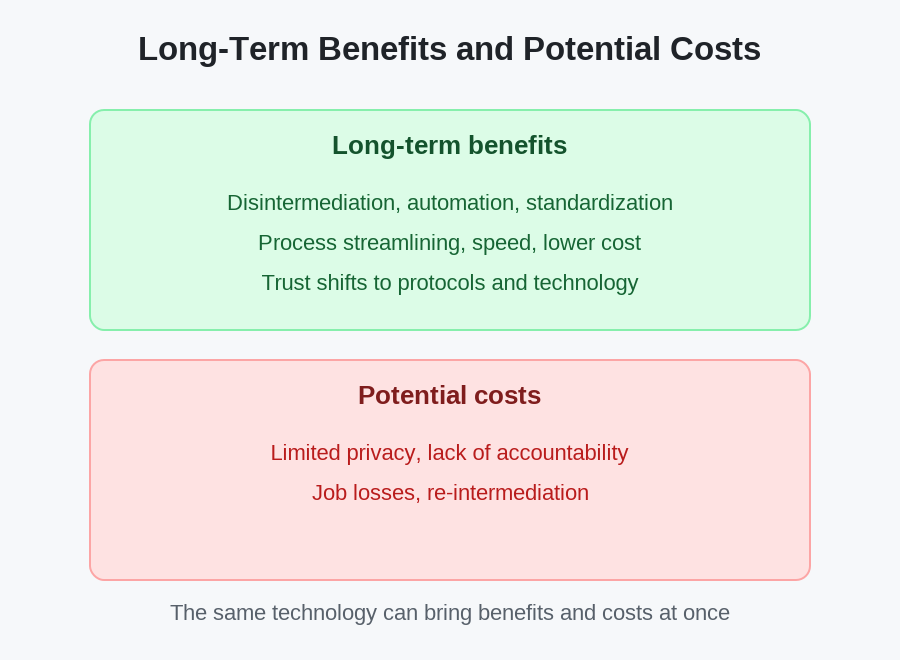
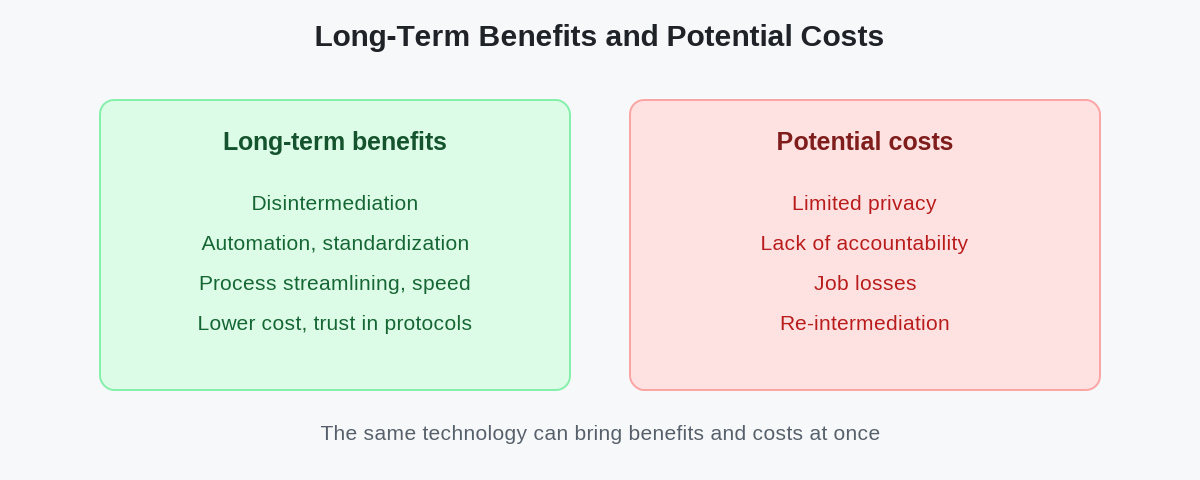
Figure 5-4-2: Three Kinds of Future Projects
5. Key Takeaways
- Blockchain will keep evolving at the technical, scalability, and conceptual levels.
- Permissions, privacy, consensus, transactions, state, and data structures are all important directions it could evolve in.
- Long-term benefits include disintermediation, automation, standardization, streamlined processes, faster processing, lower costs, and trust shifting to protocols and technology.
- Disintermediation doesn't get rid of middlemen. It replaces them with software and protocols, or squeezes the chain of middlemen.
- Potential costs include not enough privacy, lack of accountability, job losses, and re-intermediation.
- When an automated system goes wrong, it can be harder to pin down responsibility than with traditional middlemen.
- The future may include three kinds of projects: hobbyist, large-scale commercial, and government.
- Don't assume only one shape will win. Different situations will pick different trade-offs.
6. Quiz
Part 1: Single Choice (1–4)
Question 1
What's the more accurate way to understand blockchain's "disintermediation"?
A. All middlemen disappear
B. Software and protocols replace some human middlemen, or the chain of middlemen gets squeezed
C. All transactions become free
D. All organizations become government agencies
Show answer
Answer: B
Explanation: Disintermediation doesn't get rid of all middlemen. It replaces some human middlemen with software and protocols, or squeezes the chain of middlemen.
Question 2
Which of these is a long-term benefit blockchain may bring?
A. Privacy increases automatically
B. Standardized and automated processes
C. Every kind of job grows
D. Legal liability disappears automatically
Show answer
Answer: B
Explanation: Standardization and automation are long-term benefits. Privacy, jobs, and legal liability don't improve or disappear automatically.
Question 3
Why is "lack of accountability" a potential cost?
A. When an automated, protocol-driven system goes wrong, it's unclear who's responsible
B. Blockchains can't store data
C. All nodes have to use real names
D. Block headers have no timestamps
Show answer
Answer: A
Explanation: Not knowing who's responsible when an automated system fails is the heart of "lack of accountability." It has nothing to do with storage, real names, or timestamps.
Question 4
What does "re-intermediation" refer to?
A. Middlemen disappearing completely
B. People continuing to use middleman services, with the middlemen using blockchain behind the scenes
C. All nodes becoming middlemen
D. Blockchain no longer needing consensus
Show answer
Answer: B
Explanation: Re-intermediation means people keep using middleman services while the middlemen adopt blockchain behind the scenes, which cancels out part of the disintermediation effect.
Part 2: Multiple Choice (5–7)
Question 5
In which directions might blockchain keep evolving?
A. Permission models
B. Privacy protection
C. Consensus mechanisms
D. Smart contracts and state data
Show answer
Answer: A, B, C, D
Explanation: Permissions, privacy, consensus, smart contracts, and state data are all directions it could evolve in.
Question 6
Which long-term benefits might blockchain bring?
A. Automation and standardization
B. Streamlined processes and faster processing
C. Lower costs
D. Trust shifting to protocols and technology
Show answer
Answer: A, B, C, D
Explanation: All four are possible long-term benefits.
Question 7
What are blockchain's potential costs?
A. Not enough privacy
B. Lack of accountability
C. Job losses
D. Re-intermediation
Show answer
Answer: A, B, C, D
Explanation: Privacy, accountability, jobs, and re-intermediation are all potential costs.
Part 3: True or False (8–9)
Question 8
True or false: blockchain's future will take only one shape, and every other shape will disappear.
Show answer
Answer: False
Explanation: The future may include several shapes at once, like hobbyist projects, commercial projects, government projects, and more.
Question 9
True or false: smart contracts stretch blockchain from mostly storing transaction data to being able to run program code.
Show answer
Answer: True
Explanation: Smart contracts let blockchain run program code, not just store transaction data.
Part 4: Scenario Analysis (10)
Question 10
A group of banks plans to use a private, permissioned chain to automate cross-border settlement. They hope to cut down on human middlemen, speed things up, and lower costs. But regulators worry that nobody will be clearly accountable when something goes wrong.
Answer the following:
- What long-term benefits might this project gain?
- What potential costs or risks might it face?
- Why can't technology alone solve the question of "who's responsible"?
Show answer
Answer:
- It may cut down on human middlemen, speed up settlement, lower costs, and push toward standardization and automation.
- It may face risks around privacy, legal liability, acceptance by regulators, the effect on jobs, and re-intermediation.
- Figuring out who's responsible involves legal liability, contracts, regulation, and settling disputes. Technology can only record and carry out rules. It can't decide on its own who bears the legal consequences, so legal and institutional arrangements have to go along with it.