
A Blockchain Primer › Module 5 › Lesson 5.3
Lesson 5.3: Common Misconceptions and a Judgment Checklist — Clearing Up the Pitfalls All at Once
- #1. The Core Question
- #2. An Everyday Analogy
- #3. Core Concepts Explained
- #4. Diagrams
- #5. Key Takeaways
- #6. Quiz
By now you've gone all the way from "why we need blockchain" to "how to choose and combine blockchains." This lesson pulls the course's most easily confused claims into one checklist, then hands you a set of tools so you can check new claims yourself down the road.
1. The Core Question
"Blockchain is absolutely secure." "Once it's on the chain, it can never be changed." "Decentralization is always better." These claims all sound right, but every one of them hides a trap.
This lesson answers two questions: What are the most common misconceptions? And when you run into a new claim, how do you quickly tell whether it holds up?
The short version: First figure out which layer it's talking about, which premise it rests on, and which trade-off it involves. Then decide whether to believe it.
2. An Everyday Analogy
The "Non-Stick Pan" Advertisement
The seller says "this pan absolutely never sticks." You take it home, fry an egg, and it sticks anyway. The problem isn't that "non-stick" is a lie. It's that the word "absolutely" promises too much.
Lots of claims about blockchain work the same way. They turn "usually works, at a high cost" into "always works," and "under certain conditions" into "under all conditions."
The job in this lesson is to learn how to put claims back within the scope where they actually apply.
3. Core Concepts Explained
3.1 Misconception One: "Blockchain Is Absolutely Secure and Absolutely Tamper-Proof"
What's wrong: Tampering isn't impossible. It's extremely expensive. In theory, someone with enough computing power could still rebuild a chain that's consistent with itself, and the system's security depends on an honest majority.
The correct statement: As long as an honest majority controls the computing power, tampering gets caught, and rewriting usually costs too much to be worth it.
3.2 Misconception Two: "Once It's on the Chain, It Can Never Be Changed"
What's wrong: Old records that have been confirmed are hard to change, but new state keeps getting appended and updated. Off-chain information, oracle data, and smart contract upgrades can all change outcomes.
The correct statement: The historical record is append-only and tamper-resistant, but the "current state" keeps changing as new transactions come in.
3.3 Misconception Three: "Decentralization Is Always Better"
What's wrong: Decentralization brings censorship resistance and trust, but it also brings low throughput, high cost, and trouble coordinating. Centralization may come out ahead on speed, privacy, and cost.
The correct statement: Whether to decentralize depends on whether the situation needs parties who don't trust each other to maintain something together.
3.4 Misconception Four: "The Coins Are in the Wallet"
What's wrong: Ownership of coins is recorded on-chain. The wallet only holds private keys and connects you to the blockchain.
The correct statement: The wallet is a window onto the chain. Losing the private key is what costs you control of the assets.
3.5 Misconception Five: "A Smart Contract Is a Legal Contract"
What's wrong: A smart contract is a program that runs automatically. Its "smartness" comes from code logic, and that's not the same as the force of a legal contract.
The correct statement: It can be a tool for carrying out a legal contract, but whether it's legally valid has to be settled within a legal framework.
3.6 Misconception Six: "Anything Using a Blockchain Is Decentralized Finance"
What's wrong: Private permissioned chains and systems that central institutions run don't count as DeFi. DeFi requires a public, permissionless chain plus no middlemen.
The correct statement: Using a blockchain doesn't make something DeFi. Look at where it runs and whether middlemen are involved.
3.7 Misconception Seven: "Oracles Automatically Give Contracts the Truth"
What's wrong: Oracles just carry data. Errors, biases, and manipulation in real-world data flow onto the chain unchanged.
The correct statement: Oracles solve the problem of getting data in, but they don't create truth. You need checks across multiple sources and ways to fix mistakes.
3.8 Misconception Eight: "More Tokens and More Chains Mean Progress"
What's wrong: More tokens and chains don't automatically mean more value. Many projects have no practical use, and some carry a risk of fraud.
The correct statement: Judge a project by what it proves, what problem it solves, and whether its incentives hold up, not by how much noise its name makes.
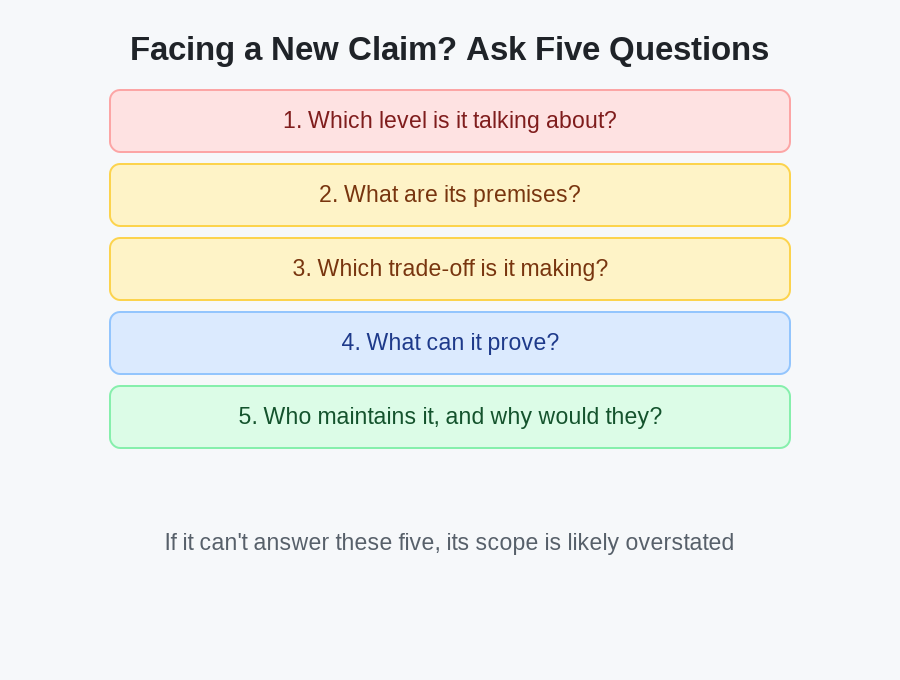
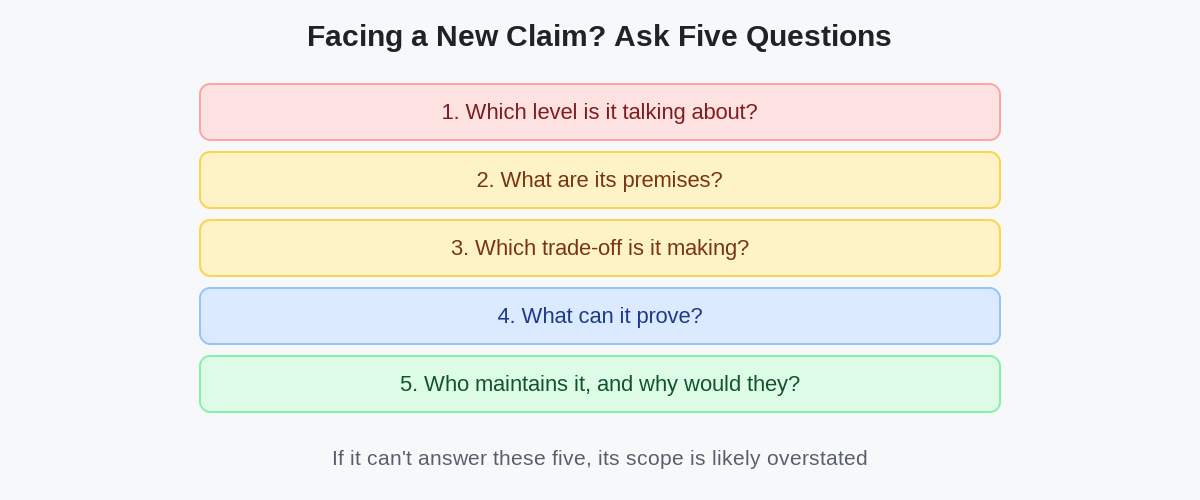
3.9 The Judgment Checklist: Five Questions for Any New Claim
- Which layer is it talking about? The data structure, the algorithms, the technology suite, or the complete system?
- What's its premise? An honest majority, how assets are distributed, legal recognition... do these premises hold?
- Which trade-off is it describing? Transparency vs. privacy, security vs. speed, decentralization vs. cost.
- What can it prove? Existence, time, order, identity, authorship, or ownership?
- Who maintains it, and why would they? Do the compensation and incentives make sense?
These five questions work for any new claim about blockchain. If a claim can't answer all five, it has most likely stretched its scope too far.
3.10 Applying the Checklist to a New Claim
The claim: "Store medical records on a blockchain, and patient data is absolutely secure."
Go through the questions one at a time:
- Which layer? The complete system, covering the ledger and storage.
- The premise? It needs medical records to be publicly verifiable, which clashes with privacy.
- The trade-off? Transparency and privacy are directly at odds. Putting medical records on a public chain actually leaks private information.
- What to prove? Maybe only "existence and time" are needed. The sensitive details don't have to go on-chain.
- Who maintains it? Can hospitals and patients run nodes together, and who pays the costs?
Conclusion: "Absolutely secure" doesn't hold up. A sensible plan puts the proofs on-chain and keeps the details in protected off-chain systems.
4. Diagrams
Figure 5-3-1: The Five Judgment Questions
5. Key Takeaways
- Blockchain's security means "expensive to attack," not "absolutely unchangeable."
- History is append-only, but the current state changes with new transactions.
- Decentralization isn't a cure-all. It depends on the situation.
- Wallets don't store coins. They hold private keys.
- Smart contracts are programs. Whether they're legally valid has to be settled within a legal framework.
- Using a blockchain doesn't make something DeFi.
- Oracles carry data. They don't create truth.
- For any new claim, ask first: which layer, what premise, what trade-off, what it proves, and who maintains it.
6. Quiz
Part 1: Single Choice (1–4)
Question 1
What's the most accurate rebuttal to "blockchain is absolutely tamper-proof"?
A. Tampering gets caught and is extremely expensive, but it isn't absolutely impossible
B. A blockchain can be deleted at any time
C. All data lives on a central server
D. Nobody will ever discover tampering
Show answer
Answer: A
Explanation: Blockchain makes tampering visible and expensive, but not mathematically impossible. Whether that holds also depends on an honest majority.
Question 2
What does a wallet actually hold?
A. All the cryptocurrency
B. Private keys and the information needed to connect to the blockchain
C. The whole blockchain
D. All smart contract code
Show answer
Answer: B
Explanation: A wallet holds private keys and connects to nodes. It doesn't store coins, the whole chain, or all contracts.
Question 3
Why is "anything using a blockchain is DeFi" wrong?
A. DeFi also requires a public, permissionless chain and no middlemen
B. DeFi can't use smart contracts
C. DeFi has to be run by banks
D. DeFi only exists on private chains
Show answer
Answer: A
Explanation: DeFi's two conditions are a public, permissionless chain and no middlemen. Private permissioned chains and centrally run systems don't count.
Question 4
When you judge a new claim, what should the first question be?
A. Which layer it's talking about
B. Whether its slogan is catchy
C. Whether it has issued a token
D. Whether a big company backs it
Show answer
Answer: A
Explanation: Ask which layer the claim is about first, so you don't confuse one part with the whole system.
Part 2: Multiple Choice (5–7)
Question 5
Which of these are common misconceptions?
A. Once it's on the chain, it can never be changed
B. Decentralization is always better
C. A smart contract is a legal contract
D. The coins are in the wallet
Show answer
Answer: A, B, C, D
Explanation: All four are common misconceptions listed in this lesson.
Question 6
Which of these are among the five questions in the judgment checklist?
A. Which layer it's talking about
B. What its premise is
C. What it proves
D. Who maintains it and why they would
Show answer
Answer: A, B, C, D
Explanation: You need to ask about the layer, the premise, the trade-off/proof, and the incentives for maintaining it.
Question 7
Which analyses of the claim "storing medical records on a blockchain is absolutely secure" are correct?
A. Publicly verifiable medical records clash with privacy
B. Maybe only the proofs need to go on-chain, with the details kept off-chain
C. You have to think through who maintains it and who pays the costs
D. The claim of "absolutely secure" holds up
Show answer
Answer: A, B, C
Explanation: Public verifiability clashes with privacy, putting proofs on-chain makes more sense, and the maintenance costs need thinking through. D's "absolutely secure" doesn't hold up.
Part 3: True or False (8–9)
Question 8
True or false: oracles can automatically give smart contracts completely truthful real-world information.
Show answer
Answer: False
Explanation: Oracles just carry data. Errors, biases, and manipulation in real-world data flow onto the chain unchanged.
Question 9
True or false: the more chains and tokens there are, the more valuable a project must be.
Show answer
Answer: False
Explanation: Quantity isn't the same as value. Look at what the project proves and what problem it solves.
Part 4: Scenario Analysis (10)
Question 10
Someone claims: "Our chain is faster than every database, guarantees data can absolutely never be changed, and suits every business."
Go through this claim point by point using the five judgment questions, and give a conclusion.
Show answer
Answer:
- Which layer: it talks about the complete system, but lumps performance, security, and scope together.
- What premise: "absolutely unchangeable" depends on an honest majority, which may not hold. "Faster than every database" ignores the trade-off between security and throughput.
- What trade-off: speed vs. security and decentralization vs. cost both involve trade-offs. You can't max out everything at once.
- What it proves / what problem it solves: it never says what a specific business situation needs to prove.
- Who maintains it and why: it says nothing about node incentives.
Conclusion: this claim stretches its scope too far and needs to be re-evaluated against a specific situation.