
A Blockchain Primer › Module 2 › Lesson 2.2
Lesson 2.2: Ownership Is Written in History — Transactions, Order, and the Audit Trail
- #1. The Core Question
- #2. An Everyday Analogy
- #3. Core Concepts Explained
- #4. Diagrams
- #5. Key Takeaways
- #6. Quiz
In the last lesson, we followed one payment from start to finish. Now we start taking apart the first step. The ledger doesn't simply write down "who owns what right now." It records every transfer and lets you work out the current state from that history.
1. The Core Question
If the ledger just says, in one line, "this camera belongs to Alex," why should anyone believe it? If it records every sale instead, so you can trace the camera from its original owner all the way to Alex, isn't that far more convincing?
This lesson answers three questions: How do you describe ownership with transaction history? Why can't the order of transactions ever get scrambled? And what does a transaction have to meet to earn a place in history?
The short version: Ownership isn't a stand-alone fact. It's what you get when you add up an ordered series of transfer records that anyone can check.
2. An Everyday Analogy
The Baton in a Relay Race
In a relay race, only one runner holds the baton at any moment. If you want to know who has it now, the most direct way isn't to guess. It's to look at the latest handoff: who passed it to whom.
If every handoff gets recorded, with the time, the runner passing it, and the runner taking it, then even after the race is over you can work backward through the records and figure out who held the baton at any point.
You can think about ownership the same way:
- The asset is the baton.
- Each transfer of ownership is a handoff.
- The complete, ordered record is the race itself.
- The current owner is whoever received the last valid handoff.
Balance vs. Transaction Log
A banking app usually gives you two views:
- One page shows your "current balance."
- Another page lists every deposit, withdrawal, and transfer.
The current balance is inventory data: it tells you straight out how much money you have now. The transaction log is transaction data: it explains where that money came from and where it went.
Inventory data looks more convenient, but it gives you only the conclusion, not the evidence. Transaction history takes more space, but it can explain what happened behind every change of ownership. Blockchain takes the second route: keep the complete log, and calculate the current state from it.
3. Core Concepts Explained
3.1 Inventory Data and Transaction Data
There are two opposite ways to describe ownership.
Inventory data describes the current state directly: who owns what right now, and how much. It's like a stock list. It's quick to read, but it only "claims" the current state.
Transaction data describes how ownership changed hands: who transferred what, how much, to whom, and when. It's like a full transaction log. It's harder to read, but it can explain how the current state came about.
You don't have to pick one or the other. Add up the transaction data in order, and you can work out the inventory data. Blockchain builds on transaction history because history gives you evidence, and a bare inventory snapshot doesn't.
3.2 What a Transaction Must State
A transaction describes one transfer of ownership. It usually needs to include:
- The sender's account identifier.
- The recipient's account identifier.
- The amount of the asset being transferred.
- The time of the transaction.
- The fee the sender is willing to pay the system.
- A note about the purpose, or a small amount of space the sender can use for data.
- Proof that the sender really agreed to this transfer.
The first few items look a lot like a bank transfer form: who's sending to whom, how much, and when. The fee works a little differently. Banks usually have a standard fee schedule, but a distributed system has no central institution setting one price for everyone, so users have to say in the transaction how much they're willing to pay. Later lessons cover who ends up collecting these fees and what they're paid in.
3.3 Executing a Transaction Means Writing It into History
On its own, transaction data is just a statement: "I want to transfer this." Actually executing a transaction means adding it to the ledger so it becomes part of the transaction history.
Once it's in history, the transaction counts the next time anyone adds up the history to work out who owns what. On the flip side, a transaction that never makes it into history is treated as if it never happened.
That's what "writing" means here: not sending a message, but making that message part of everyone's shared history.
3.4 Why Order Must Never Be Scrambled
Transaction history has to keep its order, because the same transactions in a different order can add up to a completely different result.
Say your account balance is 0. If you get 50 from a friend first and then pay a 50 bill, both go through. If you pay the bill first, the system sees you don't have enough money and rejects the payment.
So history isn't a pile of records you can sort however you like. The order itself is part of the information.
3.5 The Three Conditions Transaction History Must Meet
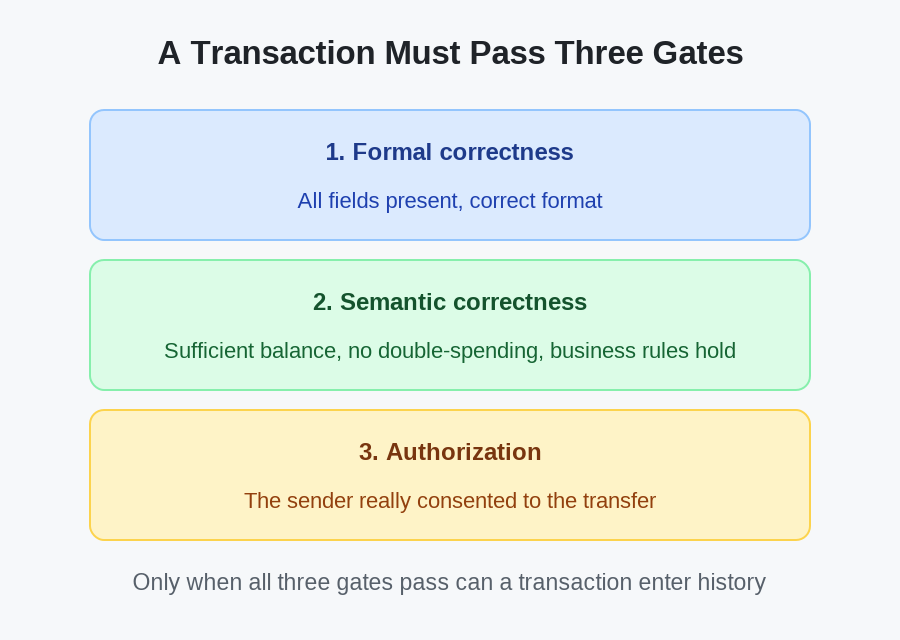
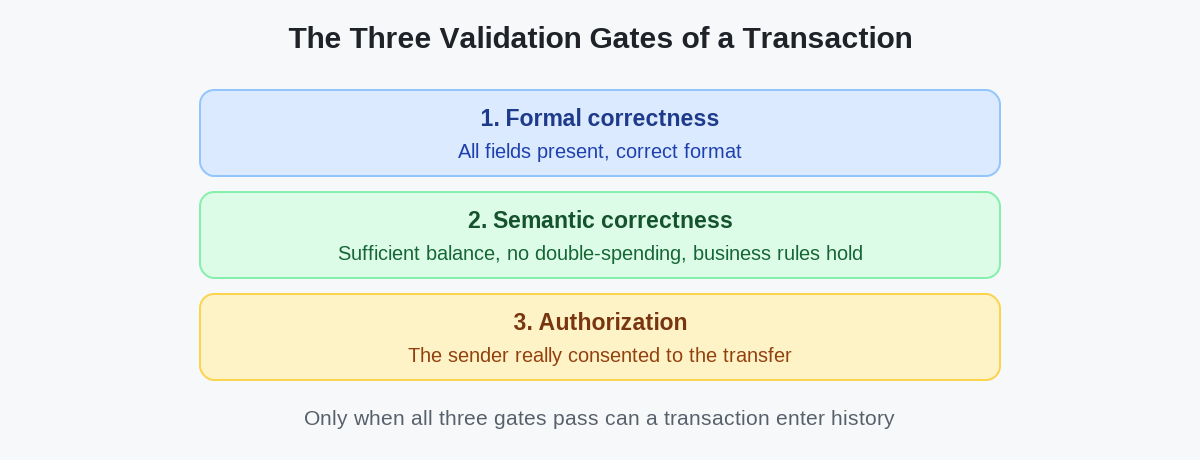
Transaction data is the heart of the ledger, and only legitimate transactions get into history. Validating a transaction usually means checking three things.
First, formal correctness. The transaction has to contain every required field, in the right format. For example, account identifiers have to be numbers of the required length, transfer amounts have to be whole numbers greater than zero, and timestamps have to follow the agreed format. Missing fields, wrong formats, or negative amounts all count as formally incorrect.
Second, semantic correctness. It isn't enough for a transaction to be "written right." It also has to "mean the right thing." That takes knowing the business rules, for example:
- An account can't send out more than it currently owns.
- The same asset can't be spent twice.
- A single transaction can't go over the set amount limit.
- A user can't submit too many transactions within a certain period.
- Some assets may have to be held for a minimum amount of time before they can be transferred out.
Third, authorization. Only the owner of the sending account has the right to start this transfer. The transaction has to carry proof that the sender really agreed to it.
You need all three. Right format but not enough balance: rejected. Enough balance but no authorization: rejected. Authorization in place but fields missing: still rejected.
3.6 Why an Audit Trail Can Prove Ownership
When every transaction is kept in order, the whole history forms an audit trail. It doesn't record "someone claims to own this." It records "here's how this asset moved, step by step, into someone's hands."
As long as the history is complete, the order is right, and the transactions are legitimate, anyone can add up the transactions from the beginning and rebuild who owns what today. Ownership no longer rests on a single statement from some central institution. It rests on a whole stretch of history anyone can check.
4. Diagrams
Figure 2-2-1: Inventory Data vs. Transaction History
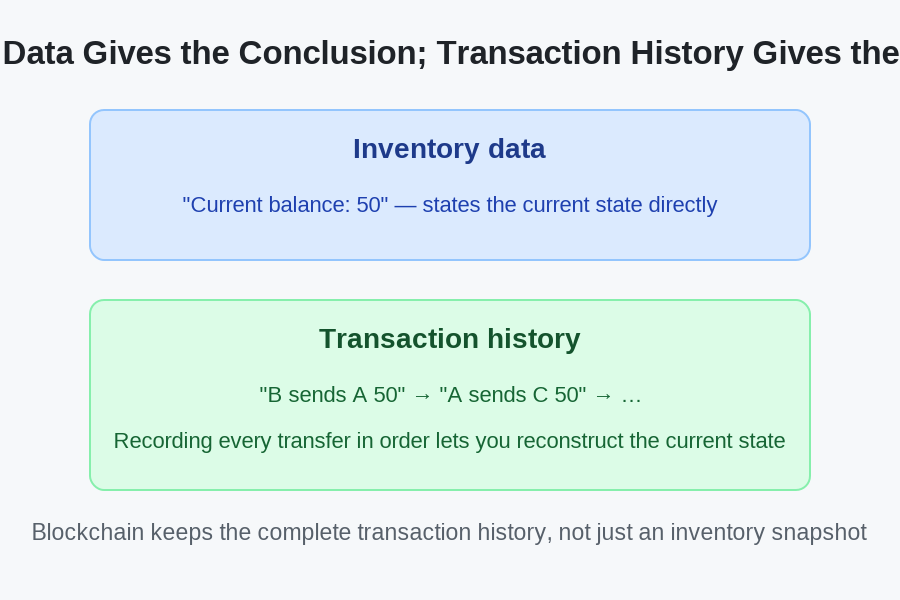
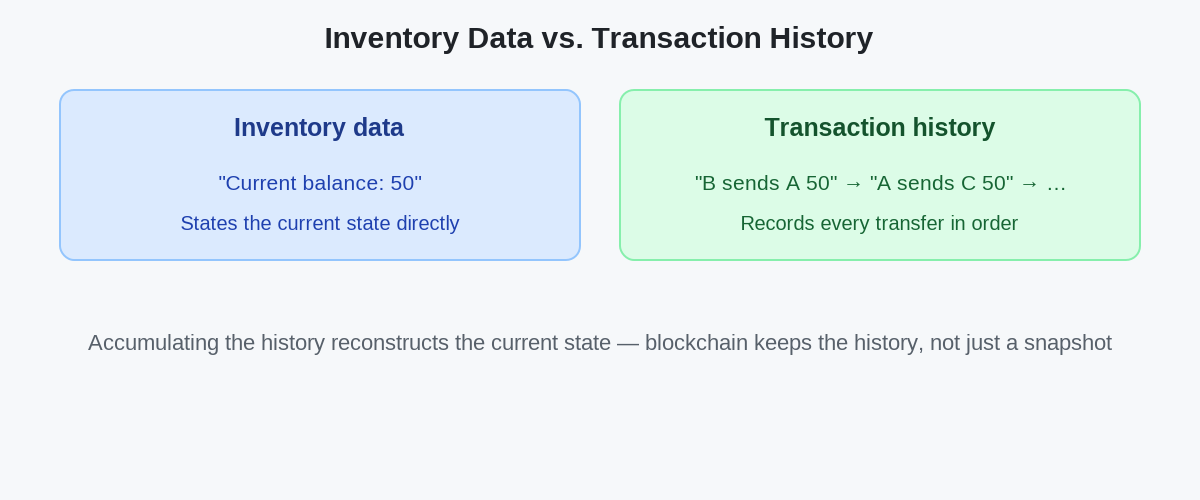
Figure 2-2-2: The Three Validation Gates of a Transaction
5. Key Takeaways
- Inventory data describes the current state directly. Transaction data describes how ownership changes hands, step by step.
- Transaction history can explain and prove ownership. An inventory snapshot can only claim the current state.
- A transaction has to state the sender, recipient, amount, time, fee, purpose, and proof of authorization.
- Executing a transaction means adding it to the ledger's history. Transactions that never get into history are treated as if they never happened.
- The order of transactions changes the result when you add them up, so the order has to be preserved.
- To get into history, a transaction has to pass all three checks: formal correctness, semantic correctness, and authorization.
- A complete, ordered history of legitimate transactions forms an audit trail you can use to rebuild current ownership.
6. Quiz
Part 1: Single Choice (1–4)
Question 1
What's the main difference between inventory data and transaction data?
A. Inventory data describes the current state; transaction data describes how ownership is transferred
B. Inventory data is always more secure than transaction data
C. You can't use transaction data to work out the current state
D. Inventory data can only record images
Show answer
Answer: A
Explanation: Inventory data describes the current state directly. Transaction data describes how things were transferred, and adding up the transaction data gives you the inventory state. B goes too far, and C and D contradict what the two kinds of data actually do.
Question 2
On a blockchain, what does "executing a transaction" mean, most accurately?
A. Sending the transaction's contents to a friend
B. Adding the transaction to the ledger's history so it affects who owns what
C. Printing the transaction out
D. Changing the transaction amount to zero
Show answer
Answer: B
Explanation: Executing a transaction isn't sending a message or printing a document. It's writing the transaction into history so it counts when ownership is worked out.
Question 3
Why does transaction order have to be preserved?
A. Because order affects the result when you add things up: receiving first and paying first can lead to different outcomes
B. Because order only affects page colors
C. Because the longer the order, the lower the fee has to be
D. Because images can't be displayed unless order is preserved
Show answer
Answer: A
Explanation: Change the order and you change the result. For example, with a zero balance, receiving first and paying first lead to different outcomes. B, C, and D have nothing to do with why order matters.
Question 4
Which of these falls under "authorization"?
A. Every transaction field is present and in the right format
B. The transfer amount is greater than zero
C. The transaction carries proof that the sender agreed to the transfer
D. The transaction timestamp follows the required format
Show answer
Answer: C
Explanation: Authorization is about whether the sender agreed. A, B, and D are formal correctness or semantic correctness checks.
Part 2: Multiple Choice (5–7)
Question 5
What information does a transaction usually need to include?
A. The sender's and recipient's account identifiers
B. The transfer amount and the time of the transaction
C. The fee and a note about the purpose
D. Proof that the sender agreed to the transfer
Show answer
Answer: A, B, C, D
Explanation: The accounts, amount, time, fee, purpose, and proof of authorization are all part of how a transaction is described.
Question 6
Which of these are semantic correctness checks?
A. An account can't send out more than it owns
B. The same asset can't be spent twice
C. A single transaction can't go over the set limit
D. Account identifiers have to be numbers of the required length
Show answer
Answer: A, B, C
Explanation: Semantic correctness checks what the transaction means against the business rules. D is formal correctness: it checks the format, not the business meaning.
Question 7
Which statements about transaction history are correct?
A. A complete history can form an audit trail
B. Transactions that never get into history are treated as if they never happened
C. The order of history affects who ends up owning what
D. As long as a transaction is formally correct, it's guaranteed to get into history
Show answer
Answer: A, B, C
Explanation: A complete history forms an audit trail, transactions outside history don't count as having happened, and order affects the result. D is wrong because it looks only at formal correctness. A transaction also has to be semantically correct and authorized.
Part 3: True or False (8–9)
Question 8
True or false: inventory data states current ownership directly, so it proves how ownership came about better than transaction history does.
Show answer
Answer: False
Explanation: Inventory data gives you the current state directly, but it can't explain how ownership came about. Only transaction history shows how it happened.
Question 9
True or false: as long as a transaction's format is correct, it's guaranteed to get into the ledger's history.
Show answer
Answer: False
Explanation: The right format only covers formal correctness. A transaction also has to be semantically correct and authorized before it can get into history.
Part 4: Scenario Analysis (10)
Question 10
A points system records every points transfer. User A's account has 0 points right now. One day, two transactions happen one after the other:
- Transaction 1: B transfers 50 points to A.
- Transaction 2: A transfers 50 points to C.
Answer the following:
- What happens if the two transactions run in the opposite order?
- What does this show is important about transaction history?
- Besides whether there's enough balance, what else does the system have to check to confirm that transaction 2 is valid?
Show answer
Answer:
- If A's transfer of 50 points to C runs first, A's balance is 0, so transaction 2 gets rejected for insufficient balance. A has 50 points only after B's transfer of 50 points goes through.
- Transaction order matters. Different orders lead to different results when you add the transactions up.
- The system also has to check formal correctness (fields and format), semantic correctness (balance, amount limits, double-spending, and so on), and whether A authorized this transfer.