
A Blockchain Primer › Module 2 › Lesson 2.1
Lesson 2.1: Case Study — Follow the Money — The Complete Journey from Signature to Block
- #1. The Core Question
- #2. An Everyday Analogy
- #3. Core Concepts Explained
- #4. Diagrams
- #5. Key Takeaways
- #6. Quiz
Module 1 laid out the problem blockchain is trying to solve. Starting with this lesson, we break that problem into engineering tasks and follow one payment from start to finish: how it starts, how it's proven, how it's validated, and how it finally gets written into the chain and becomes history anyone can look up. This lesson gives you a map of the whole route. Lessons 2.2 through 2.6 fill in each step one at a time.
1. The Core Question
You want to pay a friend 10 coins. On a blockchain, this doesn't work like tapping "send" in a messaging app and watching the money land instantly. The payment goes through a full process. First you sign off on it, then the network checks it, then it gets packed into a block with other transactions, and finally that block is attached to the chain.
This lesson answers one question: between "I want to pay" and "everyone agrees it's been paid," what actually happens?
The short version: Follow this one payment all the way through first, and you'll know which piece of the puzzle each later lesson fills in.
2. An Everyday Analogy
Mailing a Registered Letter That Needs a Signature, a Seal, and a Record
Say you need to mail an important document to a friend. If you just stuff it in an envelope and drop it in a mailbox, nobody can prove that the letter really came from you, that nobody changed what's inside, and that your friend actually got it.
So a reliable process breaks down into several steps:
- You sign: you sign the document to say "this came from me, and I agree to what it says."
- You seal: you put the document in an envelope and seal it, so nobody can swap it along the way.
- You hand it over: you give the letter to the post office, and delivery begins.
- The post office checks: it confirms the address is right, the postage is enough, and the envelope is intact.
- The post office records: it logs the mailing in its system, with the time, sender, and recipient all clearly written down.
- The record is filed: the record is linked to earlier records, so anyone can look it up later.
A blockchain transfer maps almost one-to-one onto the path this registered letter takes. Next, we'll translate each step into blockchain terms.
3. Core Concepts Explained
3.1 The Six Stages of a Transaction's Journey
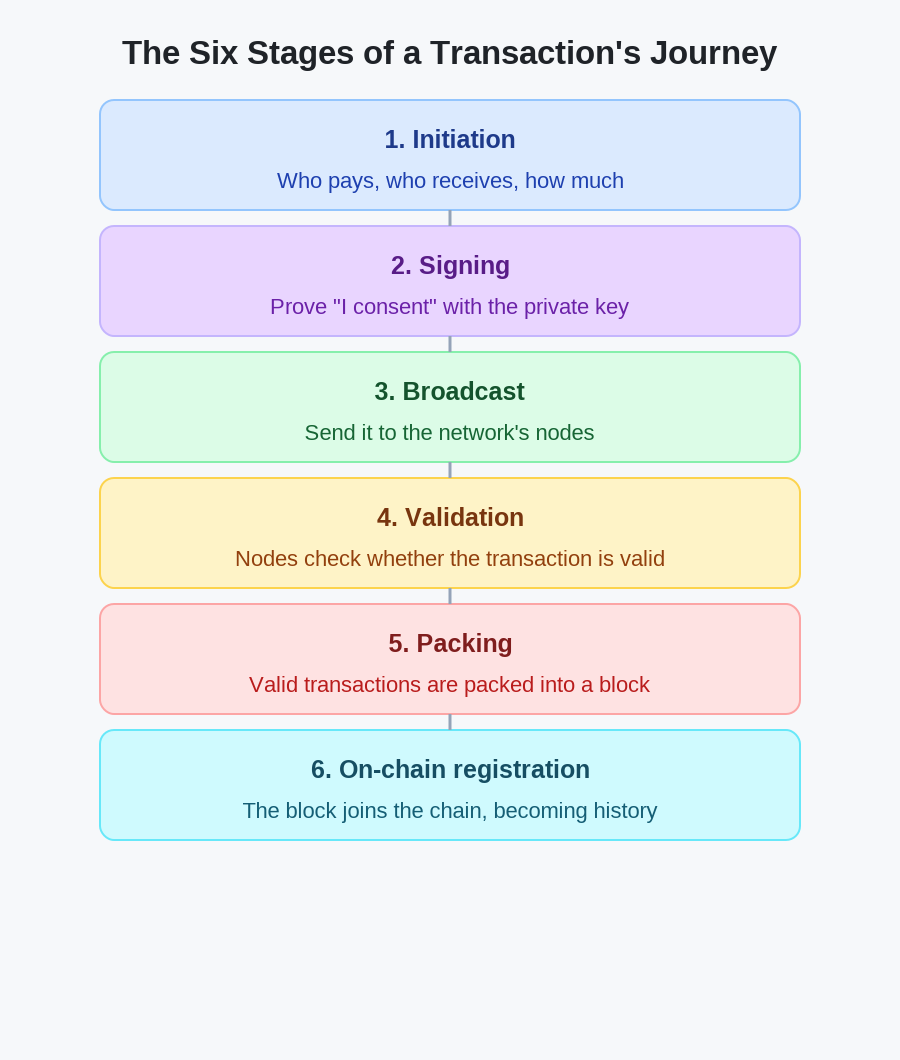
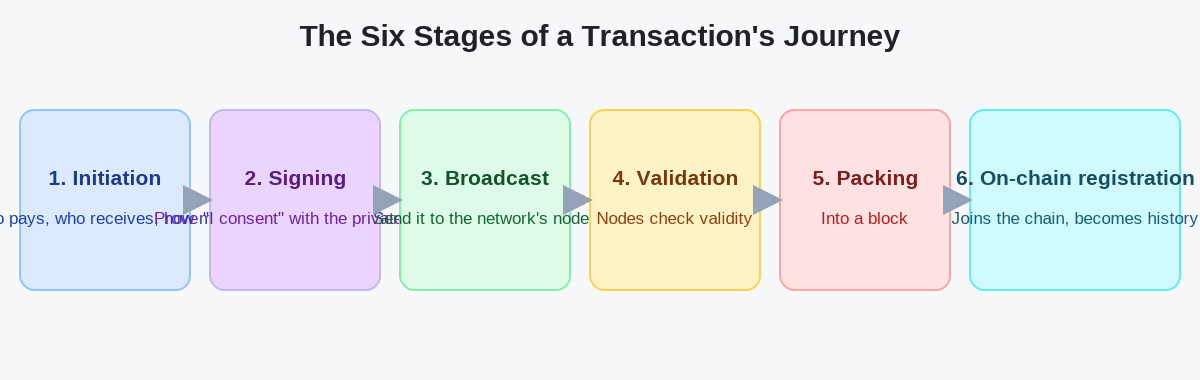
We split a transaction's path, from the moment it starts to its final registration, into six stages:
- Initiation: the payer says, "I want to send this."
- Signing: the payer proves, "I really did agree to this."
- Broadcast: the transaction goes out to the nodes in the network.
- Validation: nodes check whether the transaction is valid.
- Packing: valid transactions get packed into a block.
- On-chain registration: the block is attached to the chain and becomes history anyone can look up.
Let's go through them in order. This lesson covers only what happens, not why it's done this way or how each step works in detail. Lessons 2.2 through 2.6 handle those questions.
3.2 Stage One: Initiation
A transaction starts with a clear intent: payer A wants to send 10 coins to payee B.
The transaction has to state at least three things:
- Who pays: who the payer is.
- Who receives: who the payee is.
- How much: what the amount is.
But stating it isn't enough. Anyone can say "A is sending B 10 coins." The system has to confirm the statement really came from A herself. That brings us to stage two.
3.3 Stage Two: Signing
The payer "signs" the transaction with her own private key. Think of the private key as a seal or signature that only A has. Once she signs:
- Others can confirm that the transfer request really came from A.
- A can't turn around later and say, "I never sent that."
Signing doesn't hide the amount. It adds proof to the transaction that says "I agree to this." Lesson 2.4 covers exactly how that works.
3.4 Stage Three: Broadcast
A signed transaction doesn't go only to the payee. It's broadcast to the entire network.
When a node receives the transaction, it passes it along to other nodes. That way the transaction spreads through the network like a message until most nodes have seen it.
Why not just send it to the payee? Because in this system, there's no central institution keeping the books for everyone. Lots of nodes need to know the transaction exists before they can validate it and record it together.
3.5 Stage Four: Validation
When nodes receive a transaction, they don't just take it on faith. They check it against the rules first:
- Is the payer the legitimate owner of this asset?
- Does the payer have enough balance?
- Is the signature valid?
- Is the same money being spent twice?
Nodes keep only the transactions that pass these checks. The ones that fail get thrown out as invalid requests.
This step is the first line of defense against double-spending. Lesson 3.2 and later modules pick up the fuller set of validation rules.
3.6 Stage Five: Packing into a Block
Validated transactions don't sit around on their own one by one. They get packed together with other valid transactions into a block.
Think of a block as a box for transactions:
- The box holds a number of valid transactions.
- The box has a number, plus a marker that records which box it follows.
- Once the box is sealed, it's ready to be attached to the chain.
Why pack transactions at all? Because handling them one at a time is slow and easily gets messy. Once they're packed, it's much easier to organize, send, and check them box by box. Lesson 2.5 covers how a block is built and how the chain links together.
3.7 Stage Six: On-Chain Registration
Finally, the block is attached to the existing chain and becomes part of history.
Once it's on the chain, the transaction has a definite position. You can look up which block it's in and where it sits inside that block. And because the chain is built link after link, any later attempt to quietly change an old record gets caught by the chain's checking mechanism.
Only now is A's 10-coin payment to B truly complete. It's no longer just "I agreed to pay." It's "the network checked it, recorded it in history, and everyone accepts it."
3.8 This Map: Each Later Lesson Fills In One Piece
This lesson is a big-picture preview, so it only touches on each stage briefly. The lessons that follow take each one apart in depth:
- 2.2 covers transaction history and ownership: why "ownership is written in history."
- 2.3 covers hashing: how blocks and the chain get linked together.
- 2.4 covers keys and signatures: why a signature can prove "it was me."
- 2.5 covers blocks and the chain structure: how transactions get packed into boxes and how the boxes connect into a chain.
- 2.6 covers change detection: why changing an old entry gets caught.
Once you've finished Module 2, come back to this lesson. You'll be able to fill in the full mechanism behind every step this lesson only touched on.
A note on how the two breakdowns relate: the five stages in Module 2's introduction match the five lessons 2.2 through 2.6, while this lesson's six stages preview the whole process from start to finish. The details of the broadcast and validation stages come in Module 3, so the two sets of numbers don't contradict each other.
4. Diagrams
Figure 2-1-1: The Six Stages of a Transaction's Journey
5. Key Takeaways
- A transaction goes through six stages: initiation, signing, broadcast, validation, packing, and on-chain registration.
- Initiation only states who pays, who receives, and how much. That isn't enough on its own. The payer also has to prove she agrees.
- Signing uses the payer's private key to prove "I agree to this," and it lets others verify that proof.
- Broadcast lets the nodes in the network know about the transaction, instead of sending it only to the payee.
- Validation is the first line of defense against double-spending. Only transactions that pass the checks are kept.
- Packing puts multiple valid transactions into a block, which is then attached to the chain and becomes history anyone can look up.
6. Quiz
Part 1: Single Choice (1–4)
Question 1
What's the most sensible order for a transaction, from initiation to final registration?
A. Packing → Signing → Broadcast → Validation → Initiation → On-chain registration
B. Initiation → Signing → Broadcast → Validation → Packing → On-chain registration
C. Broadcast → Initiation → Validation → Signing → Packing → On-chain registration
D. Validation → Broadcast → Signing → Initiation → Packing → On-chain registration
Show answer
Answer: B
Explanation: The correct order is initiation (stating the intent) → signing (proving she agrees) → broadcast (sending it to the network) → validation (nodes check it) → packing (into a block) → on-chain registration (it becomes history).
Question 2
What's the most important job of the "signing" step?
A. Encrypting the transaction amount so nobody can see it
B. Proving the transfer request really came from the payer herself
C. Making multiple copies of the transaction
D. Completing the transfer on the spot, with no further steps needed
Show answer
Answer: B
Explanation: Signing uses the payer's private key to prove "this request really came from me." It doesn't encrypt the amount so it's invisible, and it doesn't mean the transfer is already complete.
Question 3
Why does a transaction need to be broadcast to the nodes in the network?
A. Because the payee might be offline
B. Because there's no central institution keeping the books, so lots of nodes need to know about it and take part in validation
C. Because broadcasting can automatically increase the amount
D. Because nodes have to see it before they can delete the old ledger
Show answer
Answer: B
Explanation: A distributed system has no central bookkeeper, so the transaction has to be broadcast so that many nodes can see it and take part in validating and recording it. A, C, and D have nothing to do with why transactions are broadcast.
Question 4
During the "validation" stage, what do nodes mainly do?
A. Color-code the transaction
B. Check whether the payer has the right to pay, whether the balance is enough, and whether the signature is valid
C. Turn the transaction into a different one
D. Decide how much of a fee this transaction can earn
Show answer
Answer: B
Explanation: Validation checks whether the payer has the right to pay, whether the balance is enough, whether the signature is valid, whether the same money is being spent twice, and so on.
Part 2: Multiple Choice (5–7)
Question 5
At a minimum, what information does a transaction have to state?
A. Who pays
B. Who receives
C. How much
D. What color the block is
Show answer
Answer: A, B, C
Explanation: At a minimum, a transaction has to state who pays, who receives, and how much. The block's color is irrelevant.
Question 6
Which statements about "packing into a block" are correct?
A. Multiple valid transactions get packed into the same block
B. The block has a number and records which block it follows
C. Packing makes transactions easier to organize, send, and check
D. After packing, transactions can never be looked up again
Show answer
Answer: A, B, C
Explanation: Packing puts multiple valid transactions into a block. The block has a number and a marker linking it to the previous one, which makes things easier to organize and check. D is wrong to say transactions can't be looked up after packing. Once they're on the chain, they're actually easier to look up.
Question 7
Why is "on-chain registration" the final step for a transaction?
A. The transaction now has a definite position and can be looked up
B. It means the network has checked and recorded it, and everyone accepts it
C. Any later change to old records gets caught by the chain's checking mechanism
D. After on-chain registration, the payee automatically gets a paper receipt
Show answer
Answer: A, B, C
Explanation: On-chain registration gives the transaction a definite position, gets it accepted by the network, and makes old records hard to change quietly. The paper receipt in D isn't something a blockchain necessarily produces.
Part 3: True or False (8–9)
Question 8
True or false: as soon as the payer says "I want to transfer," the transaction is complete. No signing, broadcast, or validation is needed.
Show answer
Answer: False
Explanation: Saying "I want to transfer" isn't enough. Signing has to prove the payer agrees, broadcast has to let the nodes know, and validation has to confirm the transaction is valid. Only then does it get packed and added to the chain.
Question 9
True or false: once a block is attached to the chain, it becomes part of history, and changes to old records are easy to detect.
Show answer
Answer: True
Explanation: Once a block is added to the chain, it becomes history, and the chain's checking mechanism makes changes to old records easy to detect.
Part 4: Scenario Analysis (10)
Question 10
Alice wants to pay Bob 10 coins through a distributed ledger system. The system has many nodes and no central institution.
Answer the following:
- What six stages does this transaction have to go through?
- If Alice sends the transaction only to Bob instead of broadcasting it to the network, what goes wrong?
- Why can the "validation" step stop Alice from spending the same money twice?
Show answer
Answer:
- The six stages are initiation, signing, broadcast, validation, packing into a block, and on-chain registration.
- If it goes only to Bob, the other nodes don't know the transaction exists and can't validate or record it. With no central institution, the network as a whole won't accept the transfer, and the "proof of payment" Bob is holding can't be relied on either.
- The validation stage checks whether Alice is the legitimate owner of these 10 coins, whether her balance is enough, whether her signature is valid, and whether she's trying to spend the same money on more than one person. Only transactions that pass these checks can move on to be packed and added to the chain.