
A Blockchain Primer › Module 1 › Lesson 1.1
Lesson 1.1: Start by Taking Systems Apart — Understanding Any System Through Four Questions
- #1. The Core Question
- #2. An Everyday Analogy
- #3. Core Concepts Explained
- #4. Diagrams
- #5. Key Takeaways
- #6. Quiz
Before you study blockchain, learn to ask a system four questions. This lesson skips blockchain's technical details entirely. Instead, it gives you a general way to look at any system, and every lesson after this one relies on it to answer one question: "What kind of problem is this, really?"
1. The Core Question
You and a friend are talking about the same food-delivery app. You say, "Their deliveries take forever." He says, "The restaurants it recommends to me are always spot-on." You talk past each other for ten minutes before you realize you've been discussing two completely different things.
Here's the real problem: when people look at a complex system, what they notice first is deeply personal. Some people focus on "what it does for me," some on "how well it does it," and some care only about "whether the technology behind it is dependable." We're each staring at a different side of the same thing, so of course the conversation drifts off track.
This lesson gives you a fixed, shared, reusable set of four questions that breaks any software system into a few clear parts, so everyone can point to the same part and be talking about the same thing.
The short version: Learn to ask the right questions first. Only then can you judge a system.
2. An Everyday Analogy
A Food-Delivery Complaint Session Where Everyone Talks Past Everyone
Picture yourself as the product lead at a food-delivery platform. One day, four pieces of feedback land on your desk at once:
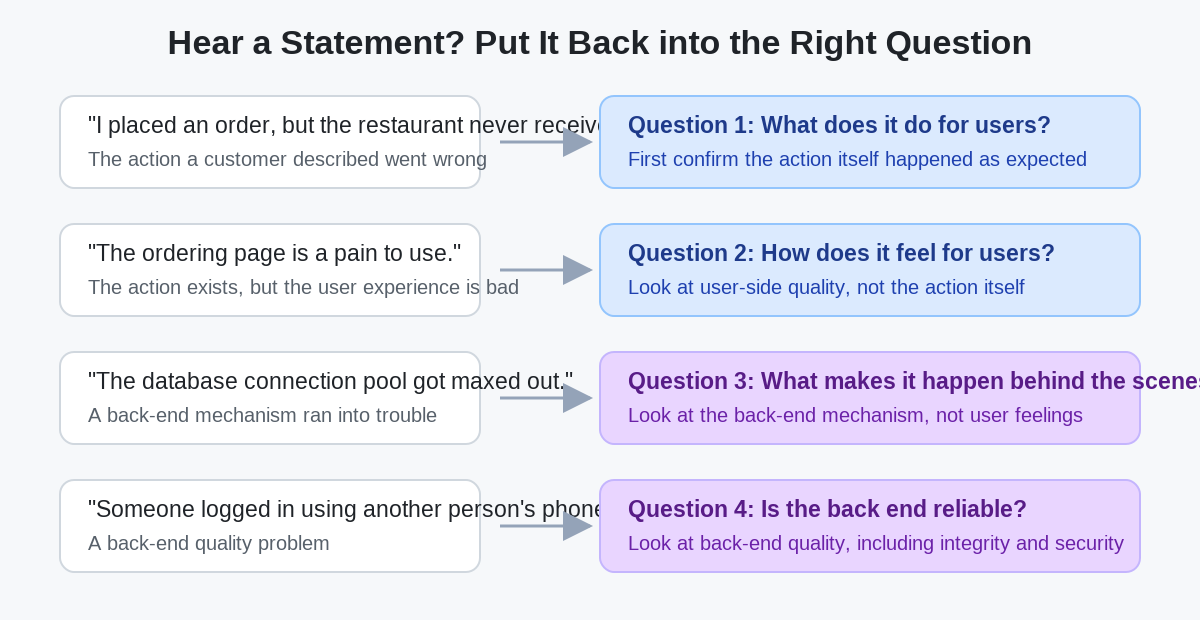
- A customer says: "I placed an order, but the restaurant never got it."
- A customer says: "The ordering page is a pain to use. It took me forever to find one button."
- An engineer says: "Last night the database connection pool maxed out."
- A security colleague says: "Someone logged in with another person's phone number."
These four comments describe four completely different things. But if nobody in the room sorts them out first, they all get stirred into one big mess. The product team blames engineering, engineering blames operations, and operations blames customers for not knowing how to use the app.
You don't need to understand code to untangle a mess like this. Every time you hear a claim about a system, you just ask yourself two questions first, then combine them into four.
The Four Questions at a Glance
Here's a plain-language answer to each of the four questions, using the same delivery platform:
| Question | What it's really asking | Example from the delivery platform |
|---|---|---|
| Question 1: What does it do for users? | What actions the system offers | Placing an order, paying, tracking the delivery |
| Question 2: How does it feel for users? | How those actions feel to users | Whether the pages are easy to use, whether ordering is quick |
| Question 3: What makes it happen behind the scenes? | Which invisible mechanisms keep it all running | How order data gets stored and passed along to restaurants |
| Question 4: Is the back end reliable? | Whether those mechanisms are reliable, secure, and error-free | Whether orders get lost, whether someone can log in as another user, whether the data contradicts itself |
Think of the four questions as four fixed cards. Whatever you hear ("deliveries are slow," "the button is hard to find," "the database connection pool is maxed out," "someone logged in as me"), place it on one of the cards first, and only then start the discussion. Sort first, judge second. That's the first rule of taking systems apart.
3. Core Concepts Explained
3.1 Why You Have to Ask: Complex Systems Need to Be Split Up First
A software system usually has many parts working together, and human attention is limited. Splitting a system into parts makes it easier to understand and use.
But you can't just split it any old way. Each of the common approaches has its own trap:
| Common way of splitting | Where it goes wrong |
|---|---|
| By function (ordering module, payment module) | Covers only "what it does," leaving no place for questions like "is it fast?" or "is it secure?" |
| By team (front-end group, back-end group) | Reflects the org chart, not the system. Reshuffle the teams and the conclusions change. |
| By importance (important vs. unimportant) | Subjective. No two people rank things the same way, so it isn't really a split at all. |
So we need a set of questions that doesn't depend on what the product looks like or how the teams are organized, and that everyone can agree on. The four questions below fit the bill.
3.2 Question 1: What does it do for users?
These are the system's actions, the things users actually talk about: listening to music, taking photos, placing orders, sending money.
- The test: you can describe it clearly in users' everyday language, with no technical background.
- This part answers "what is this system good for, from the user's point of view?" That's the system's purpose.
The easiest mistake is confusing "what the back end is doing" with "what it does for users." When the back end compresses data or connects to the network, that isn't the user's goal. It's just a way of reaching that goal. Keep the goal and the means separate.
3.3 Question 2: How does it feel for users?
The same action can be pleasant or miserable. Question 2 is about the feeling and quality an action gives users.
- Examples: whether the pages look good, how fast you get the hang of it, whether an order goes through on the first try, whether the wait is bearable.
- The question here isn't "does the feature exist?" but "what's it like to use?"
Telling Question 1 and Question 2 apart pays off: "can do it" and "does it well" are two separate things. An app can have every feature you could want and still freeze for five seconds every time you open it. Another can have very few features and feel incredibly smooth. When you evaluate a system, one can't stand in for the other.
3.4 Question 3: What makes it happen behind the scenes?
Users see "Order placed." What they don't see is how the order gets stored, how it gets sent to the restaurant, and how it stays in sync across multiple systems.
- These invisible mechanisms are what Question 3 is about.
- They're technical by nature, and they exist for one reason only: to make the actions users see actually happen.
The difference between Question 3 and Question 1 is the difference between "the user's purpose" and "the means of achieving it." Users only need to care whether they can place an order. They don't need to know which steps the order goes through in the back end. The people designing the system do.
3.5 Question 4: Is the back end reliable?
Back-end mechanisms can be fast or slow, dependable or constantly glitchy. Question 4 is about the quality of the back-end mechanisms.
- Examples: whether data gets lost or contradicts itself, whether the program produces bizarre results, whether people can see data they have no business seeing.
- This is the part you notice least in everyday life. When the system works, nobody thinks about it. The moment it breaks, everybody's asking about it.
Telling Question 3 and Question 4 apart matters just as much: "the back end has mechanisms" and "the back-end mechanisms are reliable" are two separate things. A system can have a complete storage setup and still lose data all the time. It can also run on very simple mechanisms and be rock-solid.
3.6 The Two Independent Judgments Behind the Four Questions
Look closely and you'll see that the four questions actually come from two judgments that don't depend on each other:
- Whom it's for: is this about the user side (what users experience directly) or the back-end side (the technical machinery behind it)?
- What is being discussed: is it about what is done (an action or mechanism), or how well it's done (quality)?
Cross these two judgments and you get exactly four questions. Here's the full map:
| About "what is done" | About "how well it's done" | |
|---|---|---|
| User side | Question 1: What does it do for users? | Question 2: How does it feel for users? |
| Back-end side | Question 3: What makes it happen behind the scenes? | Question 4: Is the back end reliable? |
The most common misfiling: some people assume "invisible to users" means "how well it's done." It doesn't. "Connecting to the network" is invisible to users, but it's a back-end action (Question 3). "The back end saving power" is also invisible to users, but it describes quality (Question 4). Whether something is visible depends on "whom it's for." Whether it's an action or a quality depends on "what is being discussed." Neither judgment can replace the other.
3.7 Going Deeper: Integrity Within Reliability
Question 4 covers a lot of ground, but one item ties most closely to blockchain and deserves its own section: integrity.
Integrity isn't just another word for "security." It's a broader idea with three main components:
| Component | Plain-language definition | What happens when it breaks |
|---|---|---|
| Data integrity | The data the system stores and uses is complete, correct, and free of contradictions | Account balances don't match the actual balances; two people buy the same ticket at the same time |
| Behavioral integrity | The system runs as expected, with no logical errors | You click "refund" and get neither a success nor an error; the program does bizarre things on its own |
| Security | Access to data and functions is open only to authorized users | Strangers can see your photo album and chat history |
You need all three:
- Security without data integrity → every door is locked, but what's inside was wrong from the start. The system is very securely guarding a pile of bad data.
- Data integrity without security → the ledger is accurate to the penny, but anyone can flip through it. The data is accurate, but it loses its value because anyone can see it.
- Data integrity + security without behavioral integrity → the data is right and outsiders can't get in, but the program itself acts erratically. The safe is sturdy, but it opens its own door at random.
Integrity usually works in silence. The apps you use every day haven't made you want to smash your phone because engineers keep handling the messy parts: operations happening at the same time, unexpected situations, and access permissions. It's like the wiring in your house: as long as the power's on, you never think about it. You only remember it's there when the breaker trips. Successful technology has a side effect: it hides itself, and its value gets hidden along with it.
That brings us to the one idea this lesson most wants you to walk away with: integrity. When a system is no longer run by a single company but maintained jointly by many independent participants, who makes sure the data hasn't been changed at will? Who makes sure everyone sees the same version? At that point, "how to achieve and maintain integrity" is no longer an engineering detail. It's a question the system has to answer head-on.
3.8 How These Four Questions Pave the Way for What's Next
Once you have the four questions, you can do three things whenever you discuss any system (blockchain included):
- First, place any statement on one of the four questions.
- If it lands on "back-end side × how well it's done" (Question 4), dig further: is it about integrity? If so, is it data integrity, behavioral integrity, or security?
- Keep "the user's purpose" separate from "the back end's means," and don't let technical jargon intimidate you.
Let's walk through a hypothetical scenario. Say you're deciding whether your company should adopt an attendance system. The vendor talks for half an hour, and you can take the whole pitch apart with just the four questions:
| What the vendor says | Which question it belongs to | How to follow up |
|---|---|---|
| "Supports facial-recognition clock-in" | Question 1 | Is this the action I want? Would fingerprints work? |
| "Clock-in responds very fast" | Question 2 | Does it stay fast when lots of employees clock in at once? |
| "Attendance records are stored in distributed cloud storage" | Question 3 | It's just a means. Don't let the jargon intimidate you |
| "Administrators can't tamper with the data" | Question 4 | This is what really matters. How exactly is that guaranteed? Who provides oversight? |
Notice where vendors spend their time: they love talking about the first two rows (users get them, and they demo well), but the last row is the one you need to keep pressing on during design and acceptance testing. You can now pin every statement to the right question.
4. Diagrams
Figure 1-1-1: Taking a System Apart with Four Questions
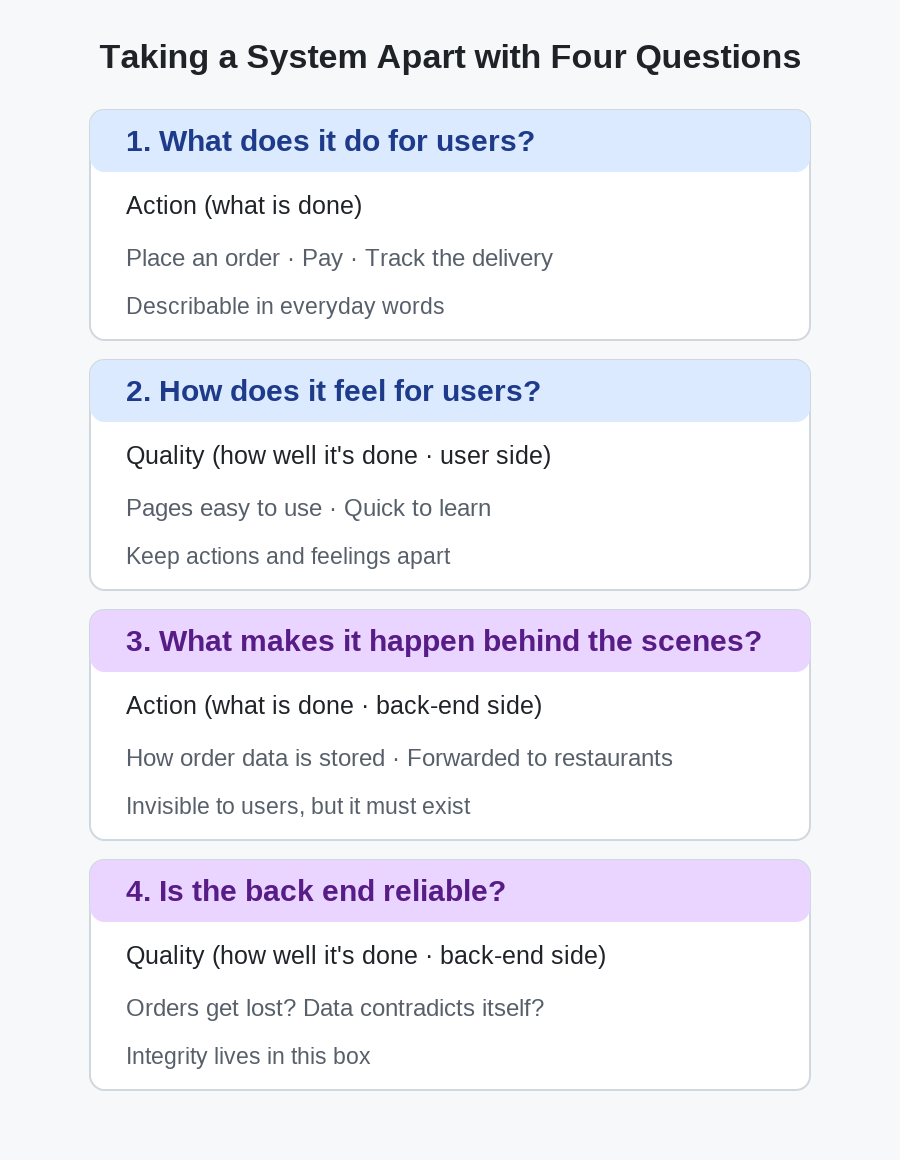
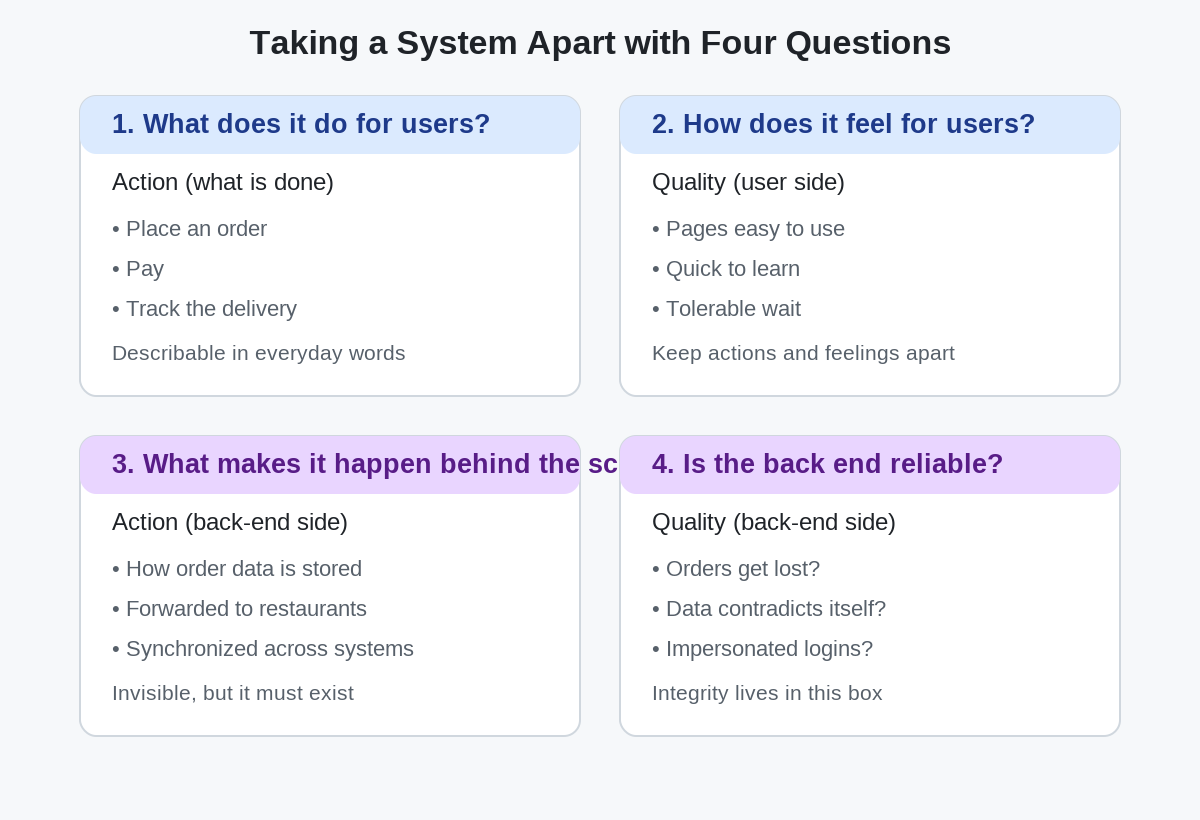
Figure 1-1-2: The Three Components of Integrity
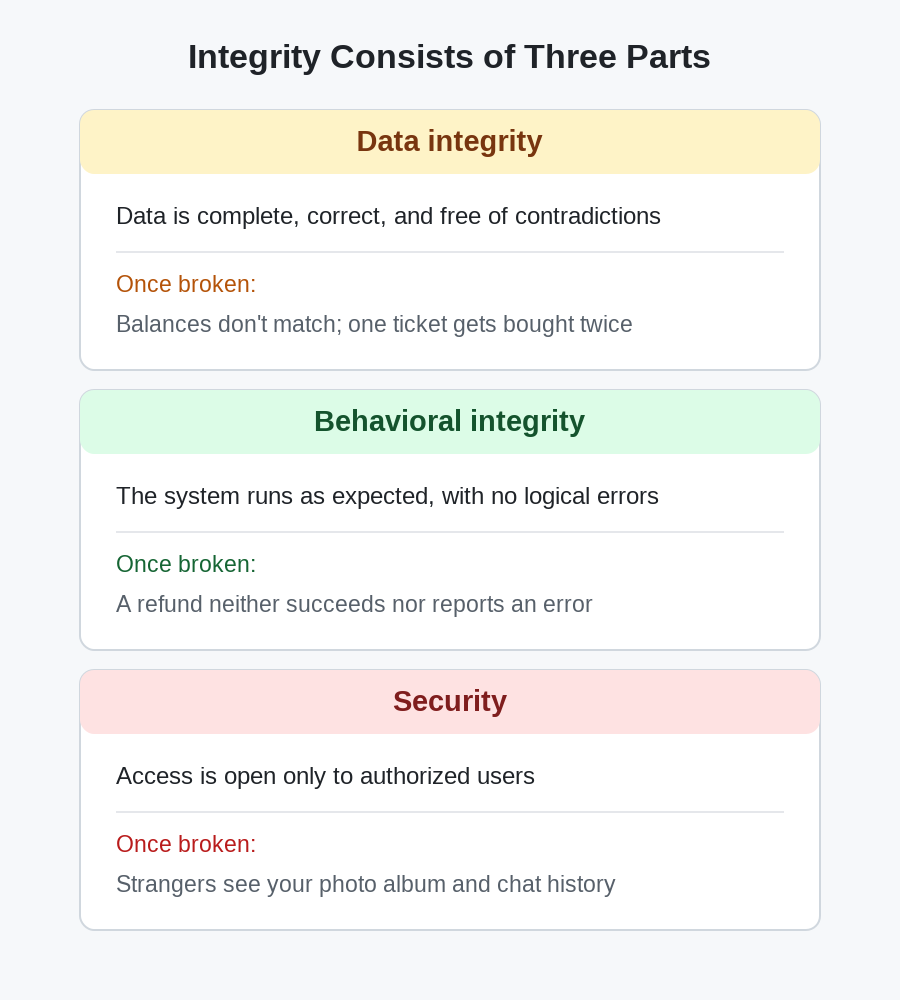
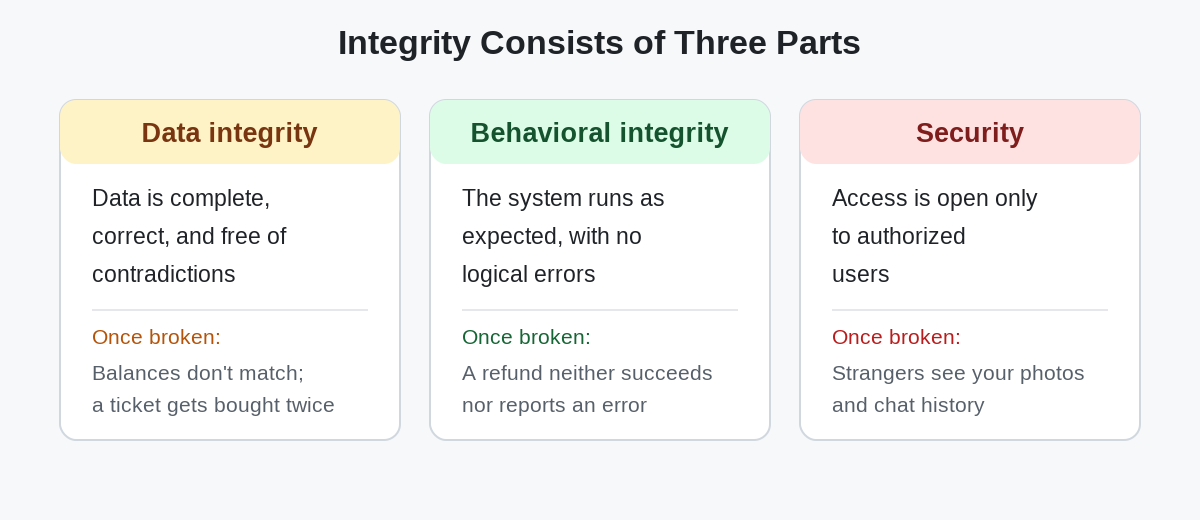
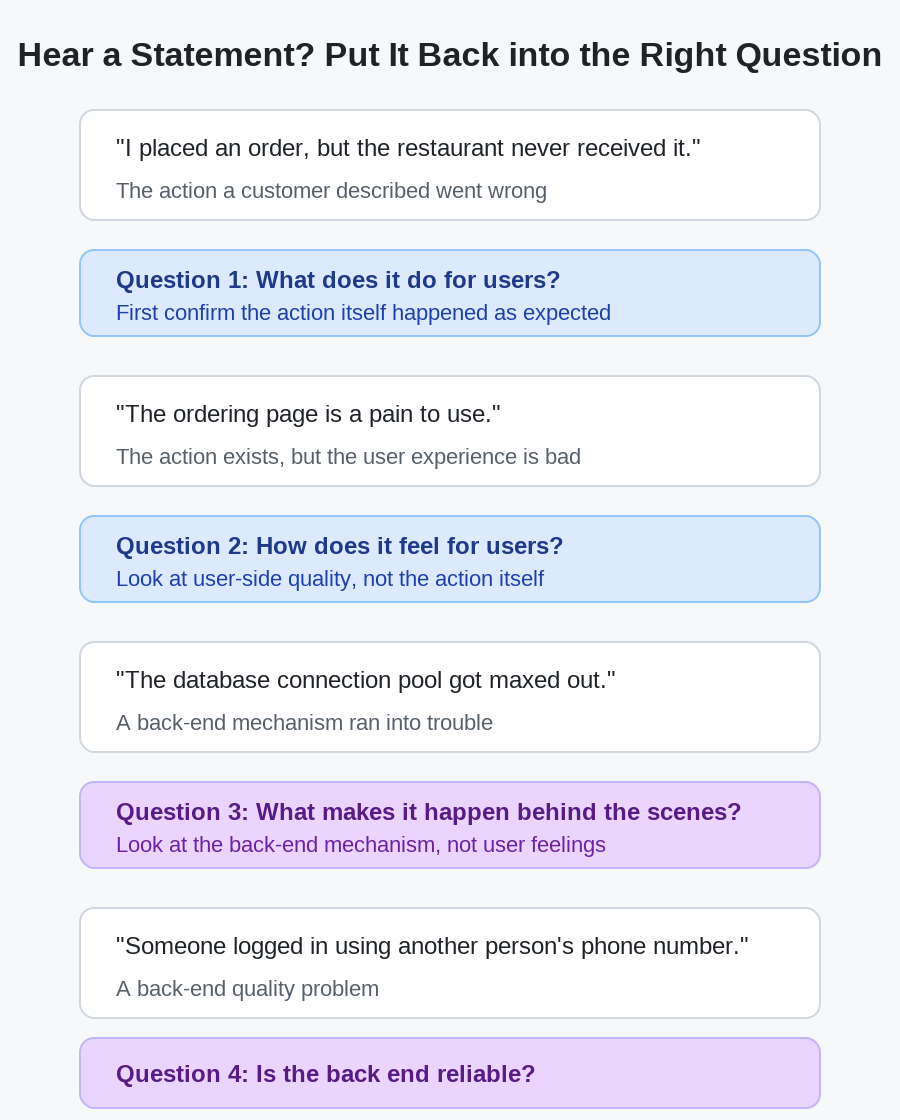
Figure 1-1-3: Tracing a User Complaint Back to the Right Question
5. Key Takeaways
- If you don't split a system up, you can't think about it clearly. If you split it carelessly, you can't talk about it clearly. The first step in any technical discussion is to sort, not to argue about who's right.
- The four questions are fixed: What does it do for users? How does it feel for users? What makes it happen behind the scenes? Is the back end reliable? Any statement about a system fits on one of these cards.
- Two independent judgments: whom it's for (user side / back-end side) and what is being discussed (what is done / how well it's done). Visibility depends on "whom it's for"; action vs. quality depends on "what is being discussed." Neither can replace the other.
- "Can do it" and "does it well" are two different things. So are "the back end has mechanisms" and "the back-end mechanisms are reliable." When you evaluate a system, one can't stand in for the other.
- Integrity is made up of data integrity, behavioral integrity, and security. In that order, they cover whether the data is correct and consistent, whether the system behaves as expected, and whether access is controlled.
- Integrity stays silent when things work and only shows up when they break. One of blockchain's core challenges is exactly this: how to maintain integrity when there's no center in charge.
6. Quiz
Part 1: Multiple Choice, One Answer (1–5)
Question 1
The only basis for deciding whether a statement belongs to the "user side" or the "back-end side" is:
A. How much code the statement involves
B. Whether it describes the user's need itself, or the technical mechanism that helps meet that need
C. Whether the front-end team or the back-end team said it
D. Whether users can see it with their own eyes
Show answer
Answer: B
Reasoning: "Whom it's for" has exactly one test: does the statement describe the user's need itself, or the technical mechanism that supports that need?
- A is wrong: code size measures workload. It has nothing to do with "whom it's for."
- C is wrong: splitting by team reflects the org chart. Reorganize the teams and the conclusion changes, so it lacks the stability of a real system property.
- D is wrong, and it's the easiest option to fall for. "Whether users can see it" is a result, not the test. "Connecting to the network" is invisible to users but belongs to the back-end side; "a nice-looking interface" is something users see every day, and it belongs to the user side.
Question 2
Under the four questions, the comment "the buttons on this delivery page are easy to find, and ordering goes smoothly" belongs to:
A. Question 1: What does it do for users?
B. Question 2: How does it feel for users?
C. Question 3: What makes it happen behind the scenes?
D. Question 4: Is the back end reliable?
Show answer
Answer: B
Reasoning: "Are the buttons easy to find, does ordering go smoothly" describes the feeling and quality users experience while performing the action. It isn't about whether the ordering feature exists, and it isn't a back-end mechanism.
- Rule out A: ordering itself is Question 1; whether it goes smoothly is Question 2.
- Rule out C/D: those would require describing internal technical mechanisms or their quality.
Question 3
The two independent judgments behind the four questions are:
A. Code size × team size
B. Whom it's for (user side / back-end side) × what is being discussed (what is done / how well it's done)
C. Importance × development difficulty
D. Whether users pay × whether it's online
Show answer
Answer: B
Reasoning: The four questions come from crossing two independent judgments: whom it's for (user side / back-end side) and what is being discussed (what is done / how well it's done).
- A/C/D all bring in irrelevant variables (code size, teams, difficulty, payment, connectivity) that can't split a system in a stable way.
Question 4
Which of the following clearly belongs to "back-end side × what is done" (Question 3)?
A. A customer taps "Place Order" in the app
B. The system compresses the order data and writes it to a storage device
C. The login screen's color scheme feels pleasant
D. The system can fend off malicious intrusions and keep its data consistent
Show answer
Answer: B
Reasoning: This is the most counterintuitive cell. A statement has to pass both tests at once.
- B: compressing data and writing it to storage is a concrete action (what is done), and it happens inside the technology users can't see (back-end side). Put together, that's exactly Question 3.
- A: tapping "Place Order" is the user's purpose itself → Question 1.
- C: the interface's color scheme is a quality users perceive directly → Question 2.
- D: fending off intrusions + staying consistent falls under reliability and integrity → Question 4.
Question 5
Which of the following is NOT one of the three components of integrity?
A. Data integrity
B. Behavioral integrity
C. Fast system response and high availability
D. Security
Show answer
Answer: C
Reasoning: The three components of integrity are data integrity, behavioral integrity, and security.
- C's "fast response, high availability" also falls under "how well it's done," but it isn't a component of integrity. It sits next to integrity, not inside it.
- The key distinction: fast ≠ correct. A system can respond extremely fast while its data contradicts itself, or crawl along while its integrity is flawless.
Part 2: Multiple Choice, Select All That Apply (6–7)
Question 6
Which of the following fall under "how well it's done" (Question 2 or Question 4)? (Select all that apply.)
A. Sending data over the network
B. The software runs fast
C. User data stays private and secure
D. Taking photos
E. Storing data in a space-saving way
Show answer
Answer: B, C, E
Reasoning: Decide whether each item is "what is done" or "how well it's done":
- A, "sending data over the network": an action, so "what is done."
- B, "the software runs fast": "fast" describes how it runs, so "how well it's done."
- C, "user data stays private and secure": a constraint on, and a quality of, how data is handled, so "how well it's done."
- D, "taking photos": an action, so "what is done."
- E, "storing data in a space-saving way": "in a ... way" describes quality, so "how well it's done."
Question 7
Which statements about the difference between the "user side" and the "back-end side" are correct?
A. User-side content can be described in users' everyday language, with no technical background needed
B. Back-end-side content is technical by nature
C. Back-end mechanisms are ends in themselves, unrelated to user needs
D. Back-end mechanisms are the means of meeting user needs
E. Which side a statement belongs to depends on the size of the team that built it
Show answer
Answer: A, B, D
Reasoning:
- A: the user side can be described in everyday language: placing orders, taking photos, listening to music.
- B: the back-end side is technical by nature: data storage, network connections, pixel recognition.
- C gets it backwards. Back-end mechanisms are the means of meeting user needs, not ends in themselves.
- D correctly describes their role as a "means."
- E: team size is an organizational variable, not a property of the system itself.
Part 3: True or False (8–9)
Question 8
True or false: "connecting to the nearest network access point" is a technical detail that ordinary users never see, so it belongs to the "how well it's done" category.
Show answer
Answer: False
Reasoning: "Connecting to the network" is a back-end-side action, so it belongs to "what is done" (Question 3), not "how well it's done" (Question 4).
- Where the misconception comes from: treating "invisible" as the test for "how well it's done." In fact, "invisible" only tells you it's on the back-end side. It doesn't decide whether it's an action or a quality. This question, option D in Question 1, and Question 4 all test for the same common mistake from three angles.
Question 9
True or false: if a system handles security well, it already has integrity.
Show answer
Answer: False
Reasoning: Integrity is made up of data integrity, behavioral integrity, and security. Handling security well, by itself, doesn't mean the system has integrity.
- With only security in place, you can still have every door locked and no outsiders getting in, while the stored data contradicts itself (no data integrity) or the program does illogical things on its own (no behavioral integrity).
- The result is "a system very securely guarding bad data," which is still an engineering failure.
- A common mix-up is treating "secure" as roughly the same thing as "having integrity." Security is about who has access; data integrity is about whether the data is right.
Part 4: In-Depth Scenario Analysis (10)
Question 10
Scenario: you're the operations lead at an online ticketing platform. In the middle of the night, complaints start pouring in from users, and they fall into three kinds:
- Complaint 1: some users' order pages say "Ticket purchased," but the ticket-scanning system has no record of the ticket. Other users find that two people bought the same seat at the same time.
- Complaint 2: a user reports that after clicking "Request refund," the system neither shows an error nor goes through. The page just hangs. When the user logs back in, the order has been marked "voided," and nobody knows who did it.
- Complaint 3: an outsider posts online that without even logging in, he can just bump up the digits in an order number one at a time and see lots of other people's full names, phone numbers, and the last digits of their ID numbers.
At the post-mortem, the product lead makes the call: "This is a database performance problem. Scale up first and get response times down."
Answer the following:
(a) Match each of the three complaints to a component of integrity, and explain your reasoning.
(b) Using the four questions, identify where all three complaints land, and explain why both the users and the product lead have trouble pinpointing the problem.
(c) Will the product lead's decision to "scale up" fix any of the complaints? Go through them one by one, and identify the thinking error behind this bad call.
Show answer
(a) Matching the three complaints to components of integrity
| Complaint | Symptom | Component | Basis |
|---|---|---|---|
| Complaint 1: the page says "Ticket purchased" but the scanning system has no record; two people bought the same seat | The same business fact gets inconsistent, even conflicting, answers in different places | Data integrity | Data integrity means exactly this: data that is "complete, correct, and free of contradictions." "The ticket exists, but the two systems don't match" violates "free of contradictions"; "the same seat sold twice" is the textbook case of data contradicting itself |
| Complaint 2: clicking refund produces neither an error nor a success; after logging back in, the order is "voided" and nobody knows who did it | The system didn't run as expected; the order ended up in a state no one can explain | Behavioral integrity | The definition is "the system runs as expected, with no logical errors." "Neither an error nor a success" means the flow stopped halfway with no clear outcome; "the order mysteriously voided" means the system did something the user never expected |
| Complaint 3: without logging in, bumping up the order number exposes other people's information | Someone without authorization got access to data and functions | Security | The definition is "access is open only to authorized users." The platform treated guessable order numbers as passes and never checked "who are you, and are you allowed to see this?" |
(b) Where the complaints land among the four questions, and why neither side can pinpoint it
All three complaints land in exactly the same place: Question 4 (back-end side × how well it's done). Inside it, the central item, integrity, takes a hit on every front: data, behavior, and security each break in one spot.
Why users can't pinpoint it: the only thing users see directly is Question 1 ("I want to buy a ticket," "I want a refund"), so that's where their descriptions stop. The real breakdown is in Question 4. Given what they can see, users only get the symptoms, never the cause.
Why the product lead can't pinpoint it either: he squeezes all three problems into one phrase, "a database performance problem." That's using "is it fast?" to cover questions of a different kind: "is it correct?" and "who has access?" The deeper cause is that he lumps "back-end side" and "how well it's done" into one bucket: since users can't see any of it, he files all of it under "underlying performance." But under the four questions, performance, integrity, and the like are separate, parallel items within Question 4, and none of them can stand in for another.
(c) Can scaling up fix anything? Case by case
- Complaint 1 (data integrity): No. Scaling up improves throughput and speed, but the problem here is that the same ticket left contradictory records in different places, and the system didn't stop the same seat from being sold twice. Speed can't fix that.
- Complaint 2 (behavioral integrity): No. The refund flow leaves an unhandled gap between "submitted" and "completed": no clear success, no clear failure, and yet the order got "voided." A faster page won't fill in the missing flow logic.
- Complaint 3 (security): No, and scaling up could even make it worse. The unauthorized access comes from treating guessable order numbers as passes, and scaling up doesn't change that. If scaling adds more entry points, each one needs its own identity and permission checks. Miss one, and the leak surface actually gets bigger.
Conclusion: Scaling up fixes none of the three complaints. Here's what actually needs to happen: keep each ticket consistent everywhere and prevent duplicate sales; build out the refund flow's success, failure, and exception branches; and add identity and permission checks to every access request.
Three thinking errors sit behind this call, and they're the main things to take away:
- Lumping different problems together: three different problems that fall under the same question (is the data right, is the behavior right, who has access) get loosely merged into "an underlying problem," and then merged again into "a performance problem." The whole point of the four questions is to prevent exactly this kind of merging.
- Assuming the back end just works: Question 4 usually holds up, so the team assumes it doesn't need its own design work or acceptance testing. Then when things break, nobody can trace the cause, so they reach for the most familiar metric by instinct: response time.
- Specifying features but not qualities: actions ("can buy a ticket") are easy to write into requirements and easy to sign off on; qualities ("the data has no contradictions, the behavior is predictable, access is controlled") are easy to leave out. These complaints are a reminder to define those quality requirements formally when a project kicks off.
So the practical value of this lesson isn't the classification itself. It's this: at project kickoff, write the Question 4 requirements down item by item, and give each one an owner.