
A Blockchain Primer › Module 3 › Lesson 3.7
Lesson 3.7: How Does a Blockchain Fit Together? — Components, the Technology Suite, and the Overall Architecture
- #1. The Core Question
- #2. An Everyday Analogy
- #3. Core Concepts Explained
- #4. Diagrams
- #5. Key Takeaways
- #6. Quiz
The previous lessons covered transactions, hashing, signatures, blocks, propagation, validation, and consensus one at a time. This lesson doesn't add any new parts. Instead, it puts the existing parts back together: what problem each one solves, which belong to a specific application, and which you can reuse elsewhere.
1. The Core Question
After learning a pile of concepts, how do you know you really understand blockchains? Not by reciting every term. You understand them when you can explain how an application goal breaks down into components, what each component depends on, which parts you can reuse when the application changes, and what happens when a component fails.
This lesson answers two questions: What layers and components make up a blockchain? Which ones are application-specific, and which ones form the application-agnostic technology suite?
The short version: The application goal decides what to manage. The technology suite supplies how to manage it. Together, they make a complete blockchain.
2. An Everyday Analogy
A Commercial Kitchen and a Restaurant's Menu
A set of commercial kitchen equipment, like stoves, refrigerators, ventilation, and sterilizers, can serve lots of different restaurants. The equipment itself doesn't decide whether you serve Sichuan food, Japanese food, or bread.
But each restaurant still needs its own menu, purchasing process, signature dishes, and pricing. Those are application-specific.
Blockchains work the same way:
- The technology suite is like the kitchen equipment. Storage, consensus, data processing, cryptography, and the peer-to-peer architecture can serve different applications.
- The application-layer logic is like the menu and purchasing process. It covers what asset is actually managed, how ownership is defined, and what business rules transactions have to follow.
Swap the restaurant, and the kitchen equipment stays. Swap the blockchain application, and you can reuse most of the technology suite too.
3. Core Concepts Explained
3.1 Components and the Concepts That Answer Them
If we gather up everything we've learned, we get a side-by-side table of components and concepts:
| Component | Main concepts |
|---|---|
| Describe ownership | Transaction history |
| Protect ownership | Digital signatures, identity, authentication, authorization |
| Store transaction data | The blockchain data structure |
| Prepare for distribution | Tamper resistance, append-only |
| Distribute the ledger | Peer-to-peer network, gossip propagation |
| Add and validate transactions | Blockchain algorithms, validation, rewards, penalties, competition, peer control |
| Decide which ledger represents the truth | Distributed consensus, longest chain / heaviest chain |
The table shows that a blockchain isn't one single technology. It's a set of concepts that depend on each other, and each row matches mechanisms from some of the earlier lessons.
3.2 The Two Functions of the Application Layer
From the application layer's point of view, a blockchain does two things:
First, it states ownership. It answers "who owns how much of what asset, and when."
Second, it transfers ownership. It answers "who transferred how much of what asset to whom, and when."
All the complex machinery underneath exists to serve these two functions.
3.3 Non-Functional Properties
A blockchain doesn't just have to "get things done." It has to "get them done reliably." It usually aims for these non-functional properties:
- Highly available: it runs around the clock, with no off switch.
- Censorship-resistant: no single party can dictate the content or shut the whole system down.
- Reliable: it keeps producing correct results.
- Open: it doesn't shut out any users or computers.
- Pseudonymous: it identifies owners by account identifiers without storing real-world identities.
- Secure: it protects both individual transactions and the system as a whole.
- Resilient: it keeps working under attacks like forgery, double-spending, and impersonation.
- Eventually consistent: it isn't always consistent right away, but it converges over time.
- Integrity-preserving: correct logic, consistent data, and a history that can't be corrupted.
No single component delivers these properties. They come from the whole architecture working together.
3.4 The Six Components of the Implementation Layer
On the inside, a blockchain breaks down into six main components:
- Ownership logic: how ownership is stated and transferred.
- Transaction security: identity, authentication, authorization, and digital signatures.
- Transaction processing logic: validating transactions and blocks, competition, peer control, rewards, and penalties.
- Storage logic: keeping the transaction history in a tamper-resistant, append-only data structure.
- Peer-to-peer architecture: independent nodes, the network, and gossip message passing.
- Consensus logic: getting nodes to eventually choose the same transaction history.
These components aren't just items on a flat list. They depend on each other in layers. Ownership logic depends on storage, consensus, transaction processing, and transaction security. Transaction security depends on hashing and cryptography. Storage logic depends on hash references and hash puzzles. Consensus logic depends on storage, processing, and the peer-to-peer architecture.
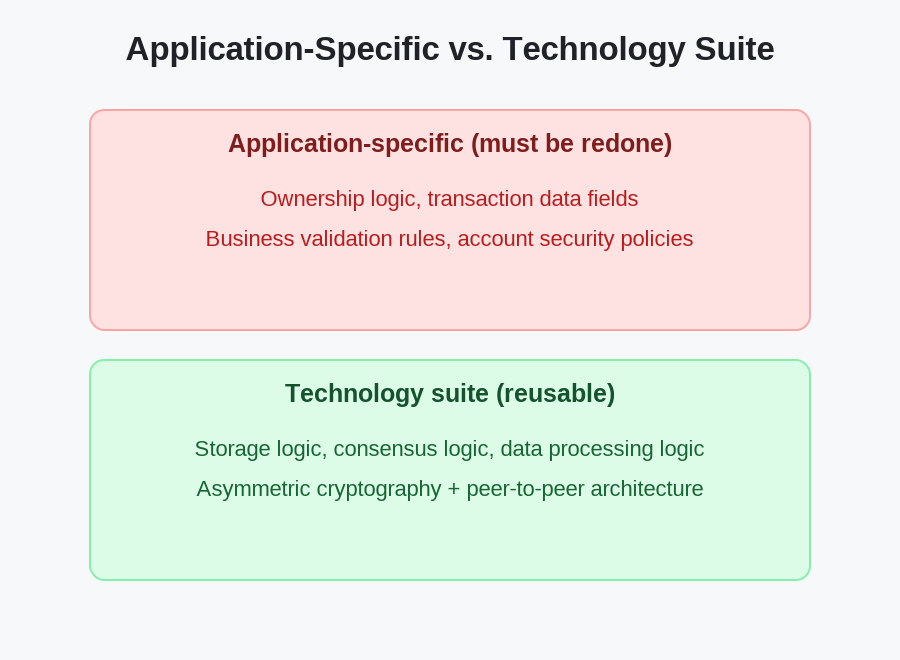
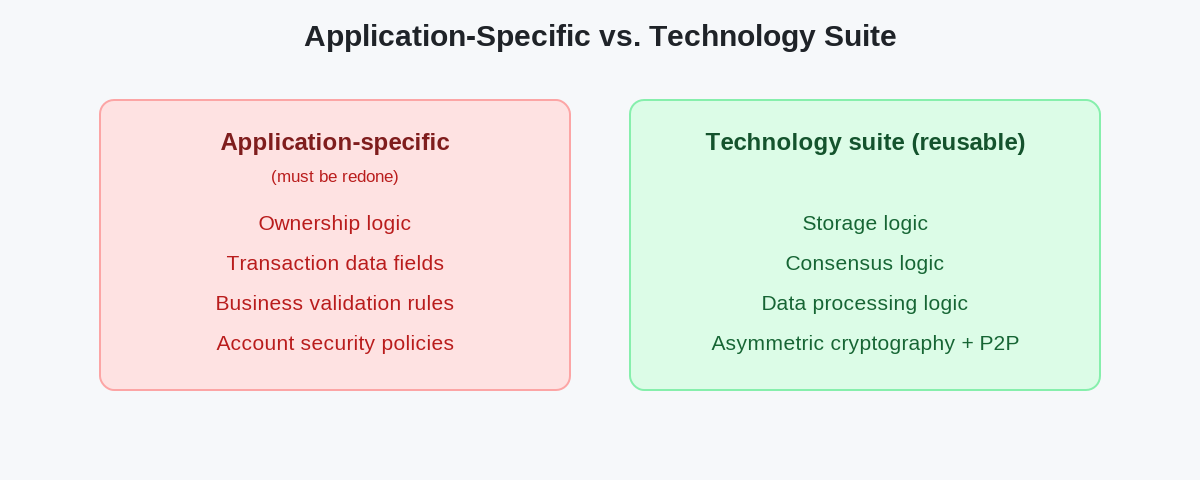
3.5 Which Components Are Application-Specific
Application-specific components usually have to be redesigned when the application goal changes. They include:
- Ownership logic: what this application actually manages, and how ownership is defined.
- Transaction data: which fields a transaction carries, and what asset they represent.
- Transaction processing logic: especially the validation rules for transaction data, because business rules vary from one application to the next.
- Transaction security: how identity, authentication, authorization, and signatures connect to the specific account system.
These parts decide "what this blockchain is actually managing."
3.6 Which Parts Form the Application-Agnostic Technology Suite
Application-agnostic components can serve many application goals. They include:
- Storage logic: tamper-resistant, append-only data storage.
- Consensus logic: how nodes settle on the same history.
- Data processing logic: general-purpose flows like validating block headers, competition, and peer control.
- Asymmetric cryptography: the basic tools of keys, signatures, and hashing.
- A purely distributed peer-to-peer architecture: independent nodes, the network, and gossip propagation.
Of these, storage logic, consensus logic, data processing logic, and asymmetric cryptography together make up the reusable blockchain technology suite. The peer-to-peer architecture is also application-agnostic infrastructure, but it's usually discussed on its own.
3.7 Why the Distinction Matters
Splitting the components into these two groups has two practical benefits.
First, you know what you can reuse. To build another application on a blockchain, you don't have to reinvent storage, consensus, cryptography, or peer-to-peer propagation from scratch. Those general-purpose parts carry over.
Second, you know what you have to redo. Ownership definitions, transaction fields, business validation rules, and account security policies have to be redesigned for the new application. You can't just copy them over.
That's also why blockchains can serve currencies, bills, identity, registries, auditing, and more: the general-purpose suite stays the same, and the application-layer logic changes.
3.8 What Happens When a Component Fails
Once you've taken the whole thing apart, you should also be able to answer this: if a component breaks, what happens to the system? That's more useful than memorizing component names.
| Failed component | Common symptoms | Possible consequences |
|---|---|---|
| Transaction security fails | Signatures forged, identities impersonated | Unauthorized transfers; ownership hijacked |
| Ownership logic fails | Business rules defined incorrectly | Transaction semantics wrong; ledger records don't match real rights |
| Storage logic fails | Hash references broken, data altered | History inconsistent; audit trail untrustworthy |
| Peer-to-peer propagation fails | Messages widely lost or delayed | Some nodes miss new transactions and blocks; more forks |
| Validation and competition fail | Invalid blocks accepted | Junk data enters the ledger; integrity damaged |
| Consensus logic fails | Nodes can't converge on one chain | The ledger forks permanently; users can't determine the truth |
The table shows that integrity isn't the work of any one component. Many components maintain it together. If any critical component fails, the system can come under threat from a different direction.
3.9 The Big Picture
Put it all together, and here's how to think about a blockchain:
- Application goals: stating ownership and transferring ownership.
- Non-functional goals: openness, reliability, security, eventual consistency, and integrity.
- Implementation components: ownership logic, transaction security, transaction processing, storage, peer-to-peer architecture, and consensus.
- General-purpose techniques: hashing, hash references, digital signatures, hash puzzles, gossip, rewards and penalties, and the longest chain / heaviest chain criteria.
This lesson doesn't add new knowledge. It puts everything you've learned back into one picture.
4. Diagrams
Figure 3-7-1: The Overall Blockchain Architecture
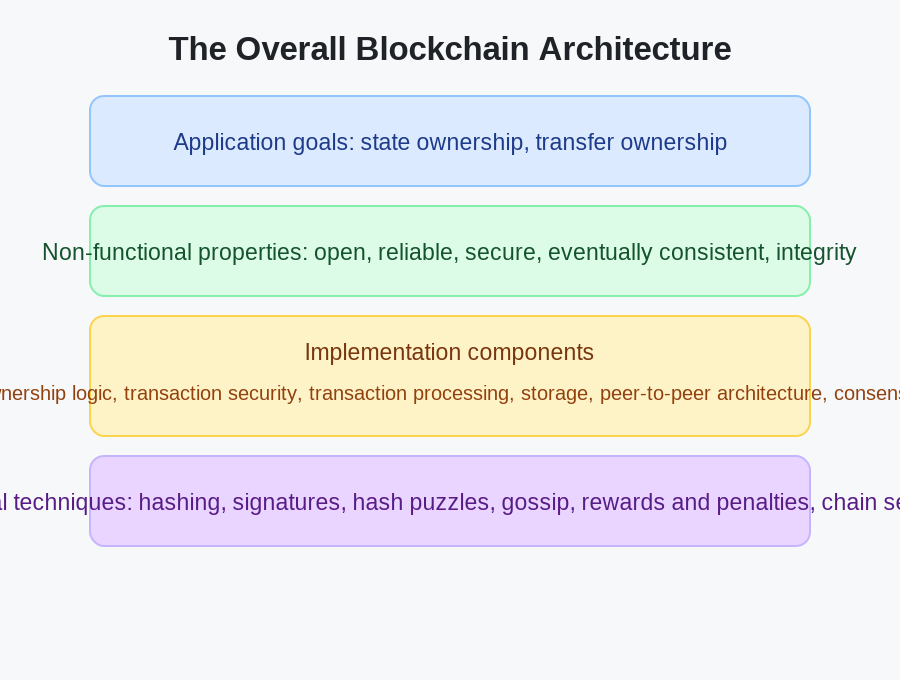
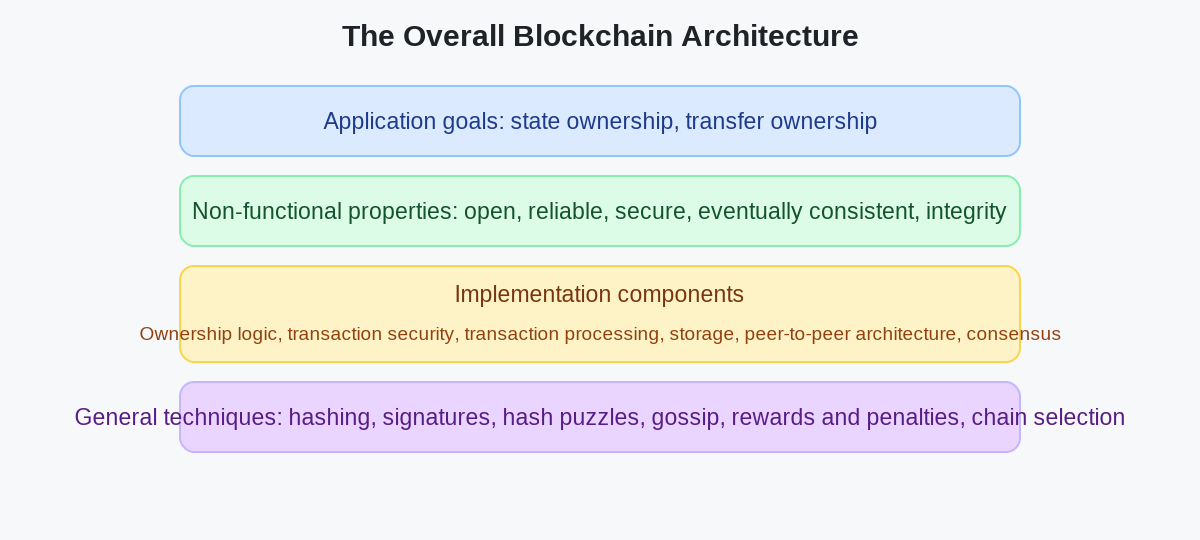
Figure 3-7-2: Application-Specific Components vs. the Technology Suite
5. Key Takeaways
- A blockchain isn't one single technology. It's a set of concepts and components that depend on each other.
- The application layer does two things: it states ownership and transfers ownership.
- Non-functional properties include high availability, censorship resistance, reliability, openness, pseudonymity, security, resilience, eventual consistency, and integrity.
- The implementation layer has six components: ownership logic, transaction security, transaction processing, storage, peer-to-peer architecture, and consensus.
- Application-specific components include ownership logic, transaction data, transaction validation rules, and transaction security policies.
- The application-agnostic parts are the technology suite and the peer-to-peer architecture. The suite covers storage, consensus, data processing, and asymmetric cryptography.
- Why the distinction matters: you know what you can reuse and what you have to redo for a new application.
- Many components maintain integrity together. If any critical component fails, the system can be at risk.
6. Quiz
Part 1: Single Choice (1–4)
Question 1
What are the two core functions of a blockchain's application layer?
A. Stating ownership and transferring ownership
B. Encrypting images and compressing videos
C. Generating private keys and deleting public keys
D. Designing web pages and laying out articles
Show answer
Answer: A
Explanation: The application layer is in charge of stating and transferring ownership. The other options have nothing to do with a blockchain's core functions.
Question 2
Which of these is closest to an "application-specific component"?
A. Hash functions
B. Transaction data fields and business validation rules
C. The peer-to-peer network
D. Gossip propagation
Show answer
Answer: B
Explanation: Transaction fields and business validation rules are closely tied to the application goal. Hashing, the peer-to-peer network, and gossip are more general-purpose.
Question 3
What does the blockchain technology suite usually include?
A. Storage logic, consensus logic, data processing logic, and asymmetric cryptography
B. Menus, purchasing, and pricing
C. Operating systems and office software
D. Photo editing and video cutting
Show answer
Answer: A
Explanation: The technology suite covers storage, consensus, data processing, and asymmetric cryptography. Menus, operating systems, and photo editing aren't part of it.
Question 4
If consensus logic fails, what's the most likely consequence?
A. Nodes can't converge on one chain, and the ledger forks permanently
B. All transactions automatically become valid
C. Private keys are automatically published
D. Block sizes automatically grow
Show answer
Answer: A
Explanation: When consensus fails, nodes can't converge on one chain, and the ledger may fork permanently. The other options have nothing to do with consensus.
Part 2: Multiple Choice (5–7)
Question 5
Which of these are non-functional properties of a blockchain?
A. High availability
B. Openness
C. Security
D. Eventual consistency
Show answer
Answer: A, B, C, D
Explanation: High availability, openness, security, and eventual consistency are all non-functional properties of a blockchain.
Question 6
Which of these are main components of the implementation layer?
A. Ownership logic
B. Transaction security
C. Storage logic and consensus logic
D. Peer-to-peer architecture
Show answer
Answer: A, B, C, D
Explanation: Ownership logic, transaction security, storage logic, consensus logic, and the peer-to-peer architecture are all implementation-layer components.
Question 7
Which statements about the application-agnostic parts are correct?
A. General-purpose technology can serve different applications
B. The technology suite can be reused
C. Application-layer business rules don't need any changes either
D. The peer-to-peer architecture is application-agnostic infrastructure
Show answer
Answer: A, B, D
Explanation: General-purpose technology can be reused, and the peer-to-peer architecture is application-agnostic. C is wrong because application-layer business rules usually have to be redesigned.
Part 3: True or False (8–9)
Question 8
True or false: a blockchain's integrity comes from the storage logic alone and has nothing to do with the other components.
Show answer
Answer: False
Explanation: Many components maintain integrity together, including storage, consensus, transaction processing, and cryptography.
Question 9
True or false: the same blockchain technology suite can serve different applications, but the application-layer logic has to be designed for the specific goal.
Show answer
Answer: True
Explanation: The technology suite can be reused, but the application-layer logic has to be designed for the specific goal.
Part 4: Scenario Analysis (10)
Question 10
A team already has a blockchain technology suite and now wants to adapt it from a "digital points" application to a "property registry" application.
Answer the following:
- Which parts can they mostly reuse?
- Which parts have to be redesigned?
- Why can't they just copy the transaction rules for points over to a property registry?
Show answer
Answer:
- They can reuse the storage logic, consensus logic, data processing logic, asymmetric cryptography, and the peer-to-peer architecture.
- They have to redesign the ownership logic, transaction data fields, business validation rules specific to property, and account security policies.
- A property registry involves business rules about title, area, location, mortgages, and co-ownership, and the balance-and-transfer rules for points can't cover those. Copying them over as is would cause semantic errors and integrity problems.