
A Blockchain Primer › Module 3 › Lesson 3.5
Lesson 3.5: Who Can Read, and Who Can Write? — Choosing Among the Four Types of Blockchain
- #1. The Core Question
- #2. An Everyday Analogy
- #3. Core Concepts Explained
- #4. Diagrams
- #5. Key Takeaways
- #6. Quiz
Until now, these lessons assumed a fully open blockchain that anyone can join. But in the real world, transparency and privacy, security and speed often pull against each other. This lesson looks at how limiting "who can read" and "who can write" produces four types of blockchain.
1. The Core Question
Are all blockchains the same? Why can anyone read and write on some, while others only let designated organizations do it?
This lesson answers two questions: How do read access and write access combine into four types of blockchain? And which core properties change when you restrict access?
The short version: Read access decides public vs. private. Write access decides permissionless vs. permissioned. Cross the two axes, and you get four types.
2. An Everyday Analogy
A Notice Board and a Members' Club
You can design a notice board in two ways:
- Anyone can look, and anyone can post. That's public and permissionless.
- Only members can look, and only administrators can post. That's private and permissioned.
You can also mix them:
- Anyone can look, but only administrators can post.
- Only members can look, but every member can post.
Blockchains work the same way. "Who can read" and "who can write" are two separate questions, and you shouldn't lump them together.
Transparency and Privacy, Security and Speed
A public notice board is easy for everyone to check, but it offers no privacy. A members-only board is more private, but outsiders can't audit it.
Letting everyone post means lots of participation, but you need extra mechanisms to keep out junk. Letting only administrators post is fast and keeps quality in check, but it concentrates power.
These are exactly the two tensions blockchains face.
3. Core Concepts Explained
3.1 Tension One: Transparency vs. Privacy
To establish ownership and prevent double-spending, a blockchain needs nodes to be able to inspect the full transaction history. The more transparent it is, the easier it is to audit. But public transaction details also leak private information.
This tension comes down to read access: who's allowed to read the ledger.
3.2 Tension Two: Security vs. Speed
A blockchain protects its history with hash puzzles. The higher the difficulty, the more secure it is, but writing also gets slower and more expensive.
This tension comes down to write access: who's allowed to validate transactions, create blocks, and write to the ledger.
3.3 Read Access: Public vs. Private
A public blockchain opens read access and the right to create transactions to all users or nodes.
A private blockchain limits read access and the right to create transactions to a pre-selected group of users or nodes. A central organization or a consortium picks that group.
3.4 Write Access: Permissionless vs. Permissioned
A permissionless blockchain opens write access to everyone. Any user or node can validate transactions, create blocks, and take part in consensus.
A permissioned blockchain grants write access only to pre-selected nodes or users that have passed onboarding. Only this group can validate transactions, add blocks, and take part in consensus.
3.5 The Four Combinations
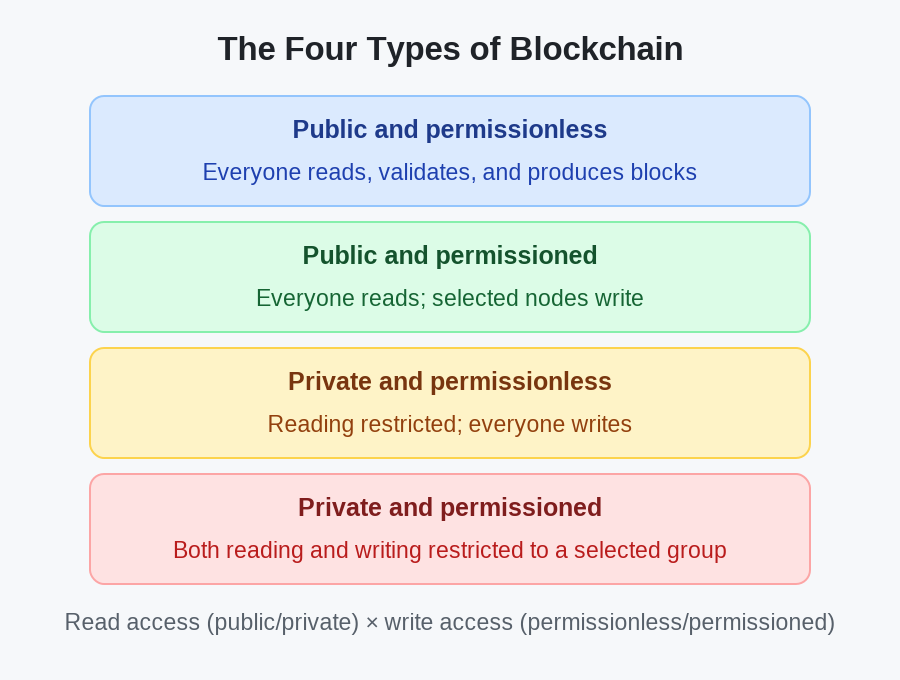
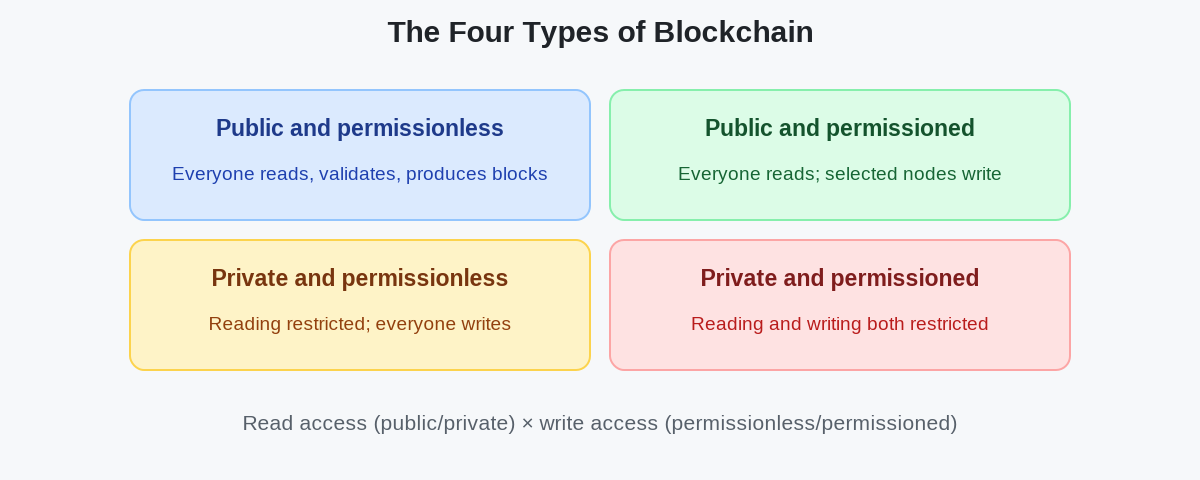
You can choose read access and write access separately, which gives you four types:
| Read access: everyone | Read access: restricted group | |
|---|---|---|
| Write access: everyone | Public and permissionless | Private and permissionless |
| Write access: restricted group | Public and permissioned | Private and permissioned |
- Public and permissionless: anyone can read, validate, and produce blocks. This is the type the earlier lessons assumed.
- Private and permissionless: reading is restricted, but anyone can write.
- Public and permissioned: everyone can read, but only selected nodes can write.
- Private and permissioned: both reading and writing are restricted. It's the most closed type.
People often see private and permissioned as the best fit for business, because it processes faster and can hide transaction data. But it's also the furthest from "open and purely distributed."
3.6 Consequence One of Restricting Access: Peer-to-Peer Equality Breaks Down
One important feature of a peer-to-peer system is that nodes are equal in rights and roles, with the same functions and responsibilities.
If some nodes can read and write while others can't, the nodes aren't equals anymore. The system may still have network connections, but it's no longer a peer-to-peer network in the original sense.
3.7 Consequence Two of Restricting Access: The Distributed Nature Weakens
If a central organization or consortium hands out read or write access, then a center holds the rules about "who gets to participate."
The system may still be distributed on the inside, but to outside nodes it acts like a centralized system, or it has a hidden center inside. Either way, it turns into more of a "distributed + centralized" hybrid.
3.8 Consequence Three of Restricting Access: The System's Purpose Shifts
Blockchain was first designed to solve this problem: how do you maintain integrity in an open peer-to-peer system where you don't know how many nodes there are or whether they can be trusted?
If only vetted, trusted nodes that passed onboarding get write access, the environment isn't "completely unknown and completely untrusted" anymore. Part of blockchain's purpose, "building trust among strangers," changes.
3.9 Why a Blockchain Still Makes Sense in a Restricted Setting
Even when you know how many nodes there are and how trustworthy they are, a blockchain is still worth having, because:
- Nodes can change when they fail or go offline.
- Network communication can still lose, delay, or reorder messages.
- Onboarding can't guarantee that nodes are 100% trustworthy.
- Even trusted nodes can produce wrong results because of technical failures.
So the purpose of blockchain can be broadened to achieving and maintaining integrity in all kinds of distributed systems, not just fully open, fully unknown environments.
3.10 How to Choose Among the Four Types
Start with two questions:
- Who needs to read the ledger? Everyone, or a specific group?
- Who needs to write to the ledger? Everyone, or only nodes that have passed onboarding?
If you need public auditing and maximum openness, lean toward public and permissionless.
If you need privacy, speed, and control over who participates, private and permissioned may be the way to go.
If you need anyone to be able to inspect the ledger but want writing kept under control, choose public and permissioned.
If reading has to be restricted but you want lots of participants writing, choose private and permissionless.
4. Diagrams
Figure 3-5-1: The Two Tensions and Read/Write Access
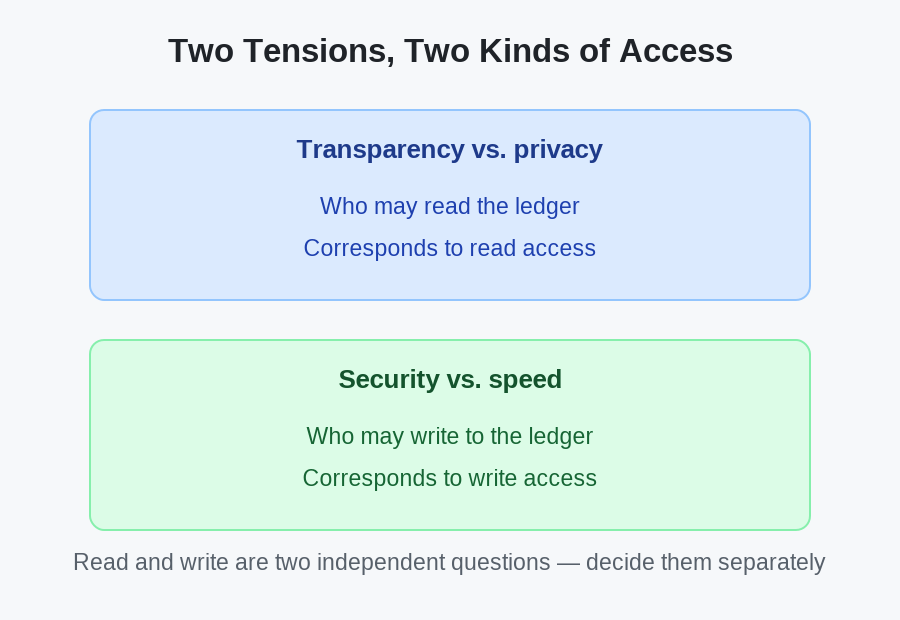
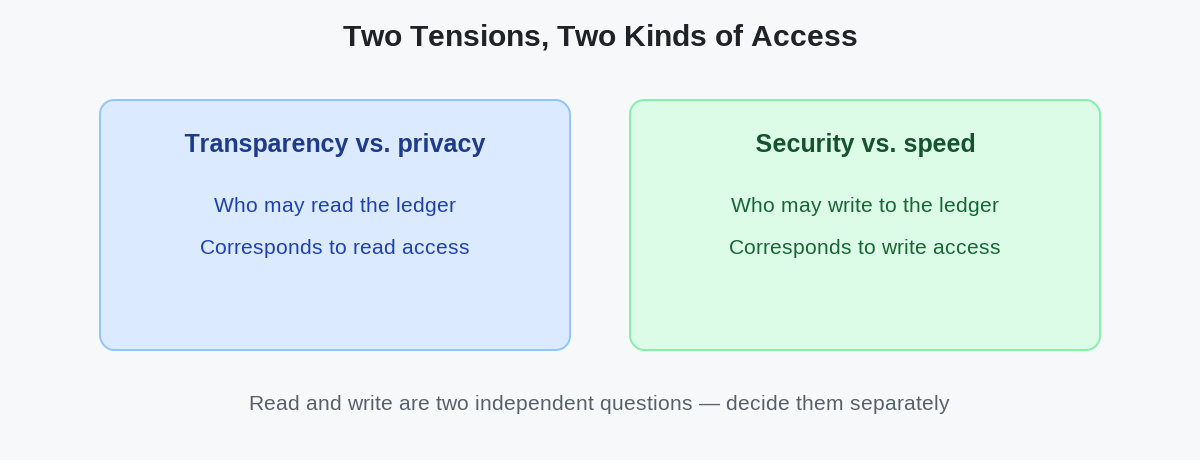
Figure 3-5-2: The Four Types of Blockchain
5. Key Takeaways
- Transparency vs. privacy comes down to read access. Security vs. speed comes down to write access.
- A public blockchain opens reading and transaction creation to everyone. A private blockchain limits them to a selected group.
- A permissionless blockchain opens write access to everyone. A permissioned blockchain grants it only to nodes that passed onboarding.
- The two axes combine independently into four blockchain types.
- Public and permissionless comes closest to the blockchain the earlier lessons assumed.
- Private and permissioned is the most closed type and usually fits businesses that care most about privacy and speed.
- Restricting read and write access breaks node equality, weakens the distributed nature, and shifts the system's purpose.
- A blockchain is still worth having in restricted settings, because failures, network problems, and mistakes by trusted nodes still happen.
6. Quiz
Part 1: Single Choice (1–4)
Question 1
Which kind of access does the "transparency vs. privacy" tension mainly correspond to?
A. Read access
B. Write access
C. Private key length
D. Block size
Show answer
Answer: A
Explanation: Transparency vs. privacy depends on who can read the ledger, so it corresponds to read access.
Question 2
Which kind of access does the "security vs. speed" tension mainly correspond to?
A. Read access
B. Write access
C. Users' names
D. Image formats
Show answer
Answer: B
Explanation: Security vs. speed depends on who's allowed to write, validate, and produce blocks, so it corresponds to write access.
Question 3
What does a public and permissionless blockchain mean?
A. Everyone can read, and everyone can validate and produce blocks
B. Only administrators can read and write
C. Everyone can read, but only administrators can write
D. Only members can read and write
Show answer
Answer: A
Explanation: Public and permissionless means reading, validating, and producing blocks are all open to everyone.
Question 4
What's the defining feature of a private and permissioned blockchain?
A. Both reading and writing are open
B. Both reading and writing are restricted to a selected group
C. Everyone can read, but only selected nodes can write
D. Everyone can write, but only selected nodes can read
Show answer
Answer: B
Explanation: Private and permissioned limits both reading and writing to a selected group, which makes it the most closed type.
Part 2: Multiple Choice (5–7)
Question 5
Which statements about public and private blockchains are correct?
A. A public blockchain opens reading and transaction creation to everyone
B. A private blockchain limits reading and transaction creation to a selected group
C. A private blockchain definitely has no nodes
D. A public blockchain definitely has no privacy issues
Show answer
Answer: A, B
Explanation: Public vs. private is mainly about read access and the right to create transactions. C and D go too far. Private chains still have nodes, and public chains can still have privacy issues.
Question 6
Which statements about permissionless and permissioned blockchains are correct?
A. A permissionless blockchain opens write access to everyone
B. A permissioned blockchain lets only selected nodes validate and produce blocks
C. A permissioned blockchain usually requires onboarding
D. A permissionless blockchain needs no validation at all
Show answer
Answer: A, B, C
Explanation: Permissionless opens write access to everyone, and permissioned limits it to nodes that passed onboarding. D is wrong because permissionless systems still require validation.
Question 7
What can happen when you restrict read and write access?
A. Nodes are no longer fully equal
B. The distributed nature may weaken
C. The problem the blockchain solves changes
D. All nodes automatically become more trustworthy
Show answer
Answer: A, B, C
Explanation: Restricting access breaks equality, weakens the distributed nature, and shifts the system's purpose. D is wrong because restrictions don't automatically make every node trustworthy.
Part 3: True or False (8–9)
Question 8
True or false: a public blockchain has to be permissionless, and a private blockchain has to be permissioned.
Show answer
Answer: False
Explanation: Read access and write access are two independent axes. A public chain can have permissioned writing, and a private chain can have permissionless writing.
Question 9
True or false: even when nodes have passed onboarding, a blockchain is still worth having for maintaining integrity in a restricted setting.
Show answer
Answer: True
Explanation: Onboarding can't guarantee 100% trustworthiness, and failures and network problems still happen, so a blockchain is still worth having.
Part 4: Scenario Analysis (10)
Question 10
A consortium of five banks wants to share one ledger. Only consortium members can read it, and only member nodes that passed the consortium's onboarding can write to it and produce blocks.
Answer the following:
- Which combination of read access and write access is this?
- Which of the four types does it match most closely?
- What openness and distributed properties does this choice give up?
Show answer
Answer:
- Reading is limited to consortium members, and writing is limited to member nodes that passed onboarding, so it's private and permissioned.
- It matches a private and permissioned blockchain most closely.
- It gives up public readability, open participation in writing, and equal rights for nodes. The consortium's centralized admission rules also weaken its distributed nature.