
A Blockchain Primer › Module 3 › Lesson 3.6
Lesson 3.6: Consensus Beyond Mining — From PoW to PoS and PoA
- #1. The Core Question
- #2. An Everyday Analogy
- #3. Core Concepts Explained
- #4. Diagrams
- #5. Key Takeaways
- #6. Quiz
The consensus we've covered so far relies mainly on proof of work: whoever solves the hash puzzle first gets a shot at producing the block. But mining burns electricity and tends to concentrate computing power. This lesson looks at another approach: swapping "burning computing power" for "putting assets on the line."
1. The Core Question
A consensus mechanism has several jobs. It has to make block production costly, make the block producer random and unpredictable, reward honesty, and punish cheating. Proof of work does all of this with computing power. Could a different resource do the job with less electricity?
This lesson answers three questions: How does proof of stake work? How is it fundamentally different from proof of work? And what other consensus mechanisms are out there?
The short version: Consensus mechanisms can "vote" with different scarce resources: computing power, assets, disk space, time, or reputation. PoS swaps burning computing power for staking crypto assets.
2. An Everyday Analogy
A Party Raffle
Picture a party that sells 100 raffle tickets at $10 each. The winner gets to pick the next song and take home a prize.
If one guest buys 75 tickets, they have about a 75% chance of getting drawn, so they end up picking the music almost every time. Understandably, the other guests aren't happy. The host ends up redistributing the tickets and limiting everyone to two.
The story shows a few things:
- When "how many tickets you hold" decides your chance of being picked, concentrated wealth turns into concentrated power over block production.
- How the tickets are first handed out, and the per-person cap, both directly affect fairness.
- A raffle by itself isn't enough. You also need rules that keep one person from controlling most of the tickets.
Proof of stake is exactly this kind of "on-chain raffle." The staked crypto assets are the raffle tickets, and the more you stake, the better your chance of being picked as a validator.
3. Core Concepts Explained
3.1 The Five Steps of Proof of Stake
Step one: staking. A node that wants to take part in block production buys "raffle tickets" with the chain's native cryptocurrency. In other words, it stakes assets. It can stake multiple tickets, and the more it stakes, the better its chance of getting picked, usually.
Step two: validator selection. The system draws one ticket at random, and its owner becomes this round's validator, with the right to submit a new block. The drawn ticket comes out of the pool and can't be used again.
Step three: block creation. The validator creates a new block that contains valid transactions and references a valid previous block.
Step four: block validation. The other nodes check whether the block and its transactions are valid in form, semantics, and authorization.
Step five: block finalization. Nodes vote on the block. Once it gets enough votes, the block is accepted and becomes part of the authoritative chain. Then the process goes back to step two for the next round.
3.2 Rewards
After submitting a correct block, a validator can receive:
- The transaction fees from the transactions in the block.
- A refund of what it paid for the staked ticket.
Rewards are usually locked up for a while. They're only fully released once enough later blocks are stacked on top and the block's confirmation is stable. That way, a cheater can't grab the reward and run.
3.3 Penalties
Penalties come in economic and non-economic forms.
Economic penalties:
- Withholding rewards.
- Slashing part of the staked assets.
Non-economic penalties:
- Kicking the node out of the consensus process, so it can't take part in block production or voting anymore.
If a block gets rejected during validation, doesn't win a majority of votes, or turns out to be wrong during the lock-up period, the staked assets may get slashed.
3.4 The Key Differences Between PoS and PoW
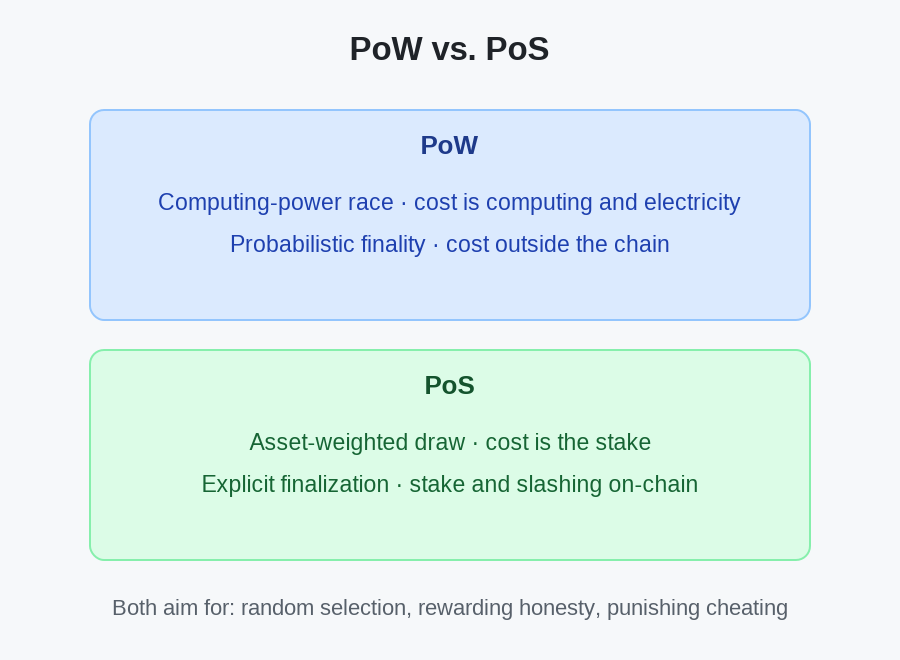
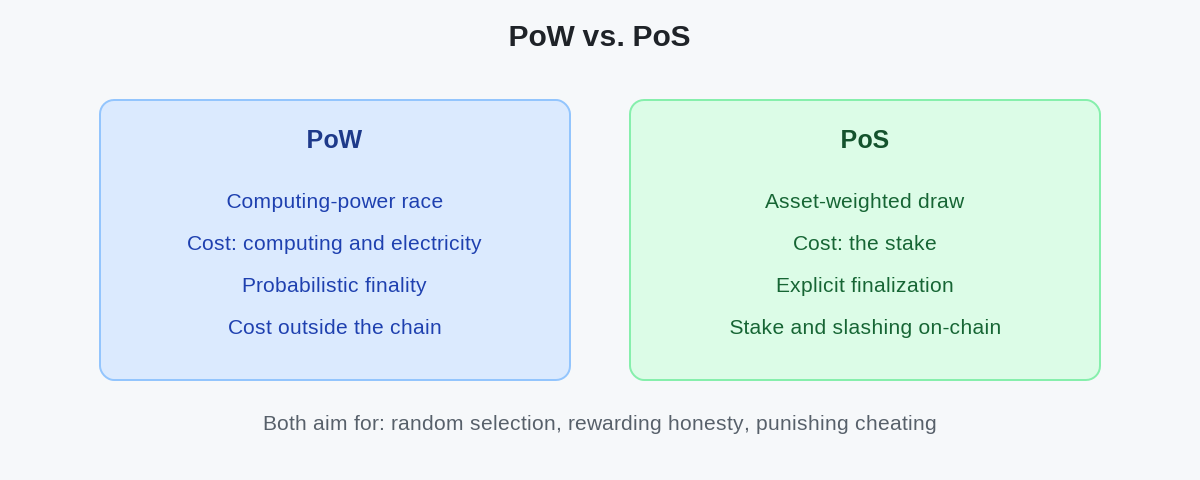
How the block producer is chosen.
- PoW: everyone races to solve the hash puzzle, and the first to solve it produces the block.
- PoS: a random draw weighted by staked assets, and whoever gets drawn produces the block.
Where the cost of block production comes from.
- PoW: the cost is computing power and electricity.
- PoS: the cost is the staked crypto assets.
Where tamper resistance comes from.
- PoW: from computing costs outside the chain.
- PoS: from staked assets inside the chain. Cheat, and you lose your deposit.
How finalization works.
- PoW: probabilistic finality. The more blocks stacked after a block, the lower the chance it gets replaced, but in theory a longer chain could always show up.
- PoS: explicit finalization. Once the voting threshold is reached, the block counts as final and can't be reversed.
3.5 The Problems with PoS
Self-reference. The system manages a currency it created itself, pays rewards in that same currency, and requires you to hold that currency to join consensus. The whole loop is more closed off.
Initial distribution. When a new chain launches, who gets the currency and how much directly decides who holds block-production power. It's hard to verify whether lots of addresses really means lots of independent, honest users.
Monopolization. The more you hold, the more likely you are to get picked. The more rewards you earn, the more you hold. It's a "rich get richer" loop.
Security concerns. Someone with large holdings can better absorb the loss of getting caught cheating. PoS also carries some manipulation risks that PoW doesn't have, or has less often.
3.6 The Advantages of PoS
People often credit PoS with these advantages:
- Low energy use, since there are no hash puzzles to solve.
- Speed, since there's an explicit finalization step.
- Potentially more decentralized, since it doesn't rely on expensive mining rigs and data centers, so more people can take part.
- Potentially harder to attack, since a 51% attack is harder if assets are widely spread out.
But these advantages depend on the specific implementation and the initial distribution. If assets are highly concentrated, PoS can end up centralized too.
3.7 The Common Framework of Consensus Mechanisms
Whatever the mechanism, consensus design usually includes:
- Picking the block producer at random.
- Making block production cost something.
- Rewarding honest behavior.
- Punishing cheating.
- Having nodes supervise each other.
The only real difference is "which scarce resource pays the cost":
- Proof of work (PoW): processor computing power.
- Proof of stake (PoS): ownership of crypto assets.
- Proof of burn (PoB): destroying cryptocurrency.
- Proof of activity (PoAc): a mix of PoW and PoS.
- Proof of capacity (PoC): disk space.
- Proof of elapsed time (PoET): actual waiting time.
- Proof of authority (PoA): reputation, so only selected trusted parties can validate.
- Proof of importance (PoI): how important a user is to the network, based on things like assets, frequency, and transaction size.
Not every mechanism suits a public, permissionless chain. Some only fit permissioned chains.
4. Diagrams
Figure 3-6-1: The Five-Step PoS Loop
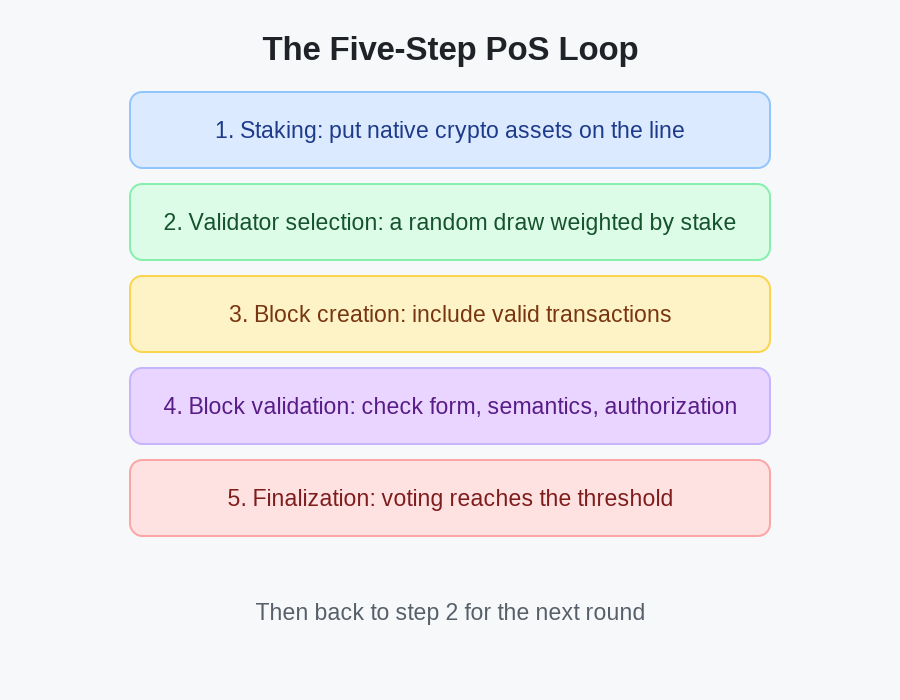
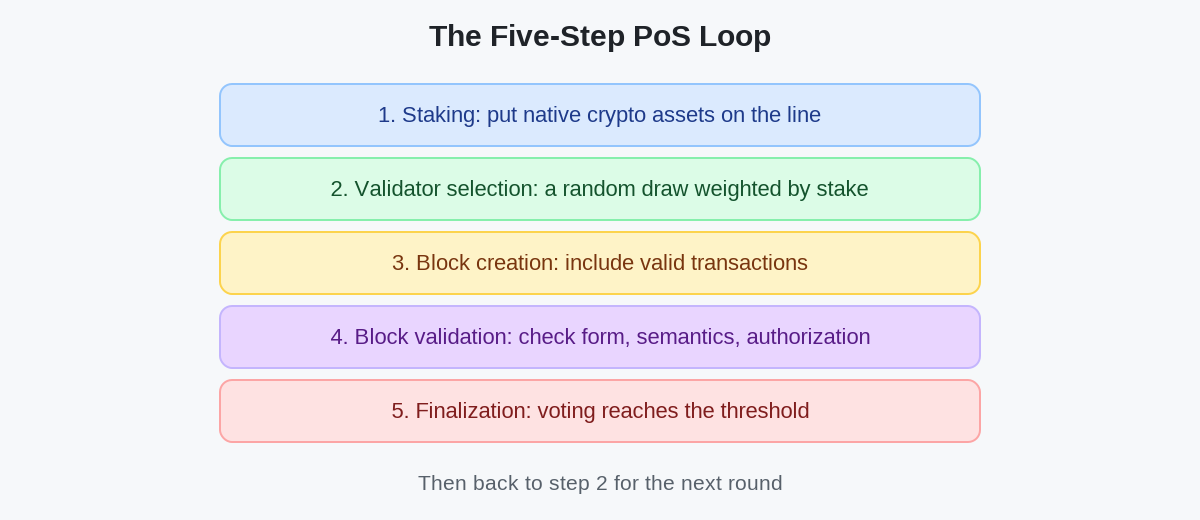
Figure 3-6-2: PoW vs. PoS
5. Key Takeaways
- PoS swaps burning computing power for staking crypto assets.
- The five PoS steps: staking, validator selection, block creation, block validation, and finalization.
- Rewards include transaction fees and the staking refund, usually with a lock-up period.
- Penalties include withholding rewards, slashing the stake, and kicking nodes out of consensus.
- PoW relies on a computing-power race. PoS relies on a draw weighted by assets.
- PoW has probabilistic finality. PoS has explicit finalization.
- PoS's problems include self-reference, initial distribution, monopolization, and security concerns.
- PoS's advantages include low energy use, speed, and potentially more decentralization and resistance to attack, but they depend on how assets are distributed.
- Other consensus mechanisms just swap in a different scarce resource, like disk space, time, reputation, or importance.
6. Quiz
Part 1: Single Choice (1–4)
Question 1
In PoS, what is "staking" closest to?
A. Buying raffle tickets, putting assets on the line for a chance to be picked
B. Deleting your own account
C. Publishing your private key
D. Increasing the block size
Show answer
Answer: A
Explanation: Staking is like buying raffle tickets: you put assets on the line for a chance to get picked. It has nothing to do with deleting accounts, publishing private keys, or making blocks bigger.
Question 2
How does PoS pick its validator?
A. Whoever has the most computing power produces the block
B. A random draw weighted by staked assets
C. Whoever is oldest produces the block
D. Whoever registers first produces blocks forever
Show answer
Answer: B
Explanation: PoS picks validators with a random draw weighted by staked assets, not a computing-power race.
Question 3
What's the main difference between PoW and PoS when it comes to finalization?
A. PoW has probabilistic finality, and PoS has explicit finalization
B. PoW never has finality
C. PoS needs no validation
D. They're exactly the same
Show answer
Answer: A
Explanation: PoW has probabilistic finality, and PoS has an explicit finalization step. Both require validation.
Question 4
What does PoS's "monopolization" problem refer to?
A. The more you hold, the more likely you are to get picked, and rewards grow your holdings even more
B. Every node has to hold identical assets
C. Only governments can produce blocks
D. Blocks can't contain transactions
Show answer
Answer: A
Explanation: The more you hold, the more likely you are to get picked. Rewards then grow your holdings, which creates a rich-get-richer loop.
Part 2: Multiple Choice (5–7)
Question 5
What can PoS penalties include?
A. Withholding rewards
B. Slashing part of the staked assets
C. Being kicked out of the consensus process
D. Automatically increasing the stake
Show answer
Answer: A, B, C
Explanation: PoS can withhold rewards, slash the stake, and kick nodes out of consensus. Automatically increasing the stake isn't a penalty.
Question 6
Which advantages do people commonly credit PoS with?
A. Low energy use
B. Speed
C. Potentially more decentralization
D. Complete independence from how assets are distributed
Show answer
Answer: A, B, C
Explanation: Low energy use, speed, and potentially more decentralization are commonly cited advantages. D is wrong because it denies that asset distribution matters at all.
Question 7
Which scarce resources might other consensus mechanisms use?
A. Disk space
B. Actual waiting time
C. Reputation
D. User importance
Show answer
Answer: A, B, C, D
Explanation: PoC uses disk space, PoET uses time, PoA uses reputation, and PoI uses importance.
Part 3: True or False (8–9)
Question 8
True or false: PoS completely eliminates the risk of centralization.
Show answer
Answer: False
Explanation: PoS can drift toward monopolization through the initial distribution and concentrated staking. It doesn't completely eliminate the risk of centralization.
Question 9
True or false: at an abstract level, every consensus mechanism needs a cost, random selection, rewards, penalties, and nodes supervising each other.
Show answer
Answer: True
Explanation: Different mechanisms only swap the scarce resource. The abstract framework is still cost, randomness, rewards, penalties, and supervision.
Part 4: Scenario Analysis (10)
Question 10
A new chain adopts PoS. The project team first hands a large share of tokens to a few addresses, then opens up staking.
Answer the following:
- Which PoS problems might this cause?
- Why does "the more you hold, the more likely you are to get picked" make concentration worse?
- What rules could ease the problem?
Show answer
Answer:
- It may lead to an unfair initial distribution, monopolization, and security concerns.
- The more you hold, the better your chance of getting picked. Rewards then grow your holdings, and the gap keeps widening.
- Possible fixes: cap the stake per address, improve the initial distribution, set fairer selection rules, and strengthen penalties and supervision.