
A Blockchain Primer › Module 1 › Lesson 1.5
Lesson 1.5: Who Owns What, and How Do You Prove It? — Ownership, Double-Spending, and Ledgers
- #1. The Core Question
- #2. An Everyday Analogy
- #3. Core Concepts Explained
- #4. Diagrams
- #5. Key Takeaways
- #6. Quiz
The last lesson split "blockchain" into four levels of meaning. This lesson turns to its most typical use: how to prove whose something is, and why the same asset can't be spent twice.
1. The Core Question
You say this camera is yours. How do you know? You say this house is yours. How do you know? And here's the harder one: if "money" is just data on a computer, can you copy it and spend it on two different people?
The short version: Proving ownership means settling three things at once: who the owner is, which object it is, and how the two are tied together. Double-spending is what happens when someone exploits a hole in that proof.
2. An Everyday Analogy
Bringing Your Own Camera into a Camera Shop
You walk into a camera shop with your own camera to buy a memory card. The clerk sees the camera in your hand, notices the same model for sale behind the counter, and suspects you took it from the store.
The shop's security camera happens to be broken, and no other customers were around at the time. How do you prove the camera is yours?
You can pull out the receipt, which shows your name, the camera model, and the serial number. Then you point to the serial number on the bottom of the camera, which matches the one on the receipt. If the clerk still isn't convinced, you can ask the other clerk, the one who sold you the camera, to vouch for you.
Three things show up in this scene:
- Your identity: who you are.
- The camera's identifier: which unit it is and what its serial number is.
- The link between the two: the receipt and the witness both point to "this camera belongs to you."
If you're the only one saying "it's mine," that's just a claim. When several independent pieces of evidence all point to the same fact, other people are far more willing to believe it.
The Same Concert Ticket Screenshot
Now flip it around. You buy an e-ticket to a concert with a QR code on it. You send a screenshot of the QR code to A and say, "I'm selling you this ticket." Then you send the same screenshot to B and say, "I'm selling you this ticket too."
If the ticketing system only checks the QR code image, A and B both hold tickets that look identical. At the entrance, both might scan as "valid." But there's only one seat in the venue.
This is the most intuitive form of copy-based double-spending: you can copy digital content almost for free, and the copy may be impossible to tell apart from the original.
Selling the Same House to Two People
Now picture a real-estate system with no central registry, where every node keeps its own copy of the ledger.
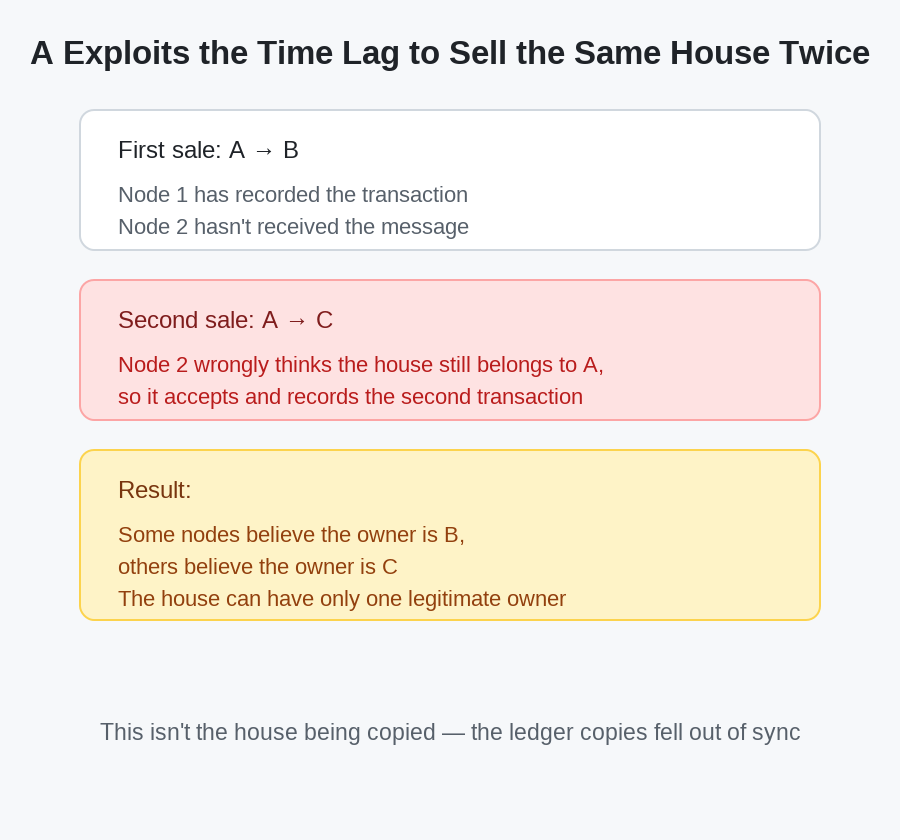
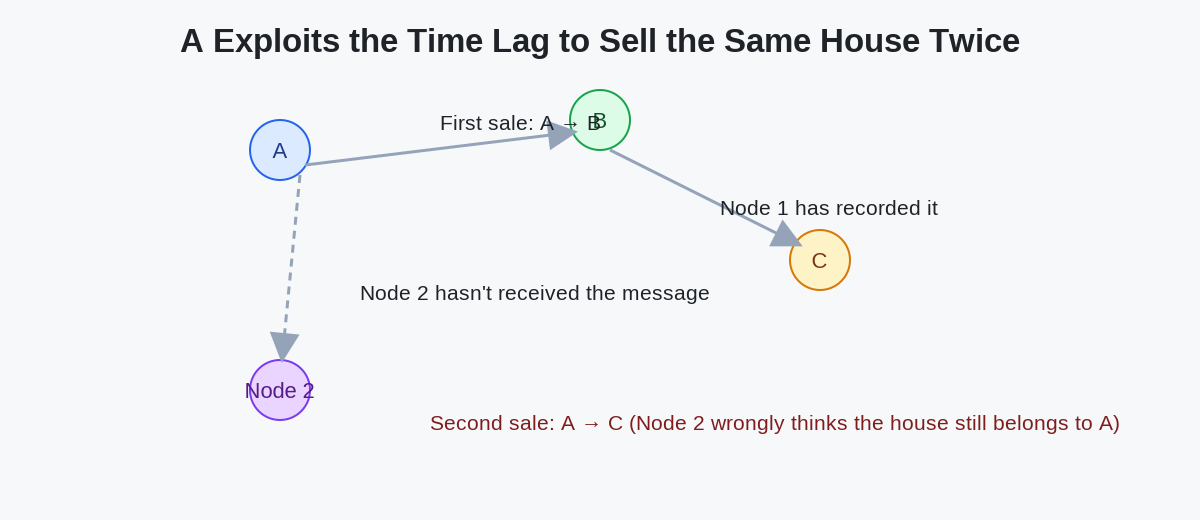
A sells a house to B, and one node records the sale. But it takes time for the news to spread across the network. A knows some nodes haven't heard yet that "the house has been sold to B," so he hurries to find another node that hasn't updated and sells the same house to C.
That second node checks its own ledger, sees that the house still belongs to A, and approves and records the sale to C. The result:
- Some nodes believe B owns the house.
- Other nodes believe C owns it.
- B and C both think they bought the house, but the house can have only one legitimate owner.
This didn't happen because the house was copied. It happened because the ledger copies fell out of sync, and A exploited that time lag.
3. Core Concepts Explained
3.1 The Three Elements of Proof of Ownership
Strip the camera story down to its bones, and proving ownership takes three things:
- Identify the owner: establish who the owner is.
- Identify the object: establish which thing is at stake.
- Establish the mapping: tie the owner to the object.
Ownership is clearly stated only when all three hold at once. Say only "I'm Alex," and you haven't said which camera. Say only "this camera is A12345," and you haven't said whose it is. Say "Alex owns A12345" without a trustworthy record, and people can still doubt you.
ID cards, birth certificates, and driver's licenses help identify owners. Serial numbers, production dates, and certificates of manufacture help identify objects. A ledger or registry keeps the mapping of who owns which object.
3.2 From Oral Witnesses to Documents, and Then to Ledgers
Historically, lots of ownership disputes were settled by witnesses speaking up. But spoken testimony has familiar problems. Memories fade, witnesses can be threatened or bought off, they may be impossible to find years later, and different witnesses may contradict each other.
So over time, society replaced spoken testimony with documents: ID cards, property deeds, patent certificates, ship registrations, vehicle registrations, and so on. Documents are stable, but they can be forged, damaged, or lost.
What actually records transfers of ownership is usually not a document that never changes. It's a ledger or registry. The ledger has to be updated with every transfer. Once it falls out of date, it can't serve as trustworthy proof anymore.
3.3 The Two Sides of a Ledger: Proof and Transfer
A ledger handles two jobs that pull in opposite directions.
The first side is reading, which proves ownership. To prove "this is mine," you look up the history: who bought it before, and how it ended up in your name. For this job, the more transparent the ledger, the better.
The second side is writing, which transfers ownership. To sell the thing to someone else, you write a new record into the ledger. This job can't be open to everyone, or anyone could write themselves in as the homeowner. Only the legitimate owner should be able to write, and only after passing identification, authentication, and authorization checks.
So the ledger has a tension built right in:
- Proving ownership needs transparency.
- Transferring ownership needs permissions.
- Reading the ledger can be open.
- Writing to the ledger has to be restricted.
Blockchain inherits the same tension. Lots of people can read the ledger data, but who gets to write the next transfer has to follow strict rules.
3.4 The Risk of a Single Ledger — and Multiple Copies
What if the whole world had only one ledger for a certain kind of asset?
- The ledger could be damaged or disappear.
- The person updating it could get things wrong.
- The person updating it could be bought off and forge records on purpose.
- The ledger could be stolen or hidden.
Once that one ledger can't be trusted, everyone who depends on it pays the price. The fix follows the same logic as a courtroom: don't rely on a single witness. Let several independent record-keepers testify together.
Copy the same ledger onto many nodes that are independent of each other, and let each node maintain its own copy. When you need to confirm ownership, go with the version most nodes agree on. That makes it much harder to destroy, alter, or buy off any single ledger.
3.5 Identification, Authentication, and Authorization Are Not the Same Thing
Ownership management often involves three security concepts that are easy to mix up:
- Identification: claiming who you are. For example, "I'm Alex."
- Authentication: proving you really are Alex. For example, showing a photo ID and having it checked.
- Authorization: deciding, based on your identity and rights, whether you're allowed to do something. For example, someone under the legal drinking age can't buy alcohol.
The usual order is: identify first, then authenticate, then make the authorization decision based on the authenticated identity. In blockchain, cryptography helps nodes prove "I control this account," which takes care of authentication and transfer authorization. The details come later.
3.6 Double-Spending: Spending the Same Asset Twice
In plain terms, double-spending means the same asset gets used twice. In digital systems, that phrase covers at least three different problems:
- The problem created by copying digital goods: data can be copied, and the copies get used as if they were separate assets.
- The problem in a distributed peer-to-peer ledger: ledger updates take time to spread, different nodes briefly see different states, and someone exploits that time lag to transfer the same thing twice.
- An example of broken integrity: multiple nodes fail to keep a consistent, correct data state.
The three levels are related, but they aren't the same thing. Solving one doesn't automatically solve the other two.
3.7 Why Copying Breaks the Rules of "Money"
Money has one basic rule: a given unit can belong to only one owner at a time.
Paper bills are hard to copy. Even counterfeiting costs something, and fakes get caught by bill validators, watermarks, and serial numbers. Digital data is different. Copying costs almost nothing, and the copy can be identical to the original file.
If a system decides whether something is money purely by what the data looks like, it will treat copies as money too. The key isn't making data impossible to copy. It's making sure the system can tell which piece of data represents the ownership that's currently valid, and which one is just a copy.
3.8 Why Distributed Ledgers Have Time Lags
In a pure distributed peer-to-peer ledger system, every node keeps a copy of the ledger. After ownership changes hands, the news has to travel across the network to the other nodes, and each node updates its copy when the news arrives.
That takes time. So at any given moment, the system might look like this:
- Node A already knows "the house was sold to B."
- Node B hasn't gotten the message yet and still thinks the house belongs to A.
- Node C has gotten only half the message, so its state is incomplete.
Whoever has the latest information can race to send conflicting transfer requests to different nodes before the others hear the news. Each node judges by the ledger in front of it, and each one may decide the request is legitimate. So the same asset gets recorded twice.
3.9 Different Levels, Different Solutions
Because double-spending means different things at different levels, there's no one-size-fits-all fix for it.
- If the problem is copying digital goods, the heart of the fix is the ownership mapping. A reliable ledger records who owns this digital asset, and only the legitimate owner can transfer it. That ledger can be centralized or distributed.
- If the problem is the time lag in a distributed ledger, you need a mechanism that lets nodes agree on the final state even when their information is out of sync. Blockchain algorithms are one of the tools built for exactly this kind of system.
- If the problem is integrity in general, blockchain is just one tool, not the only answer. Whether to use it depends on what the specific application is trying to do and what constraints it faces.
3.10 How Blockchain Relates to Ownership
Here's how everything above connects to blockchain:
- The ledger each node maintains can be seen as a blockchain data structure that holds ownership records.
- Many nodes each keep a copy, which forms a pure distributed peer-to-peer system.
- Blockchain algorithms get these nodes to agree on the current ownership state.
- Cryptography handles identification, authentication, authorization, and data security.
- The system's integrity means it can make true statements about ownership and guarantee that only legitimate owners can transfer rights.
That's why managing ownership is one of blockchain's most natural uses: it brings identity, object identifiers, ledger records, and transfer authorization together in one system.
4. Diagrams
Figure 1-5-1: The Three Elements of Proof of Ownership
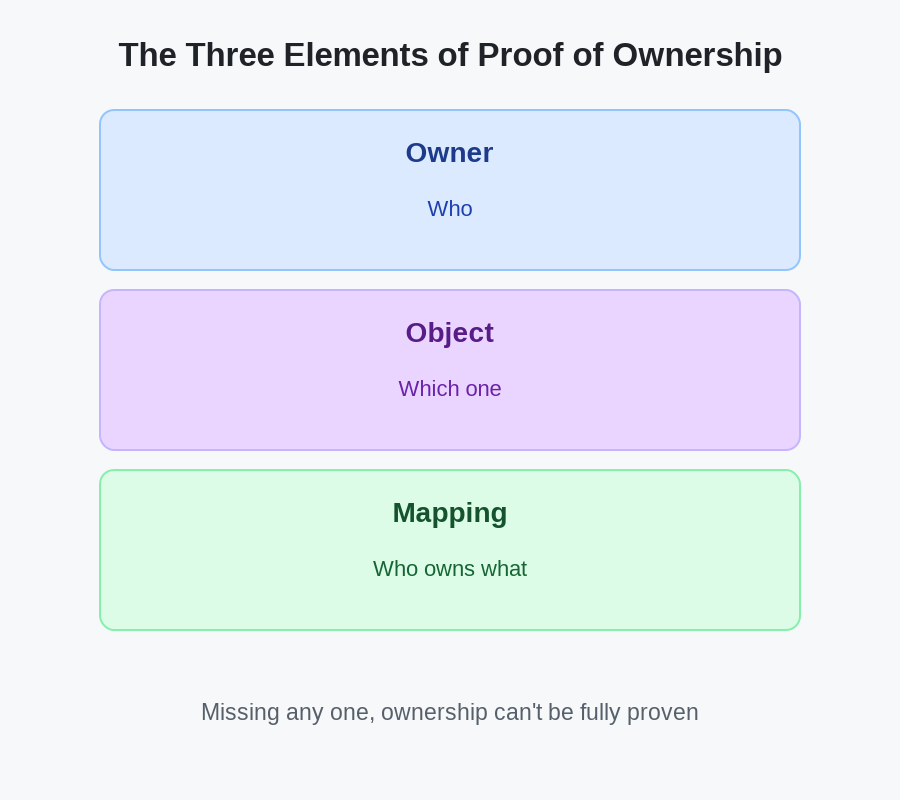
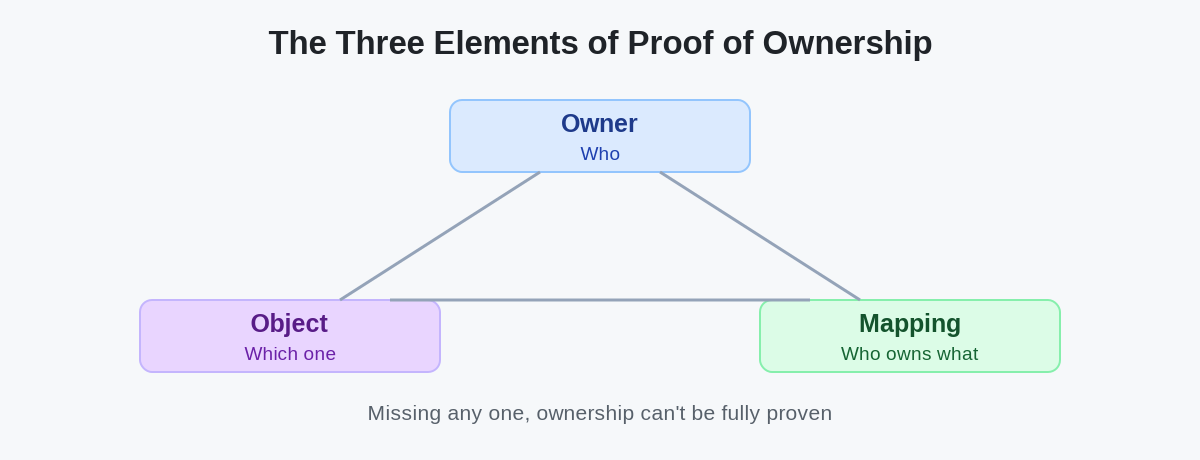
Figure 1-5-2: The Time Lag Behind Double-Spending
5. Key Takeaways
- Proof of ownership takes three elements: identify the owner, identify the object, and establish the mapping between them.
- A ledger has two opposite jobs: reading history to prove ownership, and writing new records to transfer it. The first leans toward transparency. The second has to be restricted.
- A single ledger can be damaged, wrong, or forged. Multiple independent copies plus majority agreement are more reliable.
- Identification is claiming who you are. Authentication is proving who you are. Authorization is deciding what you're allowed to do based on your identity.
- Double-spending means the same asset gets used twice. It can come from digital copying or from ledger copies falling out of sync.
- A reliable ownership ledger solves copy-based double-spending. The time lag in distributed ledgers needs a mechanism that lets nodes reach agreement.
- Blockchain is an important tool for solving double-spending in distributed peer-to-peer ledgers, but not every integrity problem needs blockchain to solve it.
6. Quiz
Part 1: Single Choice (1–4)
Question 1
What are the three basic elements of proof of ownership?
A. Name, address, phone number
B. The owner's identity, the object's identity, and the mapping between owner and object
C. Password, username, verification code
D. Blocks, algorithms, network
Show answer
Answer: B
Explanation: Proof of ownership has to settle three things at once: who owns it, what's owned, and how the two are tied together. Names and addresses, passwords, and block structures can't do all three on their own.
Question 2
What does "authentication" mean, most accurately?
A. Claiming who you are
B. Proving you really are the person you claim to be
C. Deciding whether you're allowed to do something based on your identity
D. Copying the ledger to multiple nodes
Show answer
Answer: B
Explanation: Authentication means proving you really are who you claim to be. Identification is only the claim, and authorization is the permission decision made after authentication, according to the rules.
Question 3
What does the most intuitive kind of "copy-based double-spending" refer to?
A. The same digital asset gets copied and then used as multiple assets
B. A computer's hard drive fails
C. Two nodes use different network cables
D. The ledger gets locked in a cabinet
Show answer
Answer: A
Explanation: Copy-based double-spending means digital content gets copied and used as multiple assets. A failed hard drive, different cables, and a locked-up ledger have nothing to do with double-spending.
Question 4
Where does the time lag behind double-spending in a distributed ledger mainly come from?
A. Digital assets come in different colors
B. Transaction information takes time to reach every node, so nodes briefly see different states
C. The number of nodes always has to be even
D. The ledger can't store text
Show answer
Answer: B
Explanation: Distributed ledgers rely on the network to spread updates. Until an update has reached everyone, different nodes may see different states. That's the time lag.
Part 2: Multiple Choice (5–7)
Question 5
Which of these can be used to identify an object?
A. Serial number
B. Production date
C. Certificate of manufacture
D. The object's price
Show answer
Answer: A, B, C
Explanation: Serial numbers, production dates, and certificates of manufacture all help identify an object. Prices change and can't pin down one specific object, so D is out.
Question 6
Which statements about reading and writing the ledger are correct?
A. Reading the ledger is commonly used to prove ownership, and the more transparent it is, the easier it is to verify
B. Writing to the ledger changes ownership, so permissions have to be restricted
C. Only the legitimate owner should have the right to transfer ownership
D. Reading and writing have exactly the same goal, so there's no need to tell them apart
Show answer
Answer: A, B, C
Explanation: Reading is for proof and writing is for transfer, and they have different goals and different permission requirements. D is wrong because it lumps reading and writing together.
Question 7
The term "double-spending" can refer to:
A. The problem created by copying digital goods
B. The time-lag problem in distributed peer-to-peer ledgers
C. An example of broken integrity
D. A way to increase hard drive capacity
Show answer
Answer: A, B, C
Explanation: Double-spending can refer to the copying problem, the time-lag problem in distributed ledgers, or an example of broken integrity. It has nothing to do with hard drive capacity.
Part 3: True or False (8–9)
Question 8
True or false: identification and authentication are the same thing, so saying your name completes authentication.
Show answer
Answer: False
Explanation: Identification is just claiming who you are. Authentication also has to prove the claim is true, for example by checking the photo on an ID card or another unique credential.
Question 9
True or false: as long as data is copied to multiple nodes, the double-spending problem goes away on its own.
Show answer
Answer: False
Explanation: Copying data to multiple nodes only gives you more copies. If the copies can't stay consistent, you may actually end up with more version conflicts.
Part 4: Scenario Analysis (10)
Question 10
A campus secondhand marketplace lets students sell electronics. Each device has a serial number, and the platform uses a distributed ledger to record ownership. One seller sells a camera to student A and then, while another node still hasn't updated, sells the same camera to student B.
Answer the following:
- Which kind of double-spending is this? Why?
- If the platform only checks who submitted the transaction and doesn't check current ownership in the ledger, what goes wrong?
- What kind of mechanism does the platform need so that every node eventually accepts the same owner?
Show answer
Answer:
- This is double-spending caused by the distributed ledger's time lag. The seller takes advantage of the fact that some nodes haven't received the first sale yet and submits a second sale to another node.
- Checking only who submitted the transaction confuses identity with ownership. Even a legitimate owner may have already transferred the asset to someone else, so the platform has to check the current ledger state and transfer permissions.
- The platform needs a mechanism that lets nodes validate transactions together and reach agreement, so it can decide which transaction is valid and get every node to accept the same ownership state. The specific rules for that decision are covered in later modules.