
A Blockchain Primer › Module 1 › Lesson 1.4
Lesson 1.4: What Is Blockchain, Really? — Four Meanings and a Working Definition
- #1. The Core Question
- #2. An Everyday Analogy
- #3. Core Concepts Explained
- #4. Diagrams
- #5. Key Takeaways
- #6. Quiz
We've already pinned down the hard problem blockchain is trying to solve: maintaining integrity in an open peer-to-peer system. But different people use the word "blockchain" to mean different things. If we don't unpack the word first, the conversations that follow can easily turn into everyone talking past everyone.
1. The Core Question
When someone says "I'm learning blockchain," they might be learning a data structure, an algorithm, a set of technologies, or an entire distributed ledger system. People use the word all four ways, but those four things don't sit on the same level.
The short version: First split "blockchain" into its four usages. Then tie them together with a working definition.
2. An Everyday Analogy
"The Gym" Can Mean Four Different Things
A friend says, "I'm going to the gym." That sentence can mean at least four things:
- He's going to that building, a place.
- He's going to do a set routine, a training program.
- He's using the treadmills, barbells, rowing machines, and so on, an equipment set.
- He belongs to an operation that includes the facility, the trainers, the classes, and the membership rules: the whole organization.
None of the four is wrong. But if you think "the gym" means only the treadmill, you miss the trainers, classes, and membership rules. If you think it means only the building, you'd assume the way people train inside doesn't matter.
"Blockchain" works the same way. It can mean how data is arranged, how programs run, how technologies fit together, or the entire distributed ledger system. Read the context first, then figure out which level the speaker means.
3. Core Concepts Explained
3.1 Usage One: A Data Structure
In computer science, a data structure is a way of organizing data, regardless of what the data actually says. It cares about where data sits, how it's grouped, how it's connected, and how you look it up.
When "blockchain" means a data structure, it means:
- Data is organized into separate blocks.
- The blocks come in a set order.
- The blocks are connected in a specific way that forms a chain.
Think of it as a book. The information isn't crammed onto one endless sheet of paper. It's written page by page. Each page has a place and a number, and the pages come in order. Turn to page 10 and you know page 9 came before it. If a page goes missing from the middle, the sequence gives it away.
But a blockchain's "pages" differ from an ordinary book's in one important way. An ordinary book keeps order with page numbers, while a blockchain links its blocks with a special numbering scheme that lets people check whether the chain is intact. Order still matters, but having an order and being linked together aren't the same thing. That special scheme gets its own lesson later.
3.2 Usage Two: An Algorithm
An algorithm is a sequence of instructions a computer can carry out. It tells the computer what to do first, what to do next, and how to handle different situations.
When "blockchain" means an algorithm, here's what it refers to: in a pure distributed peer-to-peer system where many nodes each hold a copy of the ledger, the algorithm coordinates what's in those copies so they gradually come into agreement.
It's a bit like a vote with no moderator. Everyone has a copy of the material, some people may have recorded it wrong, and some may have changed it on purpose. Nobody can hand their ballot to a central moderator. Instead, you need a set of rules that lets the majority reach a shared conclusion without a central referee.
The algorithm cares about the process: how nodes trade information, validate it, choose, and reach agreement. It isn't the data structure, and it isn't the whole system.
3.3 Usage Three: The Blockchain Technology Suite
When "blockchain" means a technology suite, it usually has three parts:
- The blockchain data structure organizes data into ordered blocks that can be linked.
- The blockchain algorithms let multiple nodes coordinate content and reach agreement.
- Cryptography and security technology protect the data and help the system check whether it's been changed.
Together, these three parts can maintain integrity in a pure distributed peer-to-peer system, whatever that system is used for. The data structure alone only tells you how data is arranged. The algorithms alone only tell you how nodes negotiate. Cryptography alone only solves part of the security problem.
The phrase technology suite puts the focus on how the parts work together, not on any single part.
3.4 Usage Four: A Distributed Ledger System
When "blockchain" means a distributed ledger system, it refers to a pure distributed peer-to-peer ledger system that uses the blockchain technology suite to maintain integrity.
In this sense, "blockchain" isn't one block, one piece of code, or one encryption algorithm. It's the whole thing: many nodes, copies of the ledger, communication rules, validation rules, and security mechanisms.
This also explains why the same word confuses people. Some point at one part and say, "This is blockchain." Others point at the whole machine and say, "This is blockchain." They're both right. They're just talking about different levels.
3.5 A Working Definition
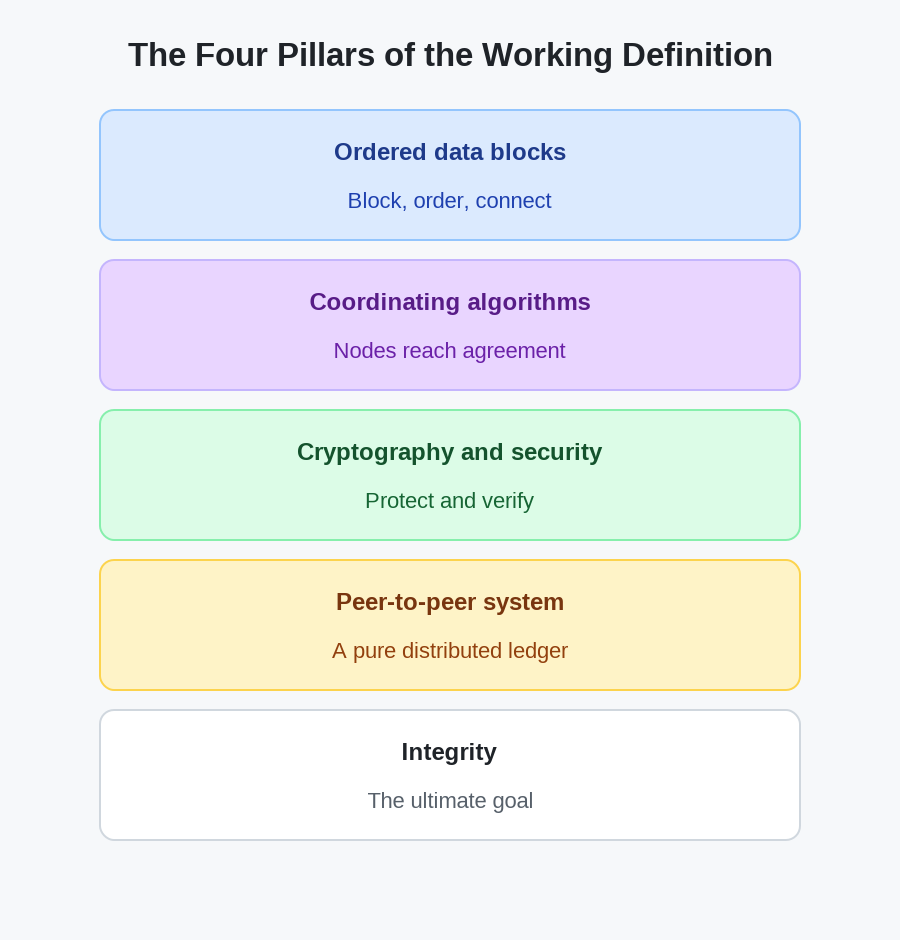
Put the four usages together and you get a working definition:
A blockchain is a pure distributed peer-to-peer ledger system. It uses algorithms to coordinate ordered, interconnected blocks of data, together with cryptography and security technology, to achieve and maintain the system's integrity.
This definition isn't complete yet. Later lessons will fill in how blocks connect, how the ledger gets updated, and how nodes reach agreement. But it already helps us draw a line. Blockchain isn't just any database, and it isn't some mysterious currency. It's a system for maintaining a ledger's integrity in an open peer-to-peer environment.
3.6 Why Ownership Management Is the Most Prominent Use
Blockchain can serve lots of purposes, but managing ownership of digital assets is the one people talk about most, for three reasons:
- It's the easiest to explain: money, tickets, real estate, memberships. Everyone understands "whose is this?"
- It was the first problem the technology tackled: if you trace who owns a digital currency, you run into, one after another, the core challenges this technology had to solve first.
- It reaches a lot of industries: banking, insurance, custody, law, registries. A huge number of businesses are, at bottom, handling ownership and the transfer of rights.
But keep this in mind: ownership management is blockchain's most prominent use, not its only use. Blockchain can also record other data that several parties need to maintain together. And in some designs, a cryptocurrency isn't just something built on top of the blockchain. It can become a component of the blockchain technology suite itself.
4. Diagrams
Figure 1-4-1: The Four Levels of Meaning of Blockchain
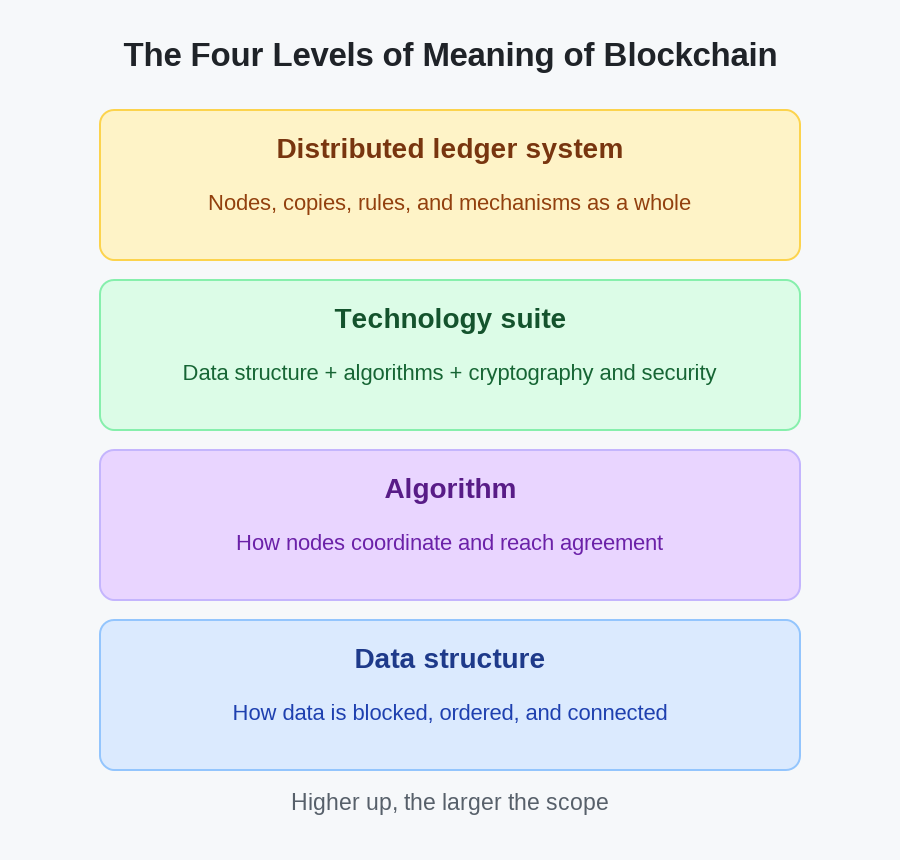
Figure 1-4-2: The Four Pillars of the Working Definition
5. Key Takeaways
- "Blockchain" has at least four usages: a data structure, an algorithm, a technology suite, and a complete distributed ledger system.
- The data structure is about how data is split into blocks, ordered, and connected. The algorithms are about how multiple nodes coordinate and reach agreement.
- The technology suite is the combination of the data structure, the algorithms, and cryptography and security technology, not any one part on its own.
- As a whole system, blockchain is a pure distributed peer-to-peer ledger system that uses the technology suite to maintain integrity.
- Ownership management is the most prominent use and the easiest to understand, but it isn't the only one.
- When you talk about blockchain, asking "Which level do you mean?" up front can save you a lot of pointless arguing.
6. Quiz
Part 1: Single Choice (1–4)
Question 1
When "blockchain" means a data structure, what is its most essential feature?
A. It has to use a digital currency
B. Data is organized into ordered, interconnected blocks
C. It can't have a central server
D. A bank has to issue it
Show answer
Answer: B
Explanation: A data structure is about how data is split into blocks, ordered, and connected. A makes "uses a digital currency" the definition, C makes "has no center" the definition, and D makes "who issues it" the definition. None of those is part of what defines a data structure.
Question 2
What is the "blockchain algorithm" mainly concerned with?
A. What color the blocks are displayed in
B. How multiple nodes coordinate data content and reach agreement
C. How big the computer's hard drive is
D. How web pages are laid out
Show answer
Answer: B
Explanation: Algorithms are about the process nodes use to coordinate and reach agreement. A is about how the interface looks, C is about hardware capacity, and D is about page layout. None of them involves how multiple nodes coordinate data content.
Question 3
Which of these comes closest to the "blockchain technology suite"?
A. Only the block data structure
B. Only cryptographic algorithms
C. The combination of the data structure, algorithms, and cryptography/security technology
D. A standalone central server
Show answer
Answer: C
Explanation: The technology suite is about combining the data structure, the algorithms, and cryptography and security technology. A mentions only the data structure, B mentions only cryptography, and D mistakes a central server for a blockchain system. Neither a single part nor a central server adds up to the whole suite.
Question 4
Why do we say "ownership management is blockchain's most prominent use, but not its only use"?
A. Because blockchain can only manage digital currencies
B. Because ownership is easy to understand and affects many industries, but blockchain can also record other data that several parties maintain together
C. Because ownership management doesn't need integrity
D. Because every blockchain has to issue a currency
Show answer
Answer: B
Explanation: Ownership management is easy to understand, reaches many industries, and has been a major driver of the technology's development. But blockchain doesn't serve ownership alone, and not every blockchain has to issue a currency.
Part 2: Multiple Choice (5–7)
Question 5
The word "blockchain" can refer to:
A. A data structure
B. An algorithm
C. A technology suite
D. A pure distributed peer-to-peer ledger system
Show answer
Answer: A, B, C, D
Explanation: People use the word in all four ways. What matters is which level the speaker means at the moment.
Question 6
Which statements about the working definition are correct?
A. It emphasizes a pure distributed peer-to-peer system
B. It includes ordered, interconnected blocks of data
C. It requires algorithms, cryptography, and security technology working together
D. It already covers every implementation detail
Show answer
Answer: A, B, C
Explanation: The working definition covers the system's form, the data blocks, the algorithms, and the security technology. But it's openly incomplete, with details still to come. D is wrong because it treats the working definition as the final one.
Question 7
Why sort out the word's meanings before discussing blockchain?
A. Different people may use the same word at different levels
B. If you don't sort out the levels, it's easy to mistake a part for the whole system
C. Once you sort them out, all blockchains are guaranteed to be identical
D. Once you sort them out, it's easier to tell whether a statement is about data, algorithms, or the system
Show answer
Answer: A, B, D
Explanation: Sorting out the meanings keeps you from mistaking a part for the whole and makes it easier to tell what's being discussed. C is wrong to claim "all blockchains are identical," because different systems can be built in different ways.
Part 3: True or False (8–9)
Question 8
True or false: as long as data is split into blocks and chained together, you already have a complete blockchain system.
Show answer
Answer: False
Explanation: Splitting data into blocks and chaining them together only covers the data-structure level. A complete blockchain system also needs algorithms, cryptography, security mechanisms, and many nodes keeping the ledger together.
Question 9
True or false: blockchain's algorithms, data structure, and cryptographic techniques can be studied separately, but maintaining integrity takes all of them working together.
Show answer
Answer: True
Explanation: You can study them separately, but integrity comes from how they work together. The data structure provides order and connections you can check, the algorithms coordinate the nodes, and cryptography and security technology provide protection and verification.
Part 4: Scenario Analysis (10)
Question 10
Three people are talking about the same project:
- A says: "Blockchain is just splitting data into blocks."
- B says: "Blockchain is just the algorithm that lets lots of nodes vote their way to agreement."
- C says: "Blockchain is a distributed ledger system that doesn't need any central institution."
Answer the following:
- Which level of meaning is each person talking about?
- Who's right?
- If you had to explain why all three statements are incomplete, how would you say it in a single sentence?
Show answer
Answer:
- A is talking about the data structure, B about the algorithm, and C about the complete distributed ledger system.
- All three are right at their own level. But each one treats "blockchain" as only their level, which can easily mislead the others into thinking that's the whole story.
- One way to put it: blockchain includes parts like the data structure and the algorithms, plus cryptography and security technology, all combined into a distributed ledger system that many nodes maintain together, so describing any one level on its own can't explain how the whole system maintains integrity.